
Test Links/Page 2

|
|
Test Links/Page 2 |
|
Home /What /How /Where & When /Who /Why /Chronology /Miscellany /Links /Map /Bibliography
Some of these links are for future development. Use them at your own risk.
Test Links Page 1 /Test Links Page 3
"Interesting to note that this makes TWO films from 1922 both of which show the Powell Street cable car on the turntable at the Bay Street terminal, the other one being Moran of the Lady Letty with Rudolph Valentinto, which I reported to you previously."
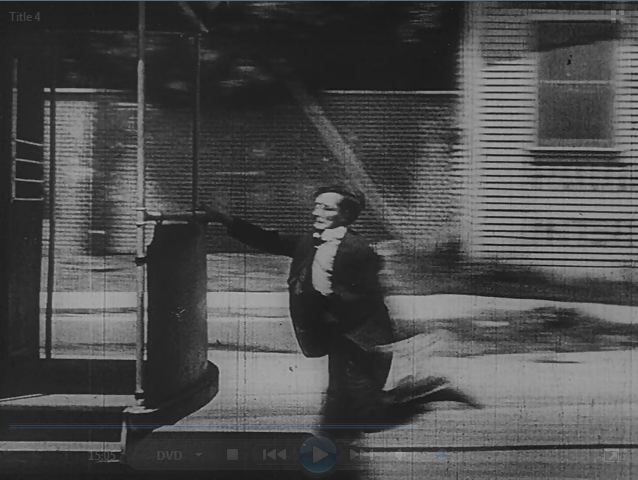
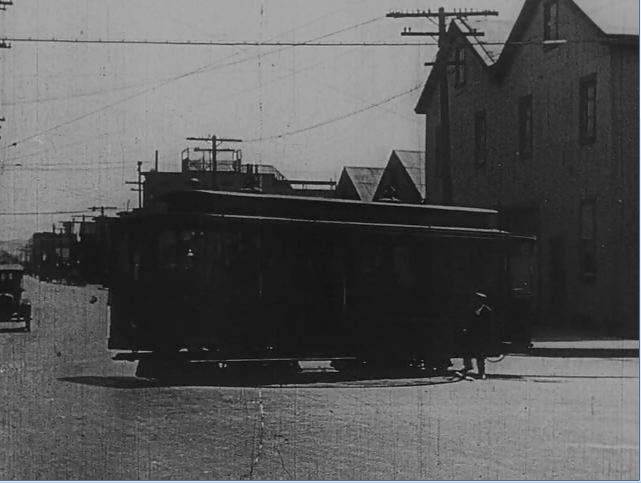
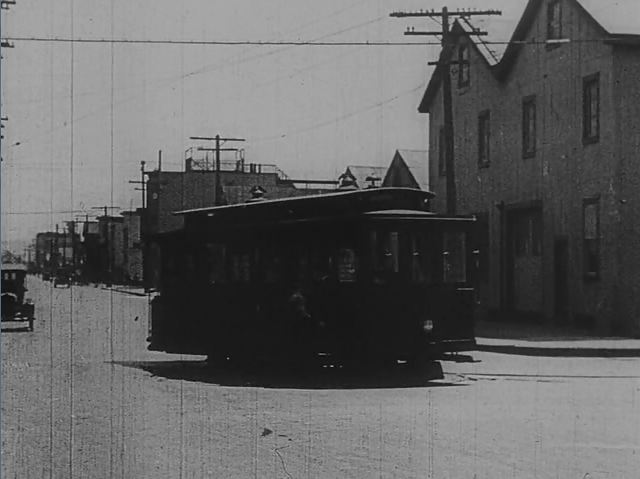
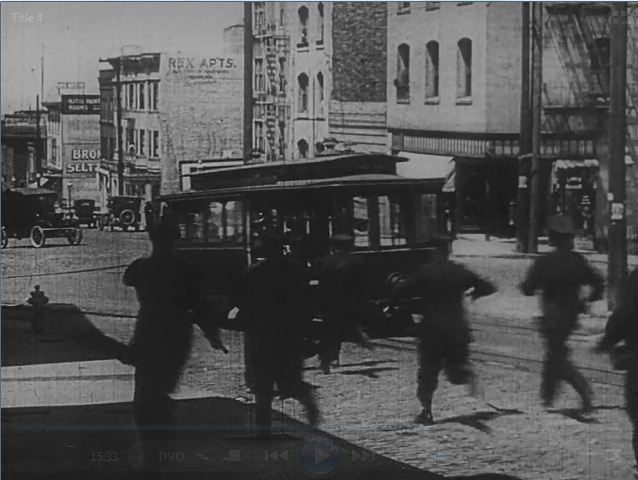
After I got this movie on DVD, I made some screen captures:

|
Buster Keaton, chased by cops, prepares to hop aboard an outbound Market Street Railway Powell/Mason car on Columbus Avenue. |
|
Buster reaches for the rear platform of a moving Powell/Mason car. According to John Bengtson (Silent Locations), this was shot in Hollywood. |

|
Buster waves to pursuing cops from the rear platform of a moving Powell/Mason car. |
|
An outbound Powell/Mason car rolls onto the turntable at Bay and Taylor. The turntable at that time was in the middle of Bay Street. The conductor prepares to turn it. |
|
The crew turns the car on the Bay and Taylor turntable. |

|
Buster sits on the front bench and reads a newspaper as the car turns on the Bay and Taylor turntable. |

|
The crew pushes the car off of the Bay and Taylor turntable. |
|
Cops intercept the inbound car as it turns from Washington Street to Powell Street. |

|
Buster tries to pay his nickel fare to a cop. The gripman works in the background. |

|
Back on Columbus Avenue, Buster jumps off of an inbound car. |

|
In a later scene, at Second and Minna, Buster waits for a Market Street Railway car signed for the 27 line. He will soon find that it is full of cops. |
Released: 1922
Produced by: Joseph M Schenck
Directed by: Edward F Cline and Buster Keaton
Written by: Edward F Cline and Buster Keaton
Check the Internet Movie Database
|
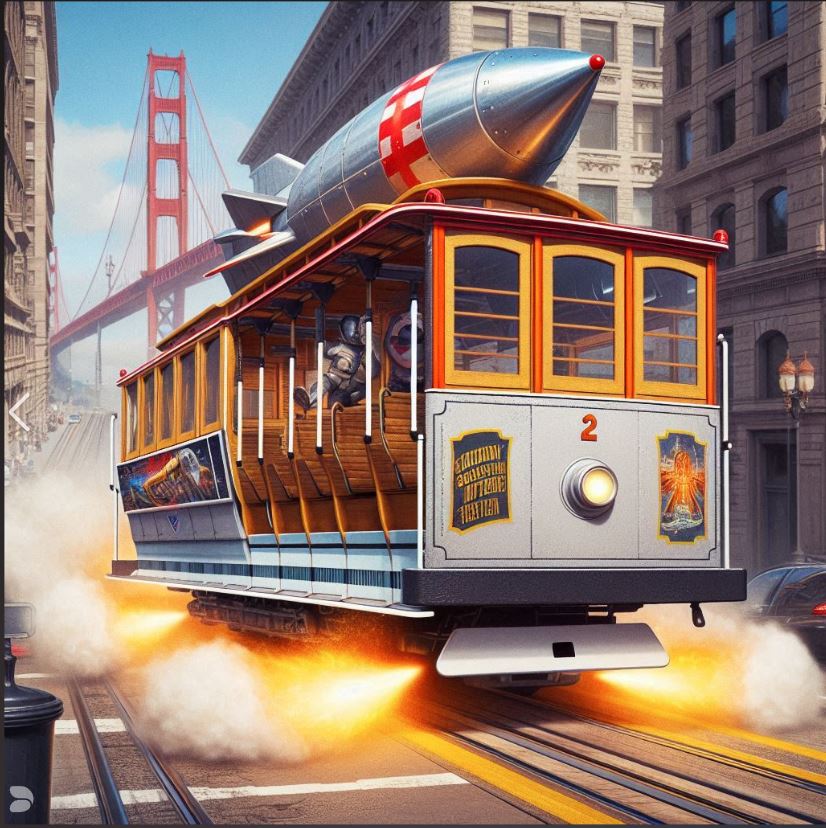
Rocket powered Powell Street cable car Number 2. Created by Microsoft Copilot. |
|
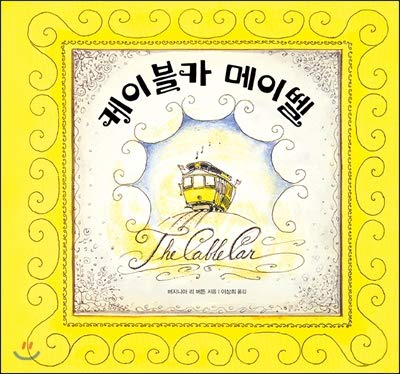
The Cable Car Mable is the Korean-language version of Virginia Lee Burton's Maybelle the Cable Car (1952). |
|
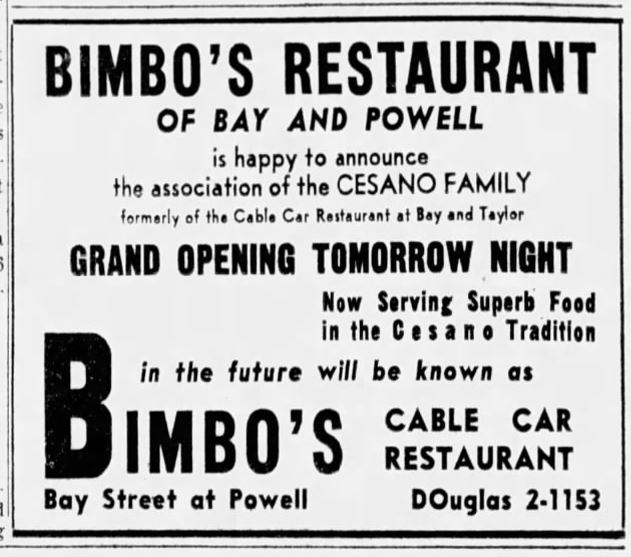
| I knew about the famous Bimbo's 365 Club on Columbus, but I did not know about Bimbo's Cable Car. They were probably not related. "Bimbo" was a popular nickname in North Beach. (Source: San Francisco Examiner, 1950-10-09). |

|
| I knew about the famous Bimbo's 365 Club on Columbus, but I did not know about Bimbo's Cable Car. They were probably not related. "Bimbo" was a popular nickname in North Beach. (Source: San Francisco Examiner, 1950-11-04). |

|
| Because of greater need during the Korean War, a special cable car, the Blood Donors' Special, took volunteer donors to the Irwin Memorial Blood Bank at Washington and Laguna. (Source: San Francisco Examiner, 1950-10-06). |
|
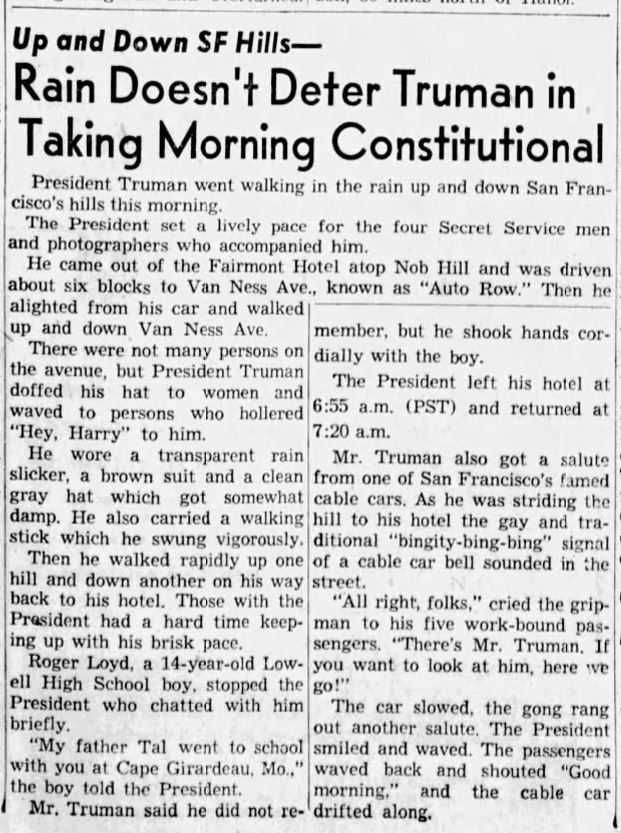
| President Harry S Truman liked to take a morning walk, so when he stayed at the Fairmont Hotel on Nob Hill, he ignored the rain and took one. A car took him to Van Ness and he walked up and down a bit and back to the Fairmont on California Street. He was greeted by the crew and the riders. (Source: San Francisco Examiner, 1950-10-17). |
|
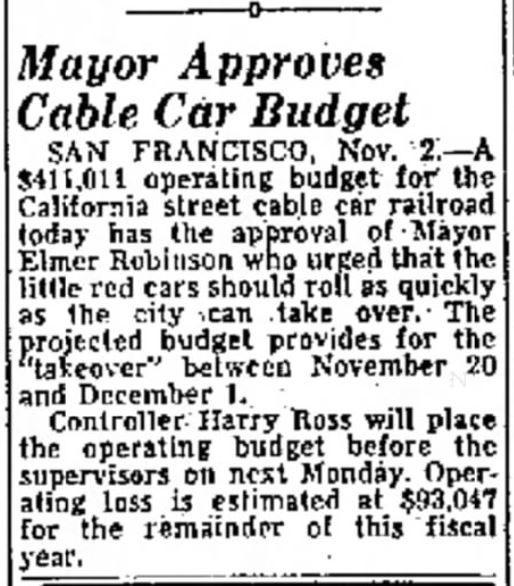
San Francisco passed a budget to allow the takeover and operation of the California Street Cable Railroad. (Source: San Mateo County Times, 1951-11-02). |

|
The wildly inaccurate reminiscences of old timer Tom Austin. (Source: San Francisco Bulletin, 1923-10-04). |
|
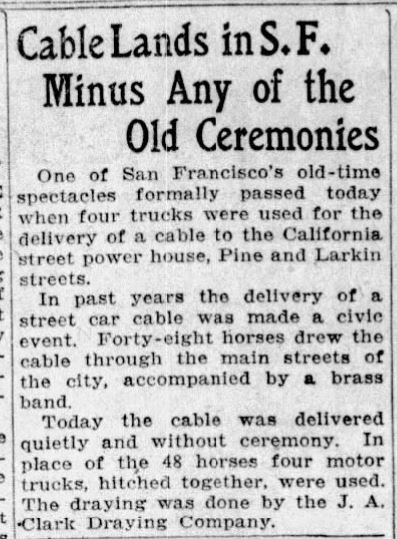
The delivery by truck of a new cable for the California Street company was compared to the old days when it was done with a dray and forty-eight horses. (Source: San Francisco Bulletin, 1923-10-04). |

|
"Who ever heard of angels riding in cable cars?" (Source: Nashville Banner, 1923-10-07). |

|
Santa rode a cable car in the "Gigantic Parade" at the Sun Valley Mall in Concord, California. (Source: Contra Costa Times, 1972-11-23). |
|
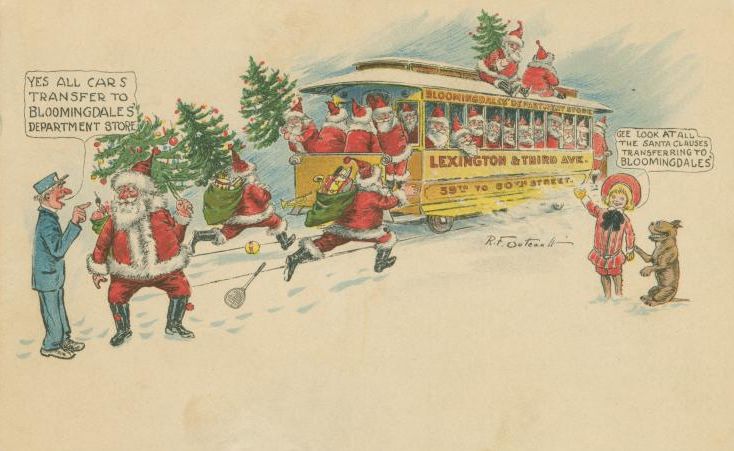
"All Cars Transfer to Bloomingdale's Department Store" was an advertising slogan used in the late 19th and early 20th Centuries. I don't know if the car illustrated here is meant to be a cable car, but I like the crush load of Santa Clauses. Artist Richard F Outcault created the comic strip Buster Brown in 1902. We see Buster and his dog Tige on the right. (Source: San Francisco Examiner, 1968-11-08). |
|
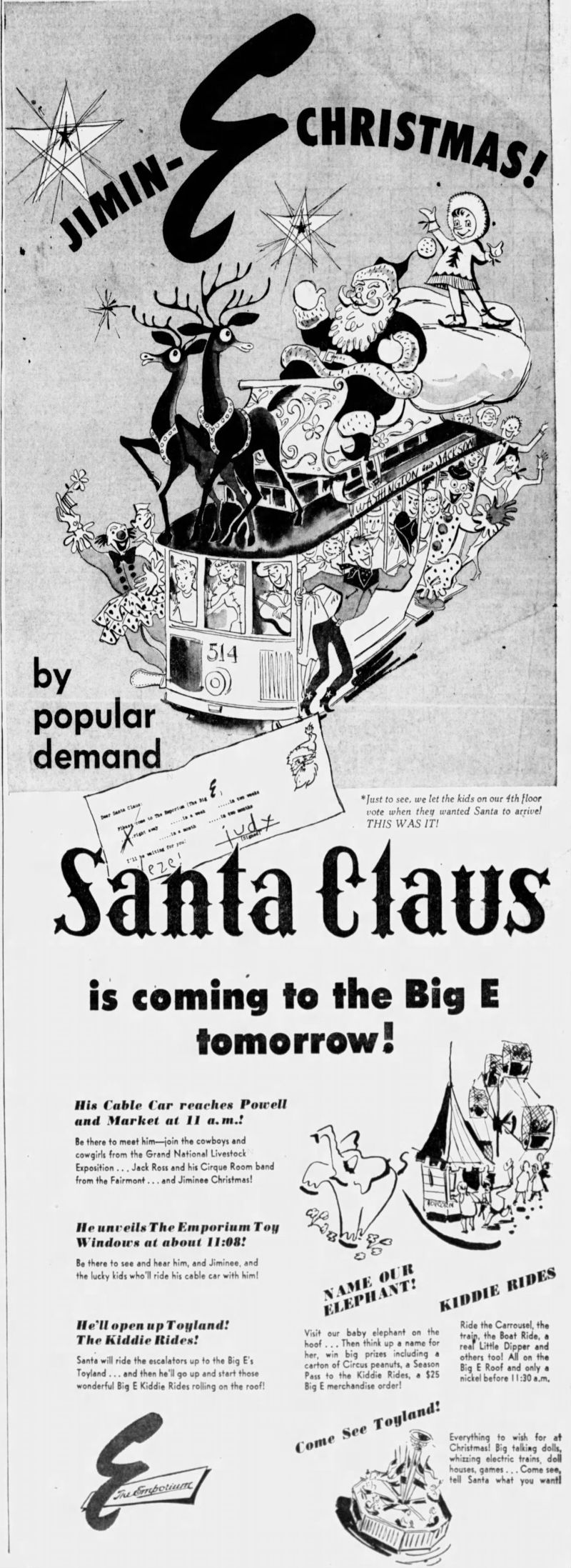
"Santa Claus is coming to the Big E tomorrow." I miss the roof rides. (Source: San Francisco Examiner, 1950-10-27). |
|
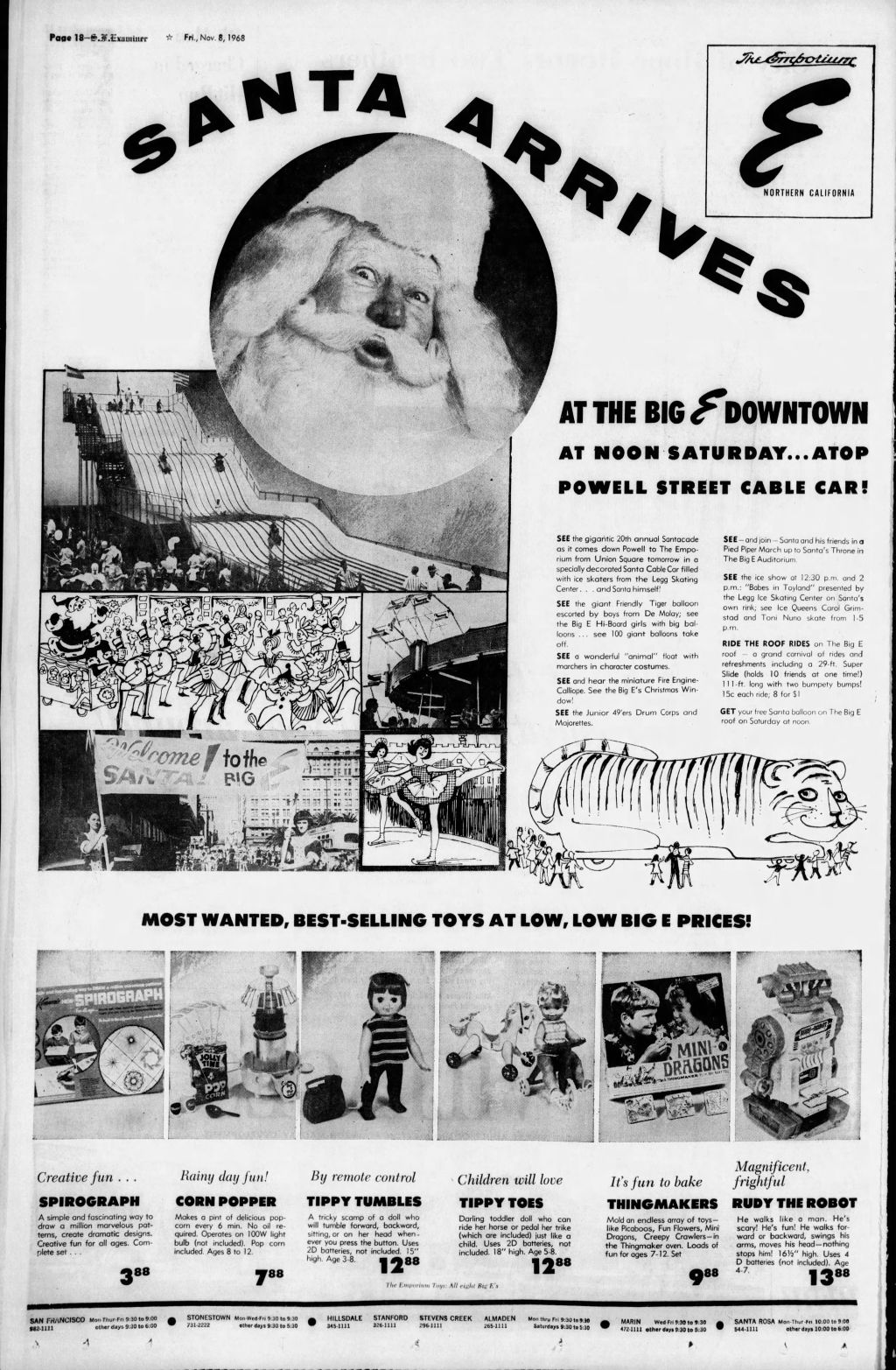
"Santa Arrives at the Big E Downtown At Noon Saturday ... Aboard a Powell Street Cable Car." A full page ad. I miss the wonderful roof rides. (Source: San Francisco Examiner, 1968-11-08). |

|
In 1956, the Santacade included Mrs Claus, Jiminee Christmas "and a host of storybook characters." (Source: San Francisco Examiner, 1956-10-28). |

|
In 1957, the Santacade included the famous Saint Mary's Chinese Girls' Drum Corps, which had been marching and playing in all sorts of parades since 1940. (Source: San Francisco Examiner, 1957-10-29). |

|
| Way out in Florida, they reported that ten Muni operators were dressing as Santa for the 1976 season. I do not remember that. (Source: Bradenton Herald, 1976-12-25). |

|
Santa visits the Mall at Northgate in San Rafael, California. He offered free rides around the mall on a motorized cable car. (Source: Marin Independent-Journal, 1975-12-10). |
|
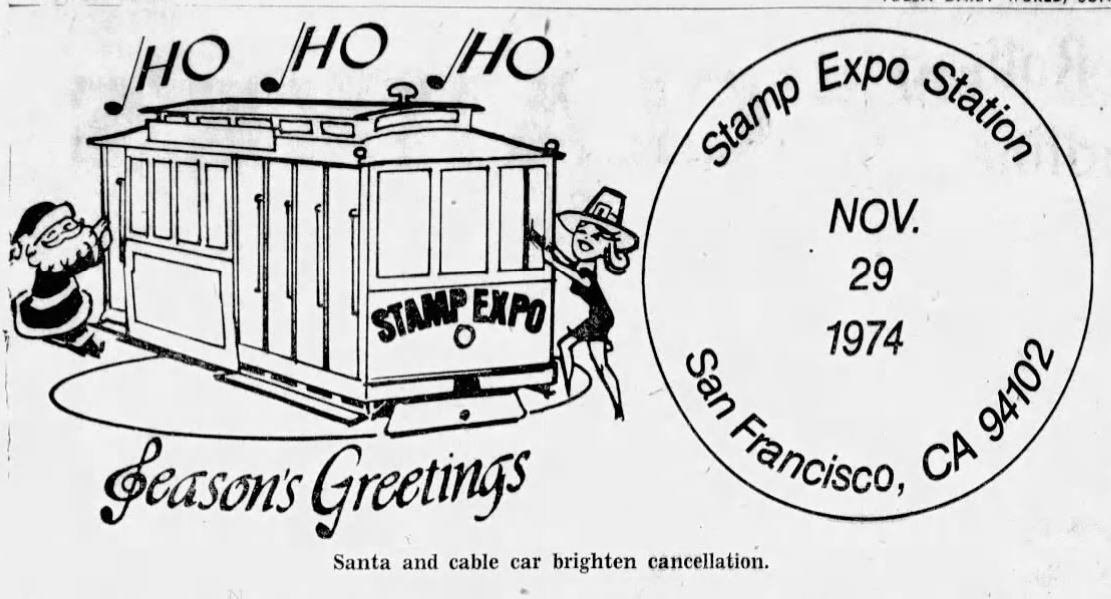
Stamp Expo '74 was held in San Francisco. The International Stamp Collectors Society offered a set of postal covers with holiday themes. "Season's Greetings" showed Santa Claus and a Pilgrim aboard a cable car. (Source: Tulsa Daily World, 19741010). |

|
Stamp Expo '74 was held in San Francisco. The International Stamp Collectors Society offered a set of postal covers with holiday themes. "Season's Greetings" showed Santa Claus and a lady Pilgrim turning a cable car on the turntable. (Source: Tulsa Daily World, 19741010). |

|
An ad for the Emporium's 1973 Santa's Cable Car Parade. (Source: San Francisco Examiner, 1973-11-09). |

|
"3,000 youngsters greeted Santa Claus at the Powell Street turntable as he arrived on a cable car yesterday." (Source: San Francisco Examiner, 1952-11-02). |

|
"Santa Claus Arrives Here on Cable Car. Emporium Santa-Cade Greeted by 3,000 Youngsters." (Source: San Francisco Examiner, 1952-11-02). |

|
"Emporium Parade Opens Yuletide Season." (Source: San Francisco Examiner, 1951-11-01). |

|
Santa sits astride a cable car at the top of the Powell Street Hill. Detail from an Emporium ad. (Source: San Francisco Examiner, 1951-11-01). |

|
Santa waits to ride a cable car down the Powell Street Hill. (Source: San Francisco Examiner, 1951-11-01). |

|
Santa waits on the roof of the Santa Express, which will carry him to the Emporium. (Source: San Francisco Examiner, 1952-07-13). |
|
|
Santa waits on the roof of the Santa Express, which will carry him to the Emporium. (Source: San Francisco Examiner, 1952-07-13). |
|
|
Santa waits on the roof of the Santa Express, which will carry him to the Emporium. (Source: San Francisco Examiner, 1952-07-13). |
|
|
Santa waits on the roof of the Santa Express, which will carry him to the Emporium. (Source: San Francisco Examiner, 1952-07-13). |
|
|
Santa waits on the roof of the Santa Express, which will carry him to the Emporium. (Source: San Francisco Examiner, 1952-07-13). |
|
|
Santa waits on the roof of the Santa Express, which will carry him to the Emporium. (Source: San Francisco Examiner, 1952-07-13). |
|
|
Santa waits on the roof of the Santa Express, which will carry him to the Emporium. (Source: San Francisco Examiner, 1952-07-13). |
|
|
Santa waits on the roof of the Santa Express, which will carry him to the Emporium. (Source: San Francisco Examiner, 1952-07-13). |
|
|
Santa waits on the roof of the Santa Express, which will carry him to the Emporium. (Source: San Francisco Examiner, 1952-07-13). |
|
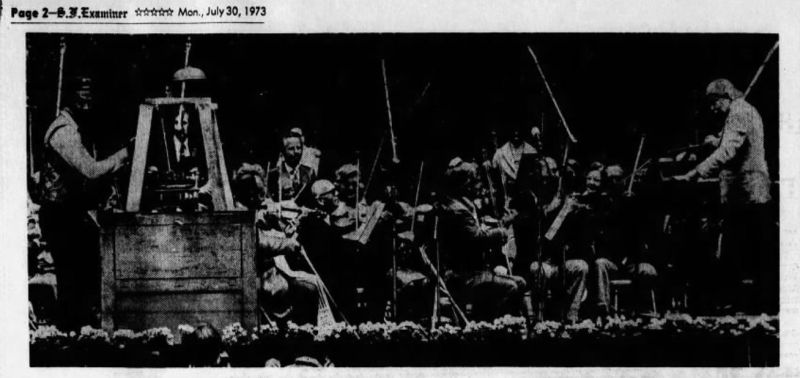
Arthur Fiedler, famous conductor of the Boston Symphony and the Boston Pops, at the War Memorial Opera House, led the San Francisco Symphony and cable car bell ringing champion Al Davison in "The Fire Bell Polka" by Josef Strauss. (Source: San Francisco Examiner, 1973-07-30, Page 2). |

|
Car 8, decorated for the centennial, runs down the Hyde Street Hill. The three photos are firefighter fan and philanthropist Lillie Hitchcock Coit, cable car promoter Andrew Smith Hallidie and engineer and philanthropist Adolph Sutro. The lumber schooner CA Thayer and ferryboat Eureka are visible at the Hyde Street Pier. Note the bunch of people in the street waiting to take a photo of the car as it turns into Victorian Park. (Source: Buffalo News, 1973-08-04, Page 52). |
|
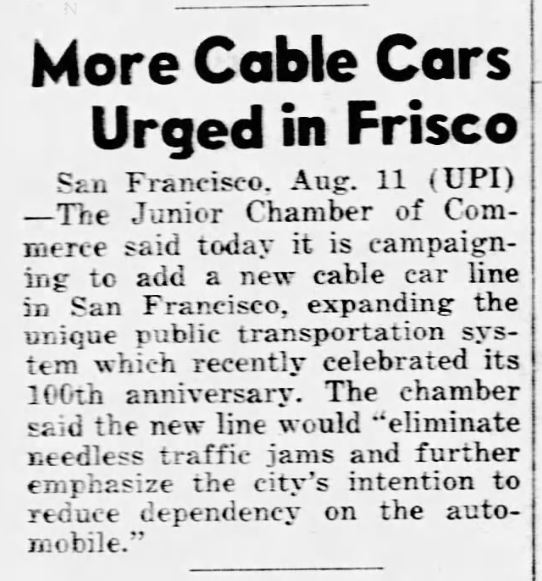
San Francisco's Junior Chamber of Commerce proposed adding a new cable car line. I wonder where. (Source: New York Daily News, 1973-08-12, Page 18). |
|
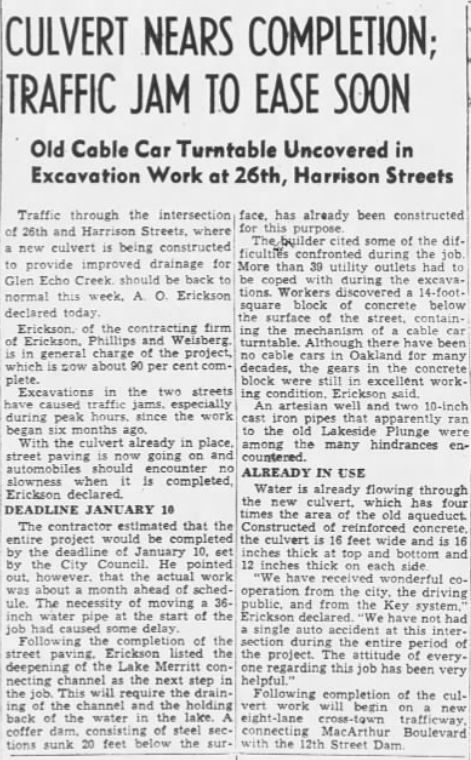
A 1947 infrastucture project met many obstructions, including what were probably some underground items having to do with the powerhouse of Oakland's Consolidated Cable Company. (Source: Oakland Tribune, 02-December-1947). |

|
Spokane's "phenomenal" growth. (Source: Salem Statesman Journal, 04-December-1888. page 2). |

|
A Salem, Oregon newspaper reported that eight new cable cars were spotted on a train bound for Spokane. (Source: Salem Statesman Journal, 09-July-1889. page 4). |

|
An Albany, Oregon newspaper reported that Spokane's cables were powered by water. (Source: Albany Democrat-Herald, 18-September-1889. page 2). |

|
A Salem, Oregon newspaper reported that four more new cable cars were spotted on a train bound for Spokane. (Source: Salem Statesman Journal, 03-April-1890. page 4). |
|
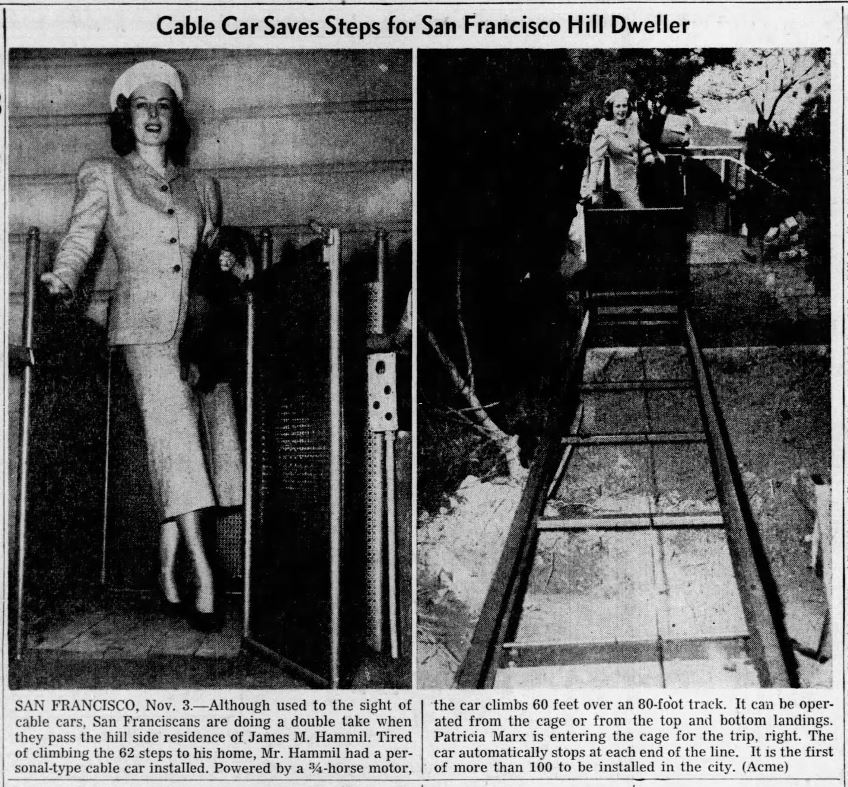
Some San Francisco people built private funiculars to deal with steep approaches to their homes. (Source: Buffalo News, 02-November-1949). |
|
|
|
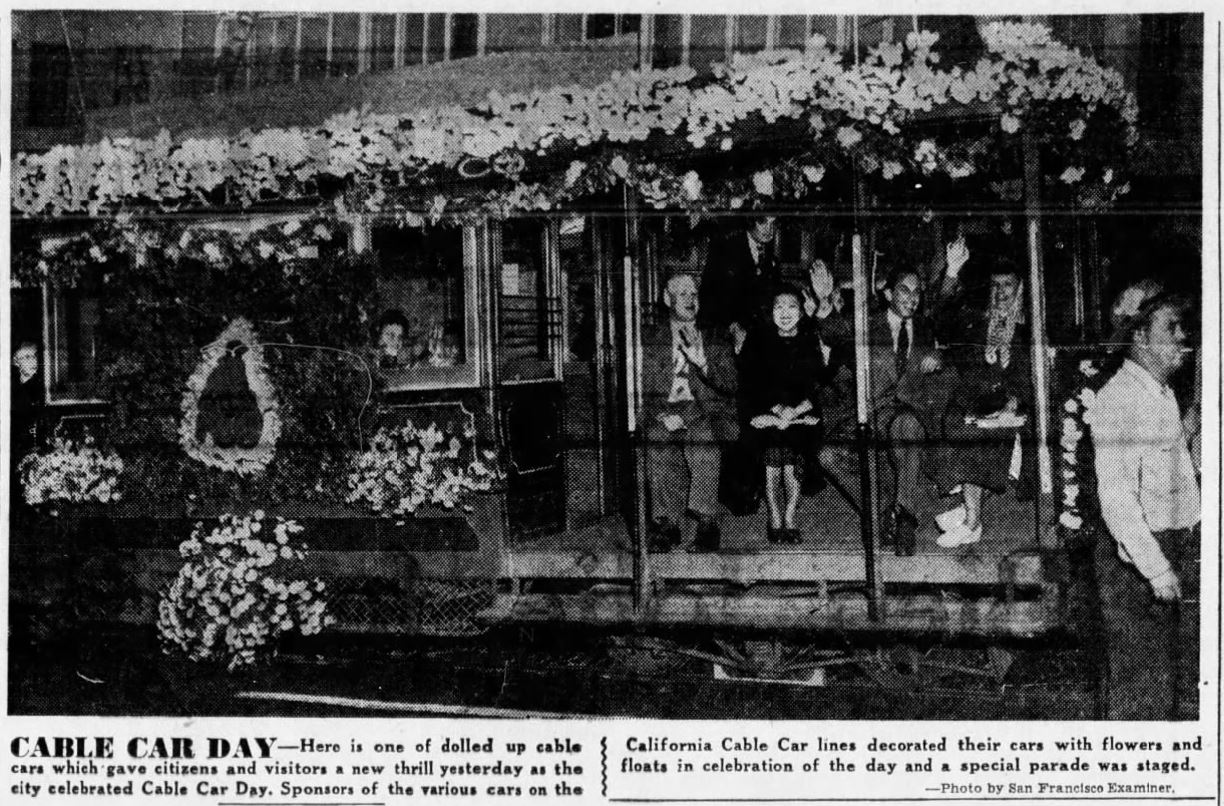
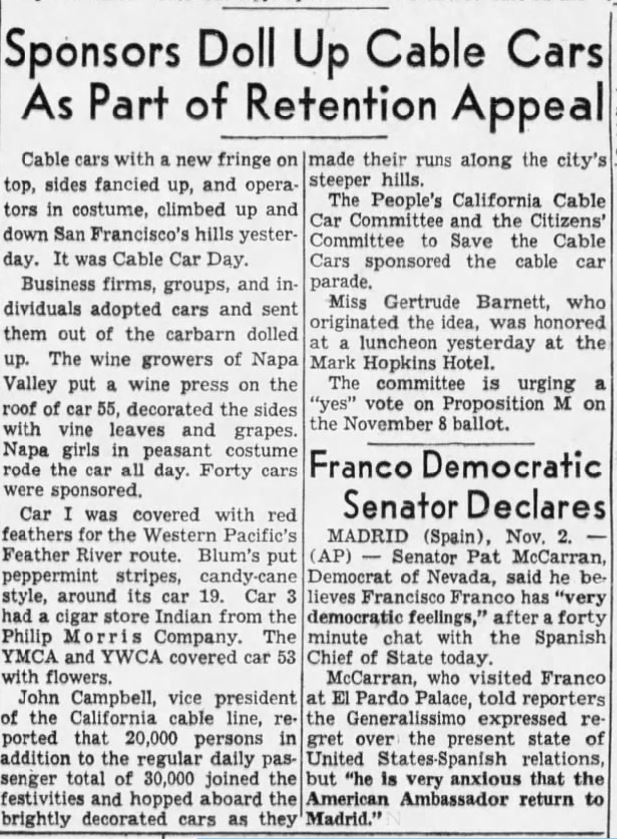
As part of the effort to save the cable cars, San Francisco people celebrated Cable Car Day on 02-November-1949. (Source: San Francisco Examiner, 03-November-1949). |

|
| Ladies representing the California Centennial Commission brought along a reduced-scale cable car to greet attendees at a bankers' convention. The accompanying article says that "President Woollen had a cable car bell instead of a gavel. He hopefully advised the assemblage to be disorderly so he could clang it. No cooperation." (Source: San Francisco Examiner, 03-November-1949). |
|
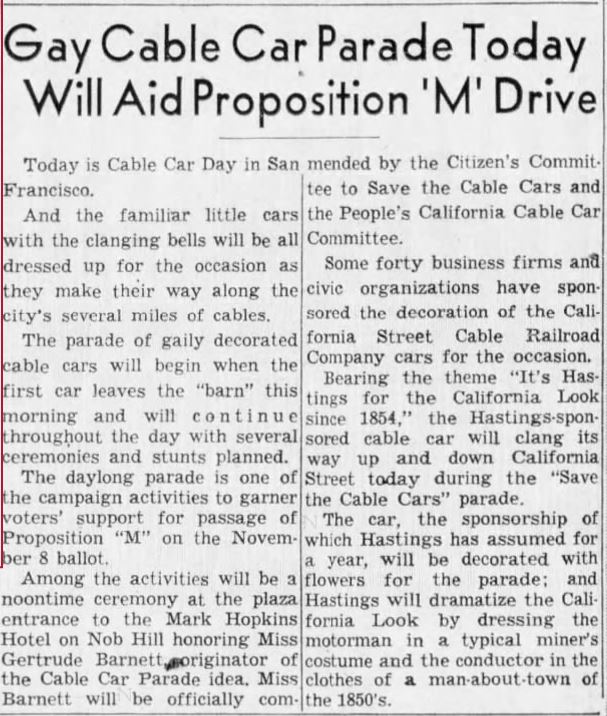
Many companies sponsored decorated cable cars that ran in a parade to support Proposition M. (Source: San Francisco Examiner, 02-November-1949). |
|
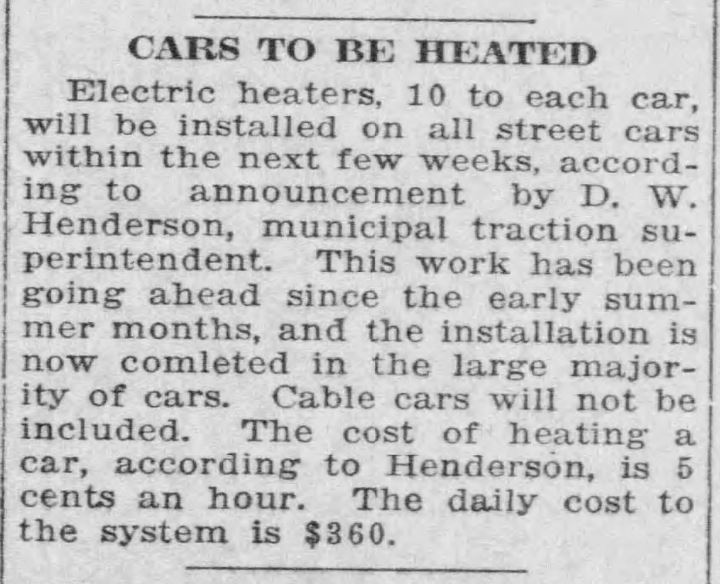
Seattle annouced that electric heaters would be installed on all streetcars, but that cable car riders would not feel the warmth. (Source: Seattle Union Record, 08-November-1949). |
|
|
Some San Francisco people built private funiculars to deal with steep approaches to their homes. (Source: Buffalo News, 02-November-1949). |
|
|
Some San Francisco people built private funiculars to deal with steep approaches to their homes. (Source: Buffalo News, 02-November-1949). |
|
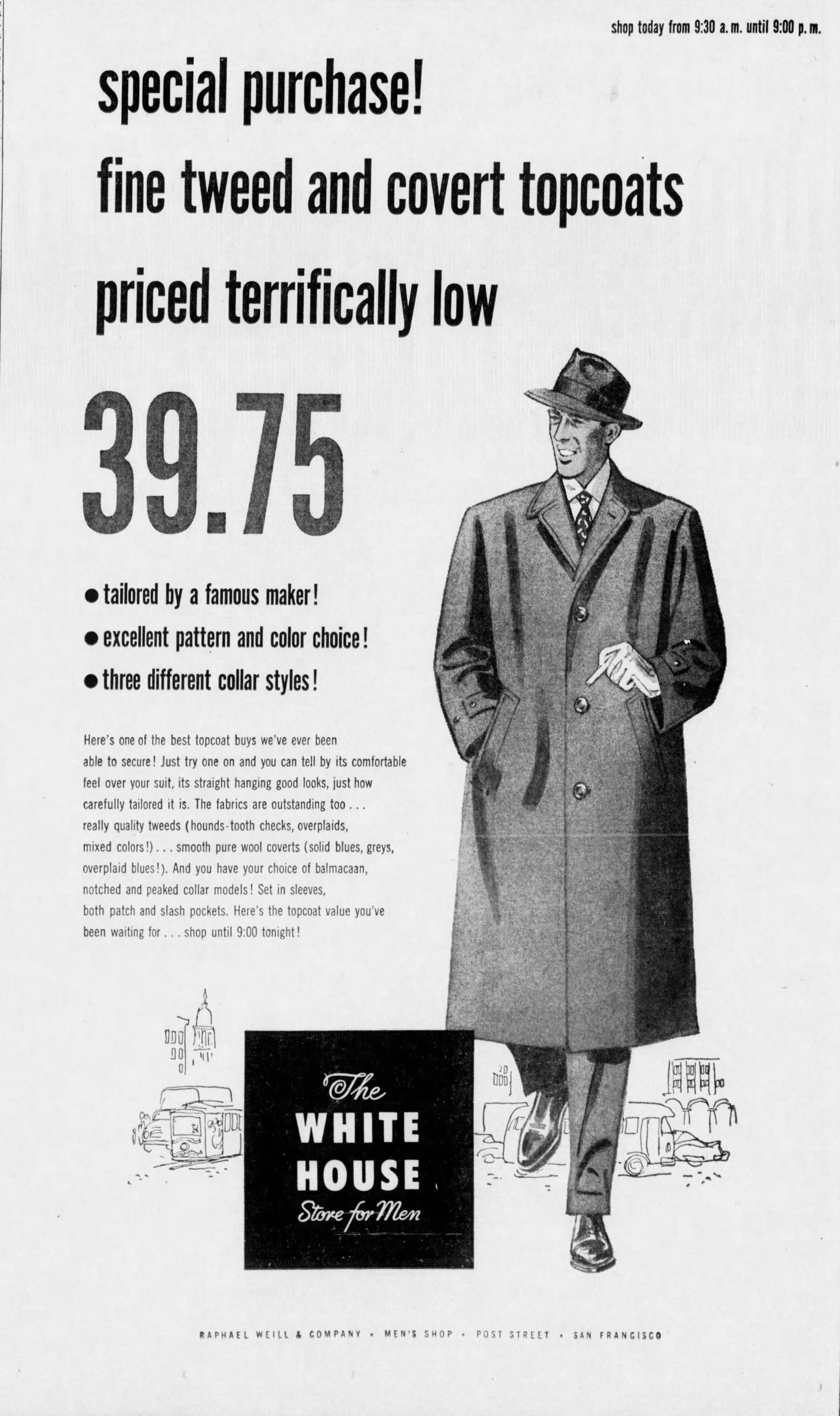
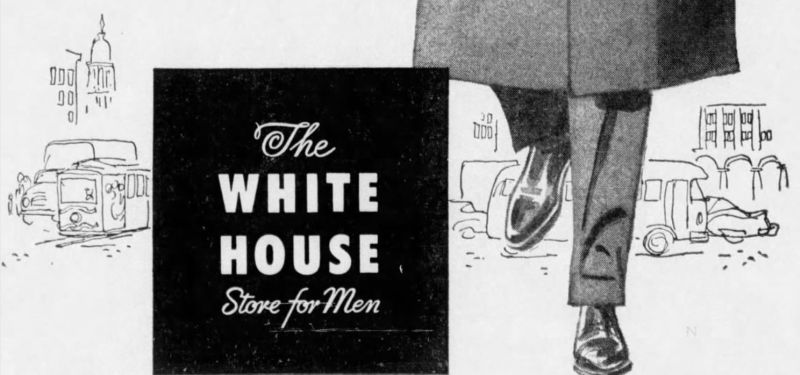
The White House was a famous San Francisco department store which operated from 1854 to 1965. The building which housed the store still stands at Sutter and Grant. Note the cable car in the image at the bottom. (Source: San Francisco Examiner, 06-February-1950). |
|
A detail from the ad above. (Source: San Francisco Examiner, 06-February-1950). |

|
x. (Source: x, x). |
|
|
x. (Source: x, x). |
|
|
x. (Source: x, x). |
|
|
x. (Source: x, x). |
|
|
x. (Source: x, x). |
|
|
x. (Source: x, x). |
|
|
x. (Source: x, x). |
|
|
x. (Source: x, x). |
|
|
x. (Source: x, x). |

|
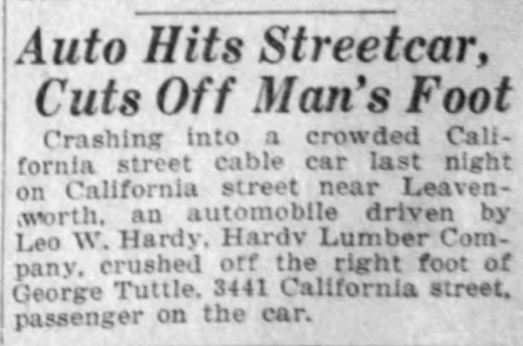
An accident which cost the foot of a Cal Cable passenger. (Source: San Francisco Examiner, 07-October-1922, page 13). Decenber, 2022 Picture of the Month. |
|
An accident which cost the foot of a Cal Cable passenger. (Source: San Francisco Examiner, 07-October-1922, page 13). |
|
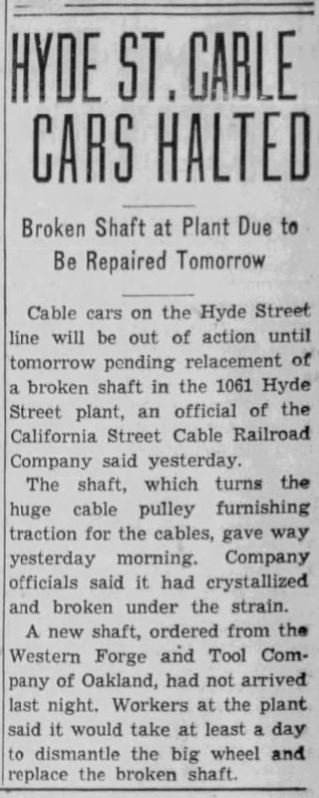
Service on the Hyde Street line was restored after a shutdown caused by broken machinery at the powerhouse. (Source: San Francisco Examiner, 14-November-1947, page 5). |
|
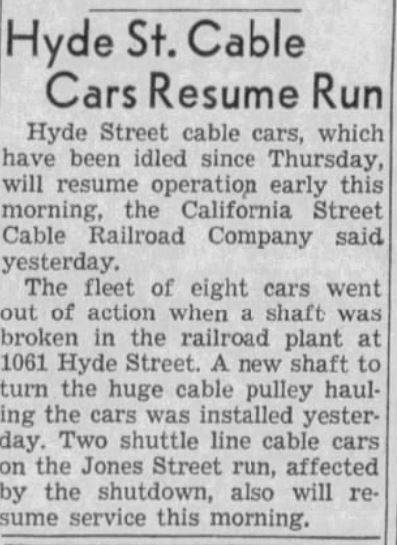
Service on the Hyde Street line was restored after a shutdown caused by broken machinery at the powerhouse. (Source: San Francisco Examiner, 15-November-1947, page 4). |
|
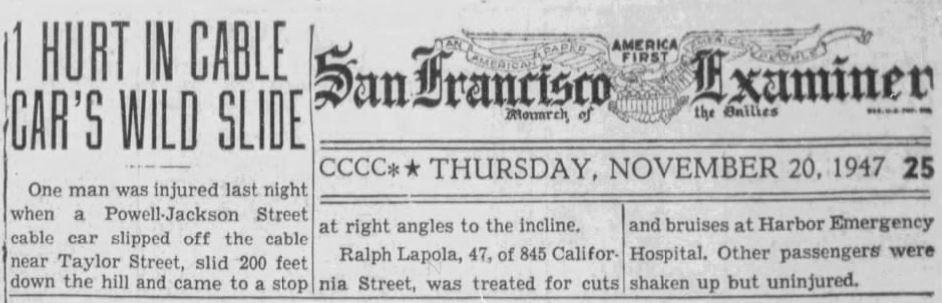
An accident which caused a cable car to slide and injured one passenger. (Source: San Francisco Examiner, 20-November-1947, page 25). |

|
An ad invites Humboldters (people from California's Humboldt County) to take a cable car to San Francisco's Grand Union Hotel (Source: Ferndale Enterprise, 13-October-1922, page 2). |

|
An ad invites visitors to take a cable car to San Francisco's Grand Union Hotel (Source: Ukiah Republican Press, 11-October-1922, page 5). |
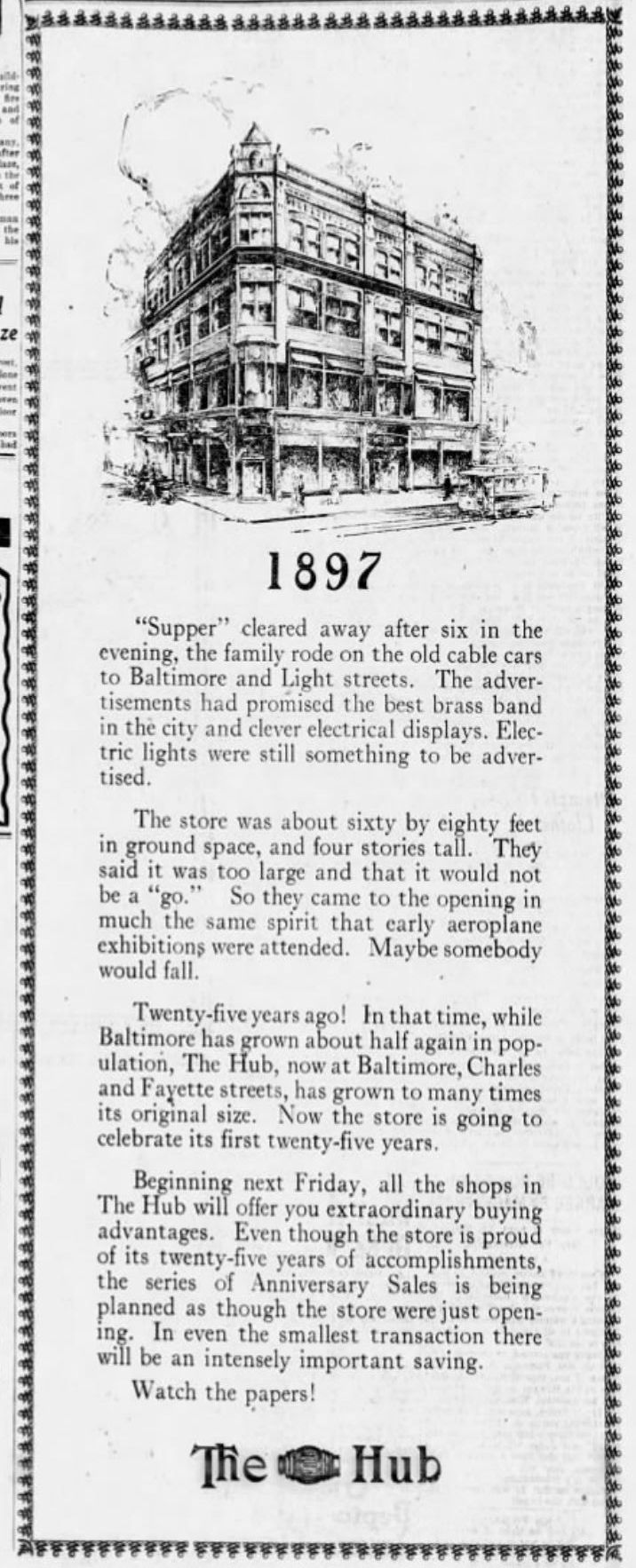
|
An ad for Baltimore's Hub department store looks back nostalgically to the days when Baltimore had cable cars (Source: Baltimore Evening Sun, 23-October-1922, page 6). |
|
|
An ad for Baltimore's Hub department store looks back nostalgically to the days when Baltimore had cable cars (Source: Baltimore Evening Sun, 23-October-1922, page 6). |

|
A real estate ad for a home near Spokane's Cable Addition neighborhood (Source: Spokesman-Review, 18-October-1922, page 12). |

|
An ad for a Tacoma grocery store, "Where the Cable Cars Stop." (Source: Tacoma News-Tribune, 18-October-1922, page 12). |

|
Oldsmobile invited people to see their product climb the Queen Anne Hill counterbalance. (Source: Seattle Star, 05-May-1923, page 11). |

|
Several Oldsmobiles were able to climb the Queen Anne Hill counterbalance in high gear. (Source: Seattle Star, 12-May-1923, page 6). |

|
Seattle's trackless trolley proponents set up a race between a trolley coach and the Queen Anne Hill counterbalance. (Source: Seattle Star, 12-August-1940, page 4). |

|
Seattle's trackless trolley proponents set up a race between a trolley coach and the Queen Anne Hill counterbalance. (Source: Seattle Star, 12-August-1940, page 4). |

|
Seattle's trackless trolley proponents set up a race between a trolley coach and the Queen Anne Hill counterbalance. (Source: Seattle Star, 12-August-1940, page 4). |

|
xxxxxSeattle's James Street cable line was the first of three cable lines to be converted or abandoned in 1940. (Source: Seattle Star, 17-February-1940, page 8). |

|
A report on the last day of service on Seattle's Madison Street cable line. (Source: Seattle Star, 03-March-1940, page 11). |

|
There was discussion about the use of buses to replace the Yesler Way cable line. Some people felt that Diesel buses could not handle the hills at the western end. It would take a while before the overhead for trolley coaches could be installed. (Source: Seattle Star, 19-March-1940, page 11). |

|
Some people suggested that the buses intended to replace the Yesler Way cable line should use the cable line's trestle at the Leschi end. (Source: Seattle Star, 22-March-1940, page 4). |

|
xxxxSeattle's transportation commission decided that all three surviving cable car lines should be replaced, starting with the James Street line. (Source: Seattle Star, 16-February-1940, page 5). |

|
xxxxA report on the last day of service on Seattle's Madison Street cable line. (Source: Bellingham Herald, 13-April-1940, page 3). |

|
xxxxA report on the last day of service on Seattle's Madison Street cable line. (Source: Bellingham Herald, 14-April-1940, page 2). |

|
xxxxAnother report on the last day of service on Seattle's Madison Street cable line. (Source: Medford Mail-Tribune, 14-April-1940, page 1). |
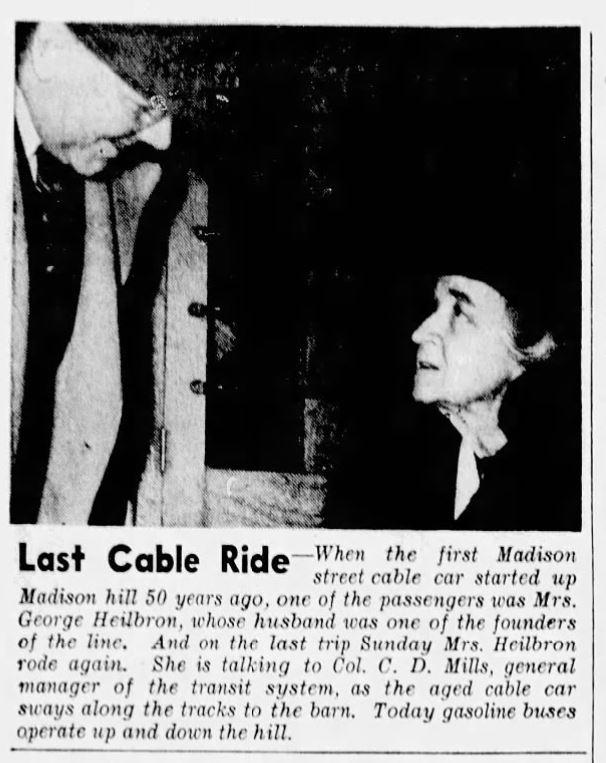
|
xxxxMrs George Heibron rode on the first Madison Street cable car on 21-June-1891 and the last in 1940. Her husband was one of the founders of the Madison Street Cable Railway. (Source: Seattle Star, 15-April-1940, page 11). January, 2023 Picture of the Month. |

|
A group of businessmen wanted to preserve Seattle's James Street cable line. (Source: Seattle Star, 25-April-1940, page 13). |

|
An announcement says that the Yesler Way cable line will be converted to buses in July. (Source: Seattle Star, 21-June-1940, page 4). |

|
The last run on Seattle's Yesler Way cable line. (Source: The Olympian, 11-August-1940, page 1). |

|
The last run of Seattle's Queen Anne Hill counterbalance was taken over by rowdies. (Source: Seattle Star, 12-August-1940, page 4). |

|
The last run of Seattle's Queen Anne Hill counterbalance was taken over by rowdies. Here three of them were arrested. (Source: Seattle Star, 14-August-1940, page 5). |

|
Seattle's was not sure what to with the rowdies who took over Queen Anne Hill counterbalance on its last run. (Source: Seattle Star, 15-August-1940, page 2). |
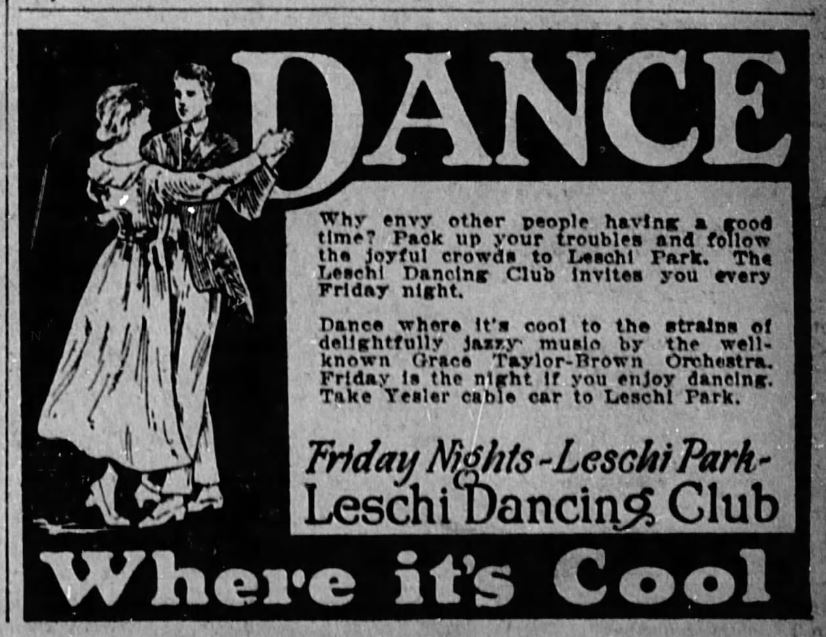
|
"Dance Where It's Cool." Seattle's Leschi Dancing Club invited people to take the Yesler Way cable car to the park. (Source: Seattle Star, 18-May-1923, page 21). |
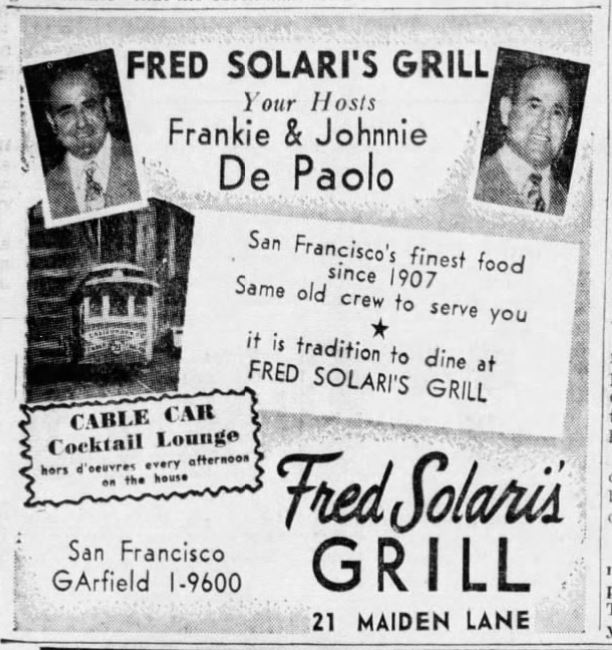
|
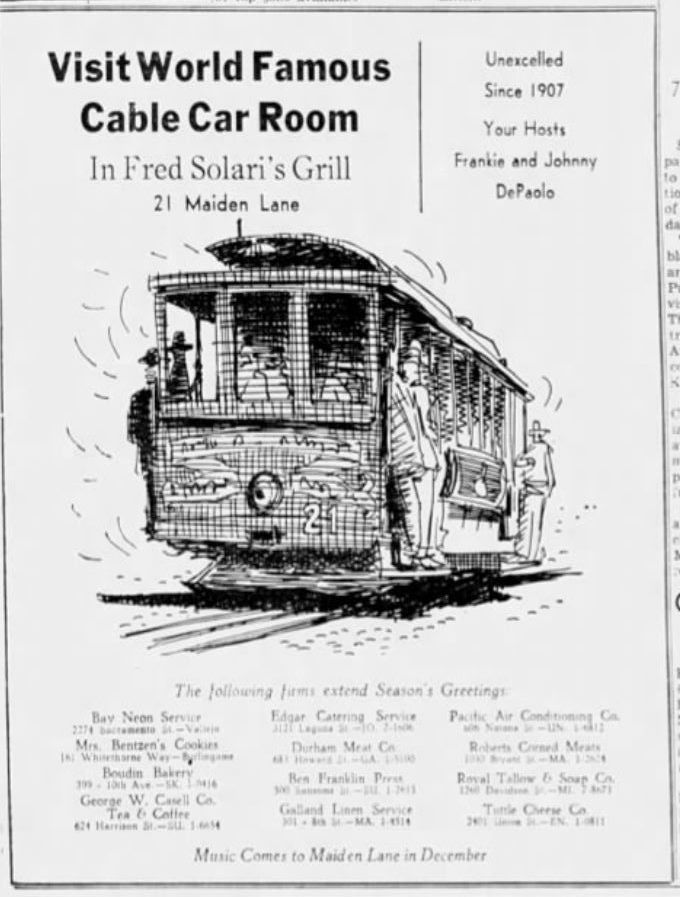
Another ad for the Cable Car Room in Fred Solari's Grill at 21 Maiden Lane. (Source: San Francisco Examiner, 09-March-1950). |
|
An ad for the Cable Car Room in Fred Solari's Grill at 21 Maiden Lane. (Source: San Francisco Examiner, 07-December-1950, page 1). |

|
Another ad for the Cable Car Room in Fred Solari's Grill at 21 Maiden Lane. (Source: San Francisco Examiner, 06-January-1951). |
|
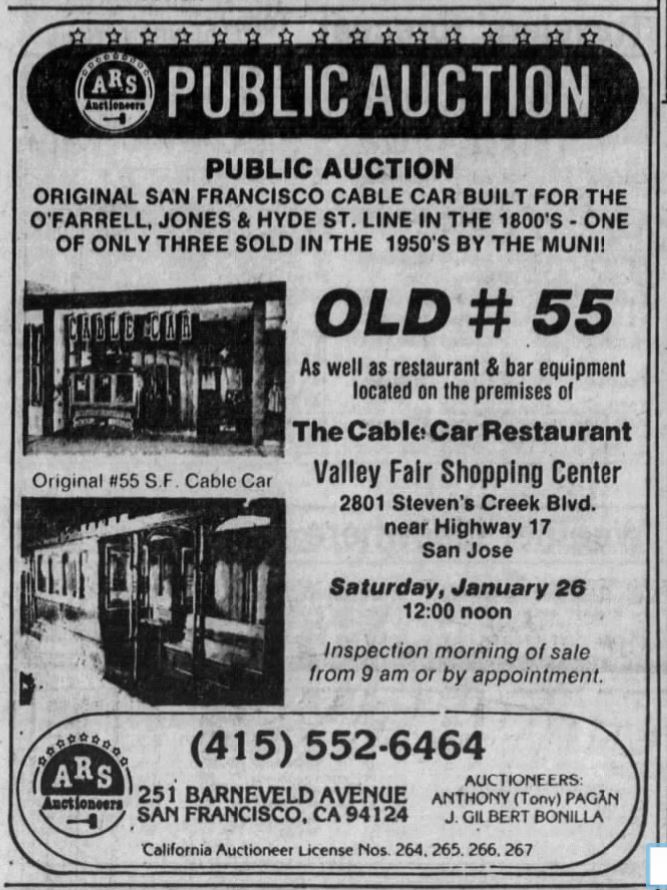
The Cable Car Restaurant in San Jose's Valley Fair Mall was housed in Cal Cable's retired car 55. Here we see the cable car and equipment up for auction in 1985. (Source: San Francisco Examiner, 20-January-1985). |

|
The voting machine entry for Proposition Q. No thumbnail. |
On 02-November-1971, San Francisco voters approved Proposition Q, which would freeze minimum cable car service in the city at the levels of 01-July-1971. The proposition was a response to threats by Muni management to reduce service.

|
The voters' guide table of contents entry for Proposition Q. No thumbnail. |
Download the Proposition Q entry from the 1971 voters' pamphlet..
Go to top of page.
|
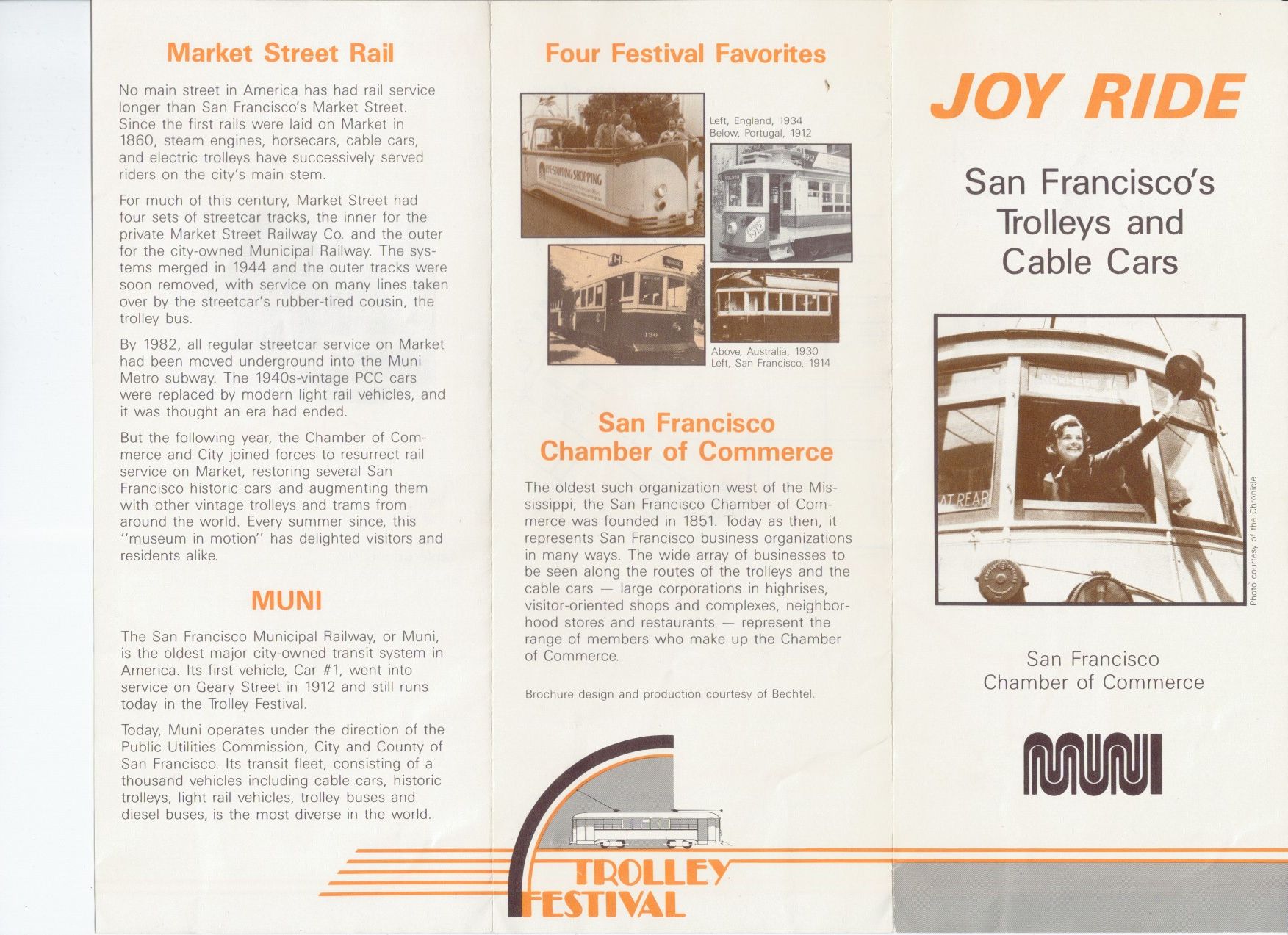
A pamphlet from the xxx. |

|
||||
|
|
||||||

|
||||||
| "The Great Fourth of July Arch Erected on Market Street Between Third and Fourth." Note the 40-foot long cable car. From the 04-July-1895 San Francisco Call. |
|
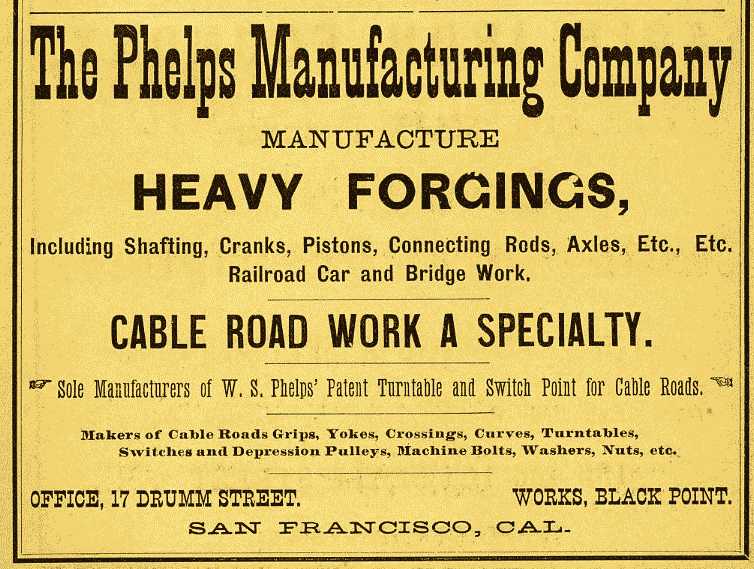
An ad for Phelps Manufacturing. From the 1890 Langley's San Francisco Directory at San Francisco Genealogy, page 13. |
|
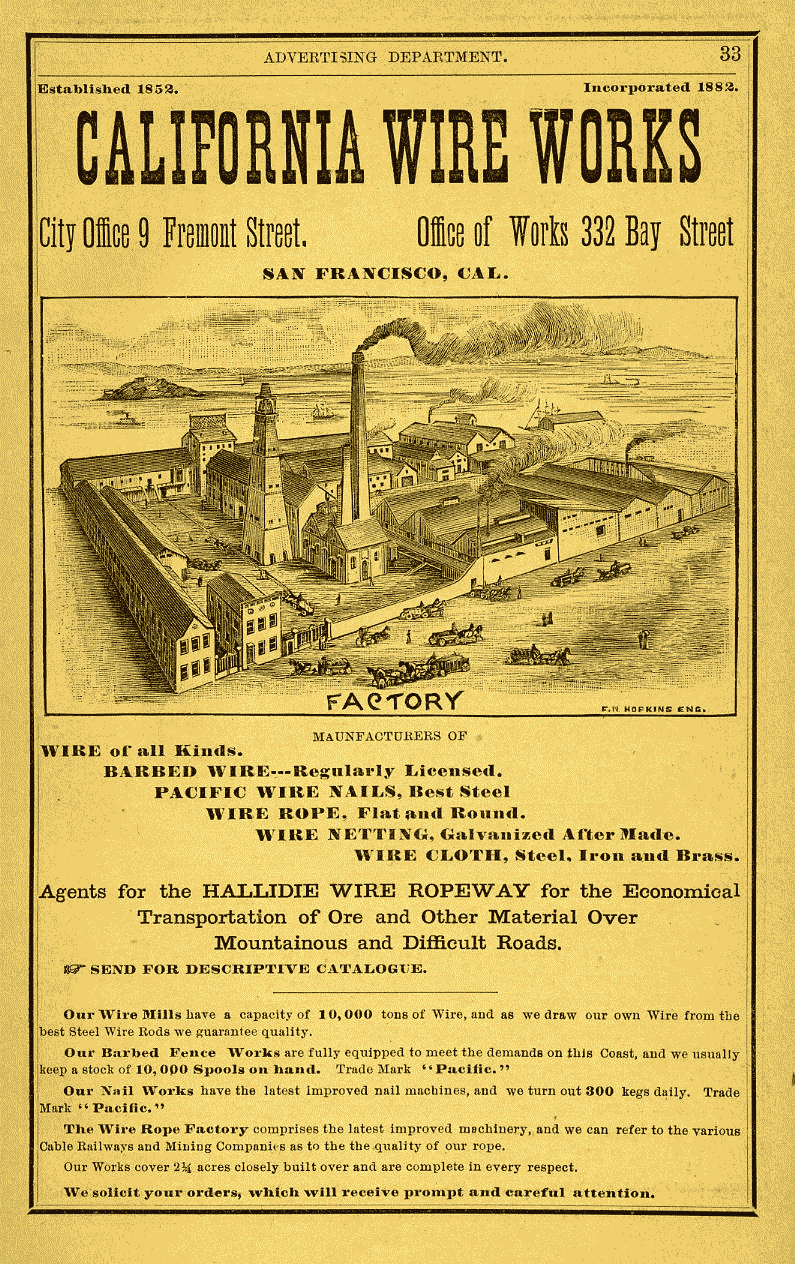
An ad for the California Wire Works. From the 1890 Langley's San Francisco Directory at San Francisco Genealogy, page 13. |
|
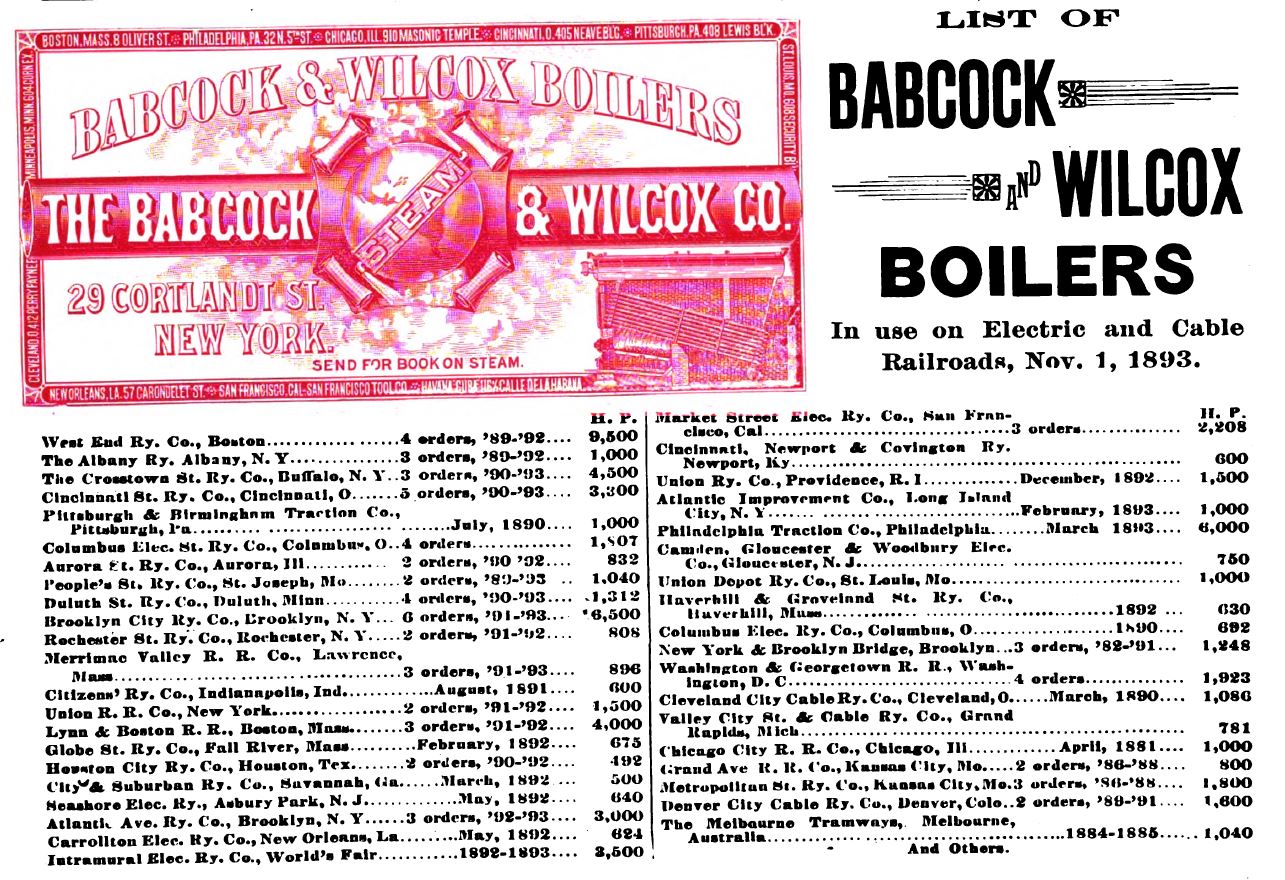
An ad for Babcock and Wilcox boilers. From the October, 1895 Street Railway Journal. |

|
An ad for cable and electric railway contractor Edmund Saxton. From the October, 1895 Street Railway Journal. |
|
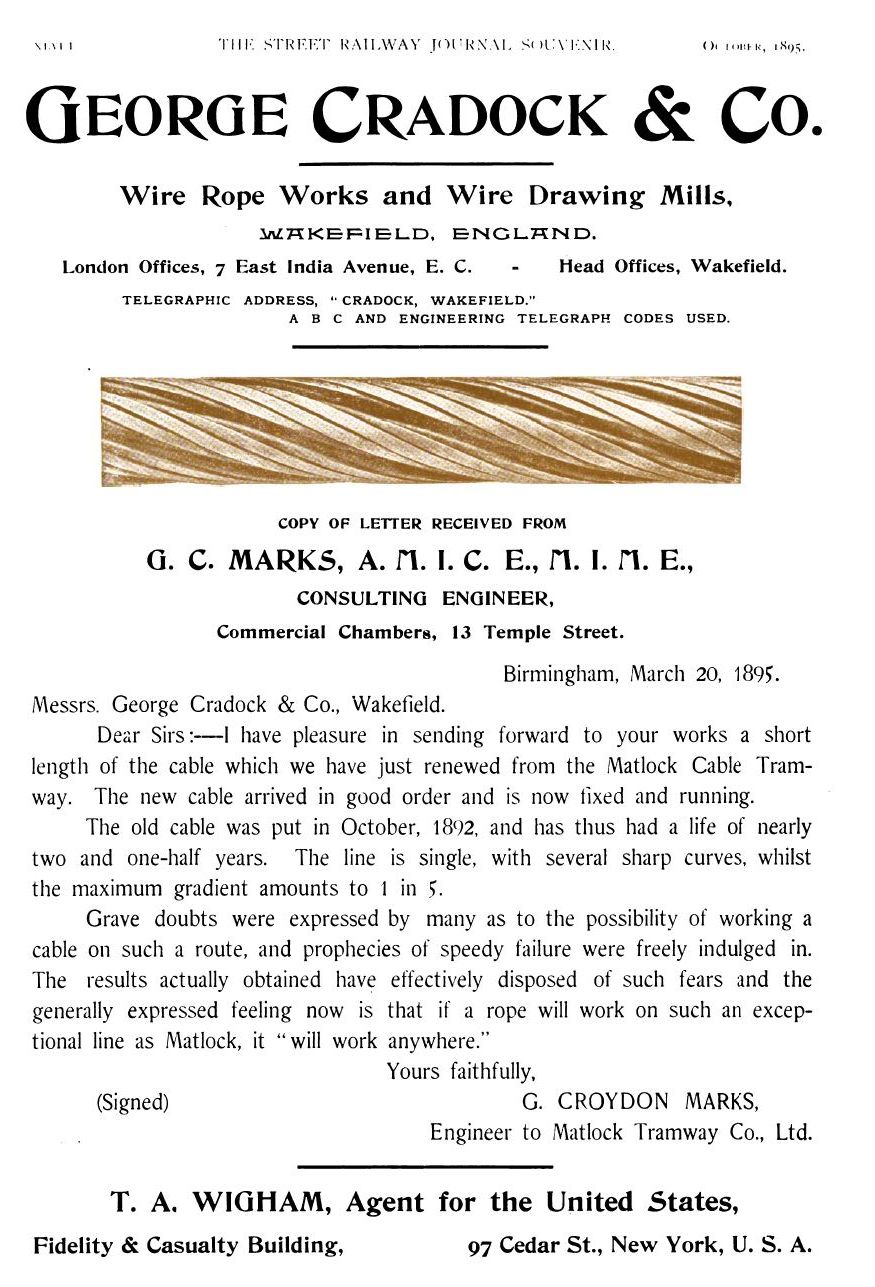
An ad for wire rope manufacturer George Cradock. It includes a testimonial from the Matlock Cable Tramway. From the October, 1895 Street Railway Journal. |
|
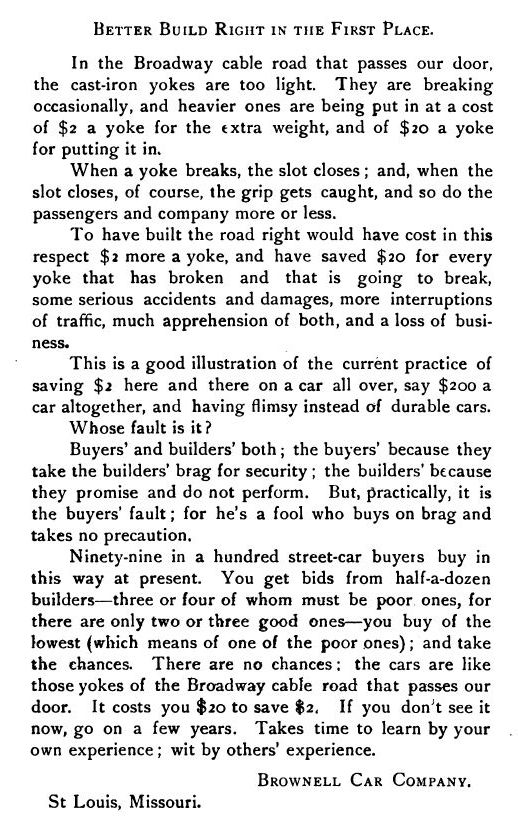
An ad for the Brownell Car company mentions the building of the Broadway Cable line in Saint Louis. From the October, 1895 Street Railway Journal. |
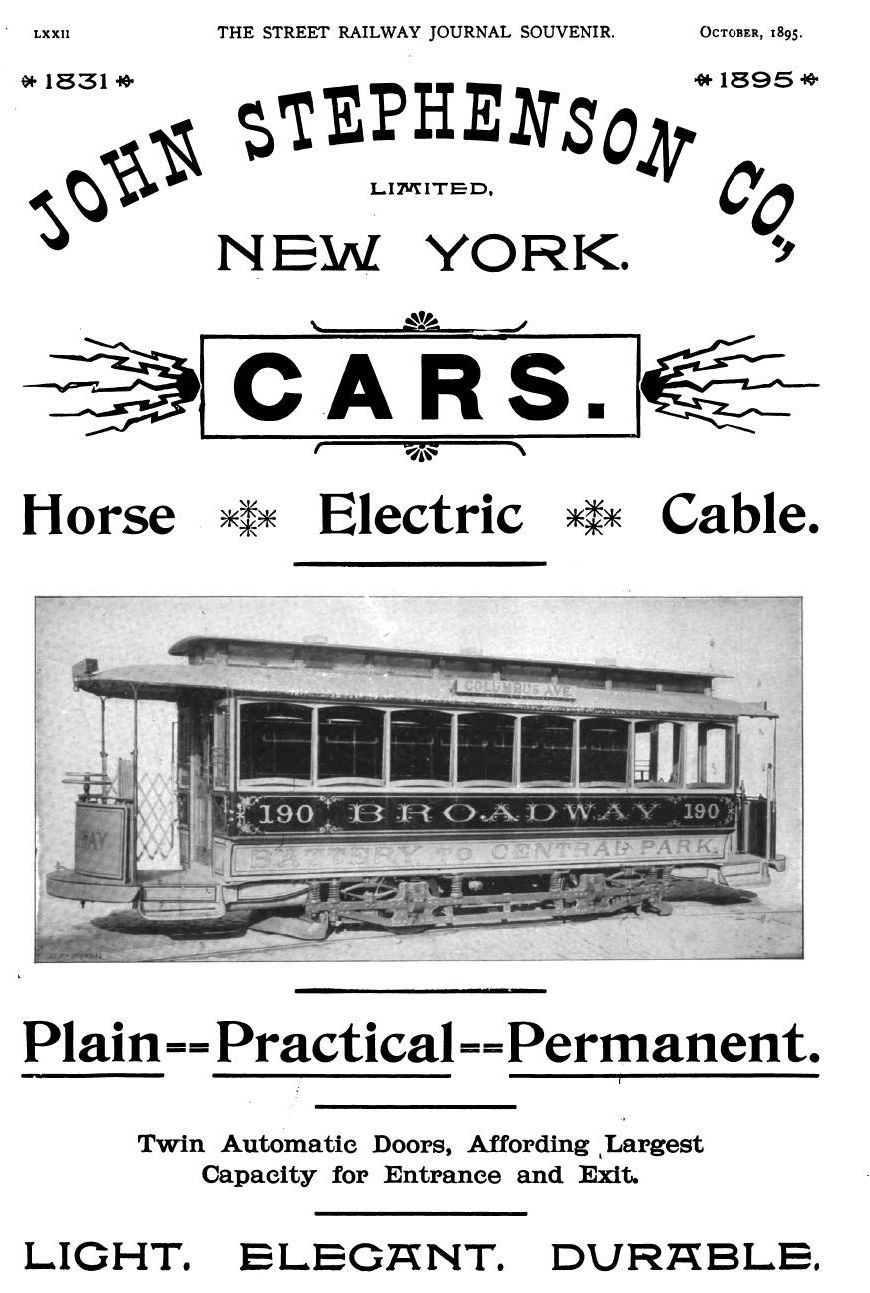
|
An ad for car builder John Stephenson features a Broadway cable car from New York. From the October, 1895 Street Railway Journal. |
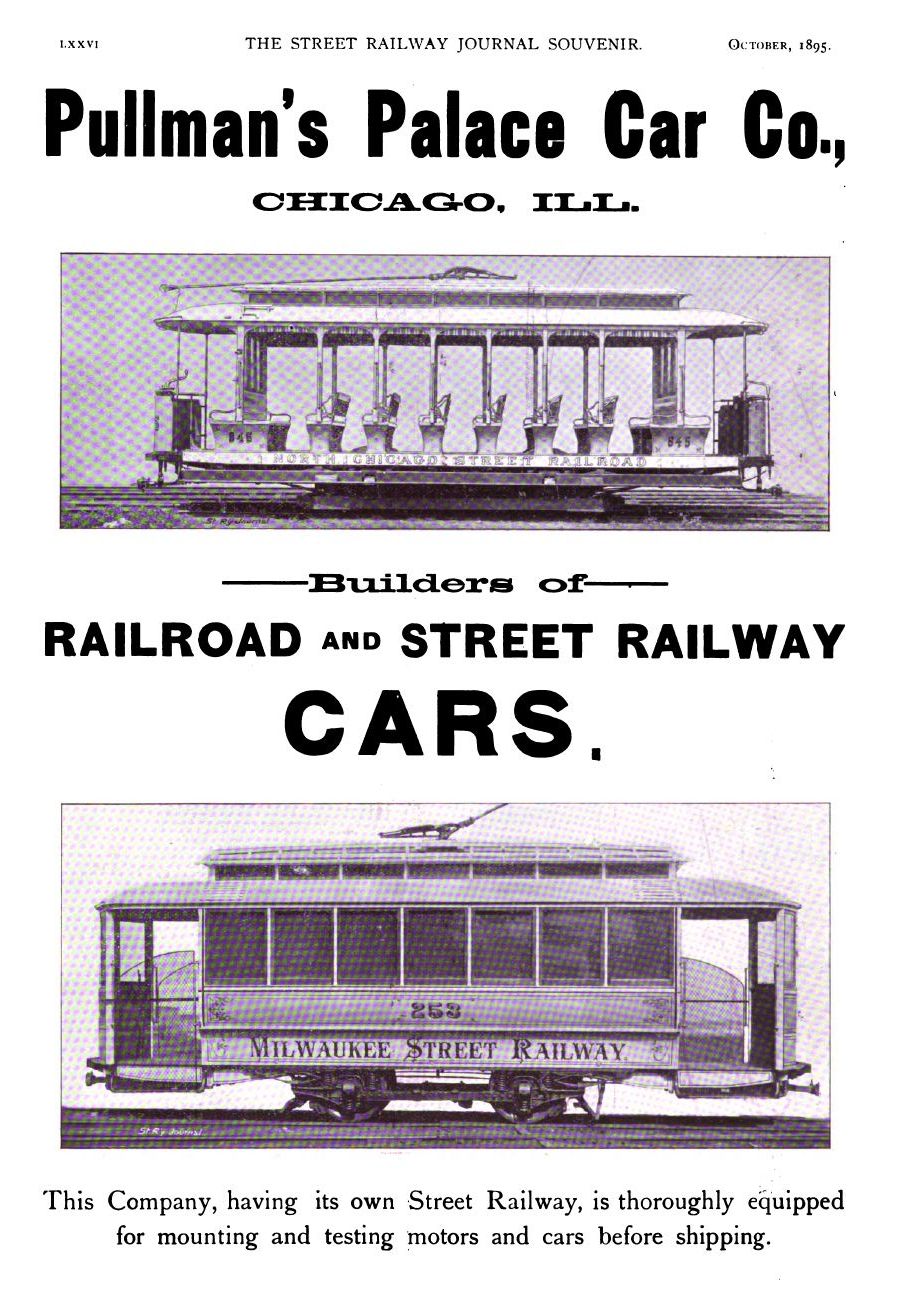
|
An ad for car builder Pullman Palace features a North Chicago cable car. From the October, 1895 Street Railway Journal. |

|
An ad for car builder Laclede features a Broadway cable car from New York. From the October, 1895 Street Railway Journal. |
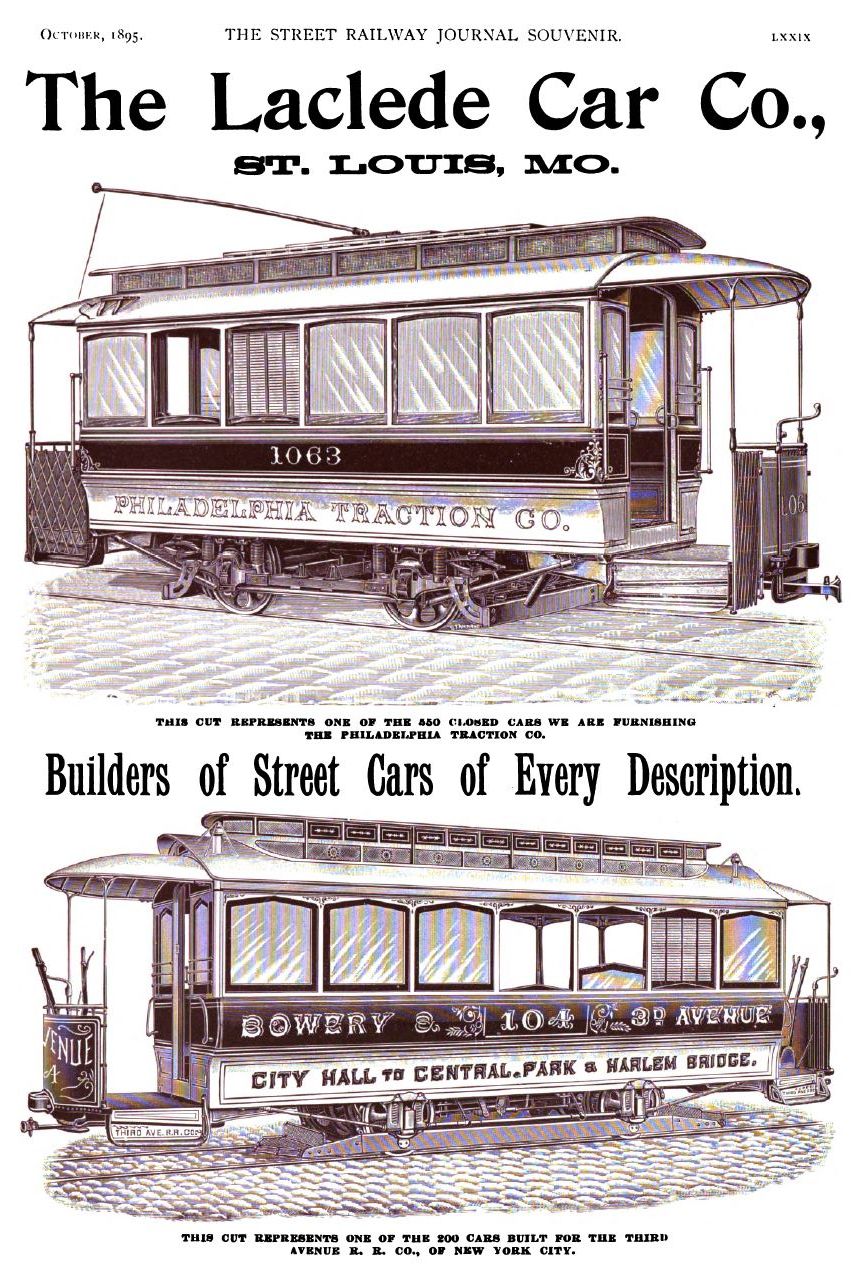
|
An ad for car builder Laclede features a Third Avenue cable car from New York. From the October, 1895 Street Railway Journal. |

|
An ad for AW Wright "Consulting Engineer for Horse Railroads". He also worked on cable railroads. Note that he is to be contacted care of the North Chicago City Railway, where he was superintendant of track and construction. From the April, 1885 Anerican Railroad Journal. |

|
An ad for San Francisco cable tramway engineer WW Hanscom. From the April, 1885 Anerican Railroad Journal. |

|
An ad for the scenic railway (roller coaster) of LaMarcus A Thompson (no relation). LA Thompson is considered to be one of the inventors of the roller coaster, which shared some technology with the cable railway. Note that one installation was at San Francisco's Midwinter Fair in 1894. From the 28-February-1903 New York Clipper. |
|
|
|
|
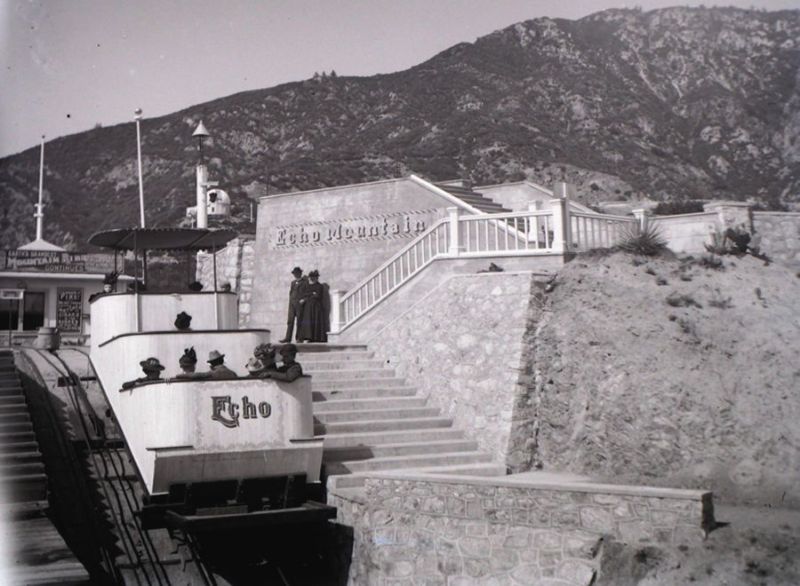
Car Echo at the top of the Mount Lowe incline. |
|
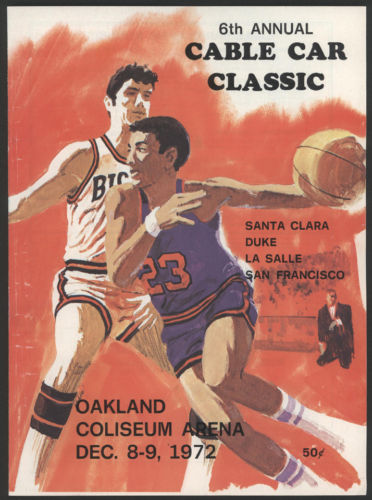
A program from the 1972 Cable Car Classic. |
|
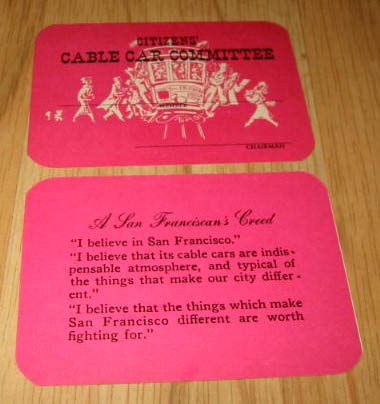
A membership card for the 1947 Citizens' Cable Car Committee. |
|
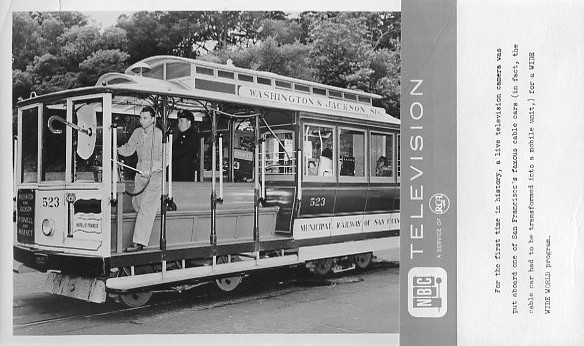
In 1963, car 523 carried a television camera for a live appearance on NBC's Wide World program. |

|
"Princes Street and National Gallery, Edinburgh." Cable tram 120 approaches the camera on Princes Street. Source: Tramway and Light Railway Society Photographic Archive. |

|
Car 49 at California and Stockton. August 2001. Photo by Joe Thompson. |
|
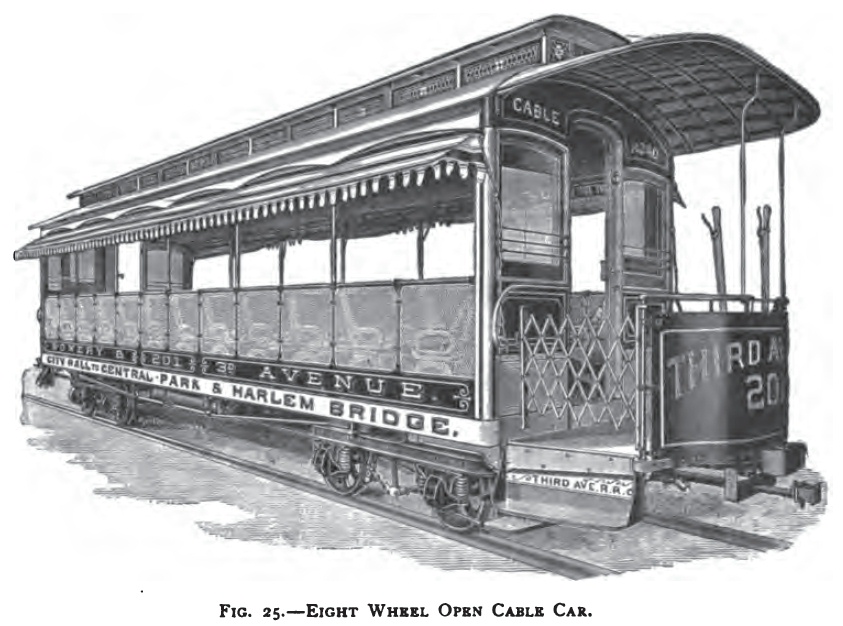
Eight Wheel Open Car (source: Street Railways: Their Construction, Operation and Maintenance by CB Fairchild). |
|
From A History of California and an Extended History of Los Angeles and Environs, Volume One By JM Guinn, A.M., 1915. PLAYA DEL REYPlaya del Rey (Beach of the King) was known to the old-timers as Will Tell's. It was a popular seaside resort thirty years ago, where sportsmen went for duck shooting on the lagoon. The southeasters of the great flood year of 1884 destroyed its hunting grounds, and for two decades it was deserted. With the great boom of ocean frontage that began in 1902 the capabilities of the place for a seaside resort were brought to the front and extensive improvements begun. In 1904 fully a quarter of a million dollars were expended. A new pavilion was built at an outlay of $100,000 and was dedicated on Thanksgiving day, 1904. On the lagoon side, and extending from the level of the pavilion to the water's edge, an amphitheater with a seating capacity of 3,000 was erected. From this a fine view of the boat races and aquatic sports can be obtained. A handsome three-story hotel was erected at a cost of $20,000 and a number of fine residences were erected. During the year 1905 extensive improvements were made at the King's Beach. The lagoon's banks were bulkheaded for miles on either side. Two suspension bridges of concrete were constructed to connect the strand with the mainland, and an incline railway was built from the beach to Mount Ballona, as the eminence is called that rises above the beach. A two-story bank building was constructed, and the Los Angeles-Pacific Electric Railway expended $5,000 in building a passenger depot in the so-called mission design. Gold has been found in the black sands of the beach. It is one of the possibilities of the future that gold mining may be made to pay. |
|
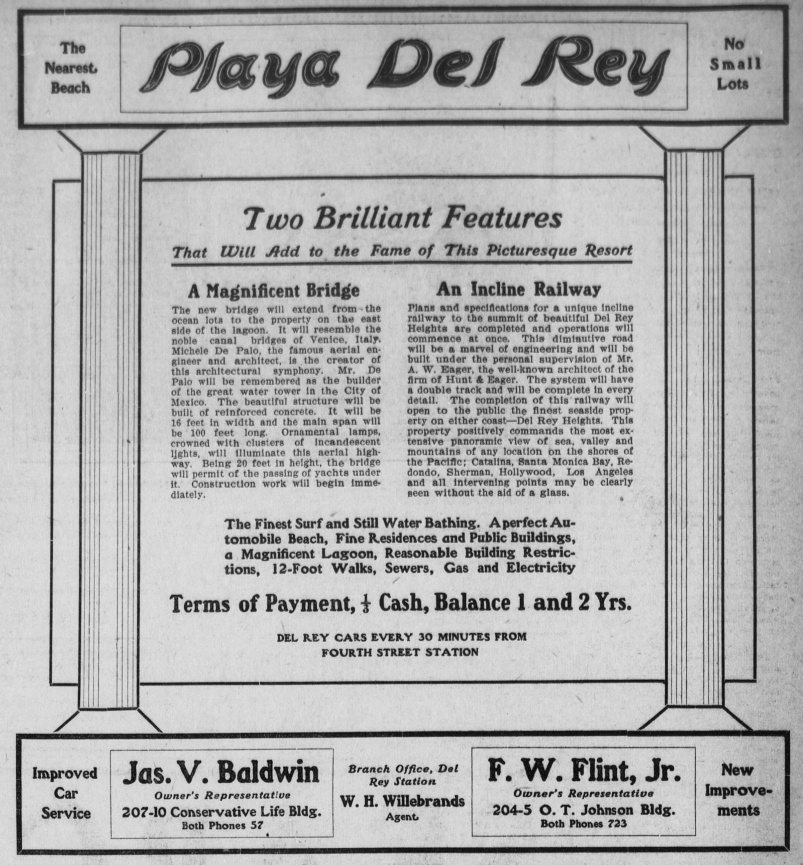
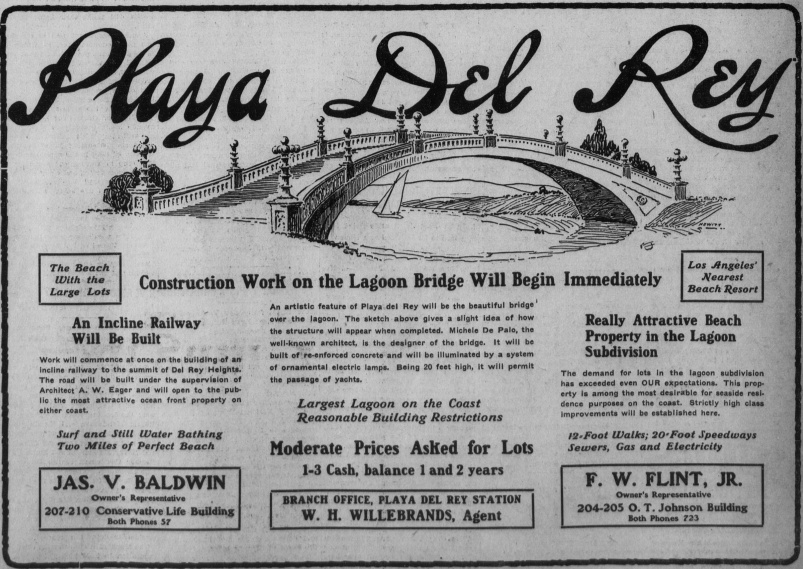
An advertisement for the Playa Del Rey development. "An Incline Railway -- Plans and specifications for a unique incline railway to the summit of beautiful Del Rey Height are completed and operations will commence at once. This diminutive road will be a marvel of engineering and will be built under the personal supervision of Mr. A. W. Eager, the well-known architect of the firm of Hunt A Eager. The system will have a double track and will be complete in every detail. The completion of this railway will open to the public the finest seaside property on either coast -- Del Rey Heights. This property positively commands the most extensive panoramic view of sea, valley and mountains of any location on the shores of the Pacific: Catalina, Santa Monica Bay, Redondo, Sherman, Hollywood, Los Angeles and all intervening points may be clearly seen without the aid of a glass." From the Los Angeles Herald, 16-July-1905. |
|
An advertisement for the Playa Del Rey development. "An Incline Railway Will Be Built -- Work will commence at once on the building of an incline railway t othe summit of Del Rey Heights. The road will be built under the supervision of architect A. W. Eager and will open to the public the most attractive ocean front property on either street." From the Los Angeles Herald, 21-July-1905. |

|
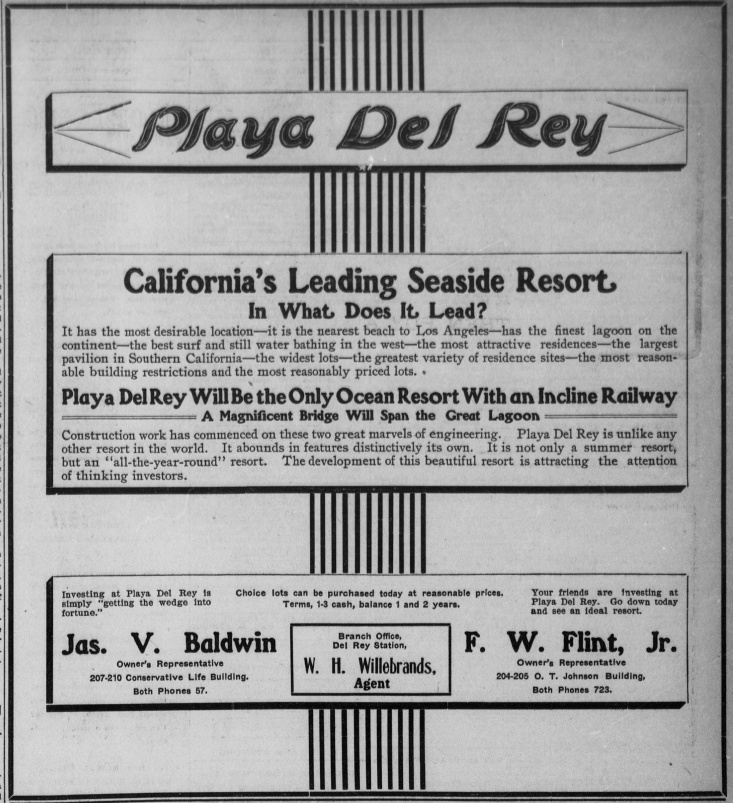
An advertisement for the Playa Del Rey development which mentions the "unique incline railway which will extend to the summit of Del Rey Heights. will be completed in a comparatively short time. Surveyors and graders are now at work preparing the roadbed. The system will have a double track, with pavillions at the summit and foot. An attractive 'midway station' will also be built. This diminutive road will be a marvel of modern engineering, and will open to the public the most picturesque seaside residence property on the Pacific Cost." From the Los Angeles Herald, 23-July-1905. |
|
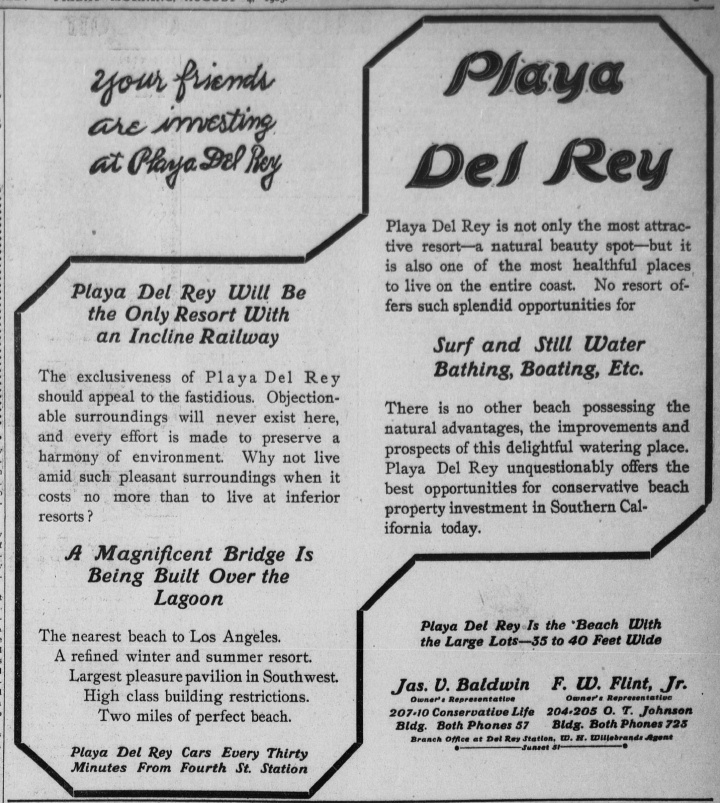
An advertisement for the Playa Del Rey development: "Playa Del Rey Will Be the Only Ocean Resort With an Incline Railway." From the Los Angeles Herald, 30-July-1905. |
|
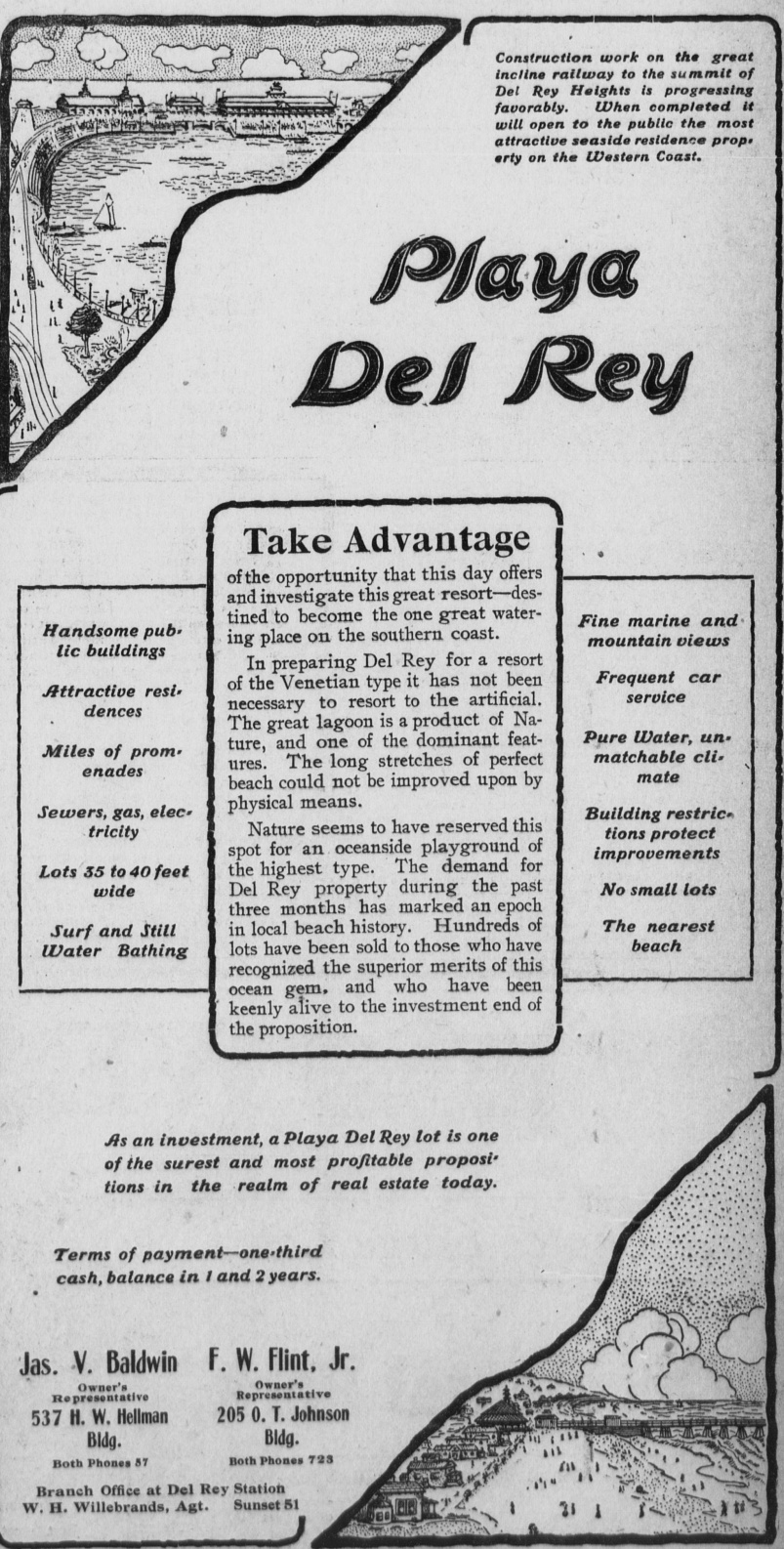
An advertisement for the Playa Del Rey development: "Playa Del Rey Will Be the Only Ocean Resort With an Incline Railway." From the Los Angeles Herald, 04-August-1905. |
|
An advertisement for the Playa Del Rey development: "Construction work on the great incline railway to the summit of Del Rey Heights is progressing favorably. When completed it will open to the public the most attractive seaside residence property on the Western Coast." From the Los Angeles Herald, 20-August-1905. |

|
Val Lupiz took this front view of freshly painted new car 15. May, 2009. Photo by Val Lupiz. All rights reserved. |

|
Val Lupiz took another front view of freshly painted new car 15. May, 2009. Photo by Val Lupiz. All rights reserved. |

|
A beautiful United Airlines ad shows Grant Avenue and California Street in Chinatown. The only problem is, that is a Powell Street cable car climbing the California Street hill. From the wonderful Facebook group Vintage Advertising and Poster Art. |

|
Cable car crossing sign at Powell and California. January 2002. Photo by Joe Thompson. |

|
Do not board in this area sign at Powell and California. January 2002. Photo by Joe Thompson. |
Municipal Transportation Agency (MTA)
Tuesday, August 1, 2000 Meeting Agenda and Minutes
http://www.sfmuni.com/rid_mta/mt000801.htm
General Manager Burns spoke about placing cable car #4 at PacBell Park. Muni retains ownership of the car and the Giants are responsible for relocating and restoring it. Advertising on the car will be done through the TDI contract and some revenue will come to Muni once relocation and restoration costs have been recovered.
San Francisco Traffic Code
ARTICLE 3 OBEDIENCE TO SIGNS AND STOPPING OR PARKING
SEC. 31.2. DRIVING ON EXCLUSIVE CABLE CAR LANES ON POWELL STREET.
--------------------------------------------------------------------------------
SEC. 31.2. DRIVING ON EXCLUSIVE CABLE CAR LANES ON POWELL STREET.
Except as to cable cars, Municipal Railway vehicles, and authorized emergency vehicles, it shall be unlawful for the operator of any vehicle to drive on the exclusive cable car lanes on Powell Street between California Street and Sutter Street over, upon or across the cable car lanes or to make any left or U-turn on the exclusive cable car lanes except for passing a disabled vehicle. (Added by Ord. 204-74, App. 4/24/74)
San Francisco Traffic Code
ARTICLE 6 STREETCARS
--------------------------------------------------------------------------------
San Francisco Traffic Code
ARTICLE 6 STREETCARS
SEC. 129.1. SINGLE-ENDED CABLE CARS.
--------------------------------------------------------------------------------
SEC. 129.1. SINGLE-ENDED CABLE CARS.
On single-ended streetcars propelled by cable, the maximum number of passengers that may ride standing on the right-hand running board is six, and on the left-hand running board the maximum number is eight. No more than two passengers may stand on running boards between each vertical stanchion. (Added by Ord. 65-77, App. 2/18/77)
San Francisco Traffic Code
ARTICLE 6 STREETCARS
SEC. 129.2. DOUBLE-ENDED CABLE CARS.
--------------------------------------------------------------------------------
SEC. 129.2. DOUBLE-ENDED CABLE CARS.
On double-ended streetcars propelled by cable, the maximum number of passengers that may ride standing on each running board is four. No more than two passengers may stand on the running board between each stanchion. (Added by Ord. 65-77, App. 2/18/77)
San Francisco Traffic Code
ARTICLE 6 STREETCARS
SEC. 129.3. CABLE CARS-STANDING.
--------------------------------------------------------------------------------
SEC. 129.3. CABLE CARS-STANDING.
On any streetcar propelled by cable, passengers are prohibited from standing between the forward cabin door and the gripman, in the entryways, on those portions of the running boards forming part of the entryways, and on the prohibited areas of the rear platform of single-ended cars as designated by the Municipal Railway. (Added by Ord. 65-77, App. 2/18/77)
San Francisco Traffic Code
ARTICLE 6 STREETCARS
SEC. 129.4. CABLE CARS-SIGNING.
--------------------------------------------------------------------------------
SEC. 129.4. CABLE CARS-SIGNING.
Every streetcar propelled by cable shall carry legible signs stating the limitation on standing passengers on running boards and a prohibition against passengers leaning out. (Added by Ord. 65-77, App. 2/18/77)
San Francisco Traffic Code
ARTICLE 6 STREETCARS
SEC. 129.5. CABLE CARS-MOVING RESTRICTED.
--------------------------------------------------------------------------------
SEC. 129.5. CABLE CARS-MOVING RESTRICTED.
Crew members are prohibited from moving a streetcar propelled by cable while the number of passengers or their location in exterior areas are in violation of Sections 129.1, 129.2, 129.3 and 129.4 of this Code. (Added by Ord. 65-77, App. 2/18/77)
San Francisco Administrative Code
APPENDICES INITIATIVE ORDINANCES
APPENDIX 2 REGULATION OF STREET RAILWAY CARS
--------------------------------------------------------------------------------
APPENDIX 2
REGULATION OF STREET RAILWAY CARS
Adopted May 2, 1935
Providing for the Operation of Street Railway Cars by a Motorman and Conductor, Specifying the Entrance Age of Employees on Street Railways, and Providing a Penalty for Violations Thereof.
Be it Ordained by the People of the City and County of San Francisco:
SECTION 1.
Every street railway car and every cable car while carrying passengers in the City and County of San Francisco, except street railway cars acquired or to be acquired by the City and County of San Francisco subsequent to January 1, 1939, shall be in charge of a motorman or a gripman and a conductor; every motorman and gripman and conductor employed in the operation of any street railway car or cable car must be an adult of not less than 21 years of age.
This ordinance shall not be repealed, modified or amended except by vote of the electorate.
SECTION 2.
Any person, firm or corporation violating any provision of this ordinance shall be deemed guilty of a misdemeanor, and, upon conviction thereof, shall be fined for each offense, not less than $50 nor more than $300, or by imprisonment for a term not exceeding six months in the County Jail of the City and County of San Francisco, or by both such fine and imprisonment. (Adopted, 1935; amended, 1954)
Tacoma News Tribune
1938
April 9: The last cable car moves up 11th Street.
June 11: Trolleys in downtown Tacoma are replaced by buses.
Cable road, a railway on which the cars are moved by a continuously running
endless rope operated by a stationary motor.
Websters Revised Unabridged Dictionary 1913, Page 203, available at
Bibliomania

|
Cross Section of a Clay Street Hill car. From Smith? |


