
Test Links/Page 3

|
|
Test Links/Page 3 |
|
Home /What /How /Where & When /Who /Why /Chronology /Miscellany /Links /Map /Bibliography
Some of these links are for future development. Use them at your own risk.
Test Links Page 1 /Test Links Page 2
Go to top of page.
Did you know that a cable car line was built, that never ran? In San Francisco? And that a piece of it still exists? 'Tis true and Hilton doesn't mention it! It was franchised to the City Railroad, a horsecar line that never ran cable cars, in December, 1890. The line was built the following year, 1891. And then nothing happened. Cars were built, but remained at the factory. The City Railroad was, by this time, controlled by the Market Street Cable Railway. The line ran from 14th and Mission via Mission, West Mission (Otis), Potter (12th Street), Page, Masonic, and Frederick Streets to 1st Avenue (Arguello Boulevard). The line lay unused until it was electrified on August 23, 1894, becoming the new Market Street Railway's first trolley operation.
The line eventually became part of the 6 Masonic trolley line, and was eventually converted to trolley coach in 1949.
The cars, built by O'Brian & Sons in 1890, went to the Metropolitan Railway, (electric) and were rebuilt for that use. One of these cars was rebuilt twice: 1900 and 1913. This is the surviving "piece". It is now Muni car 0109, and it was a rail grinder from 1913 until the 1980's, and is now on loan to the Western Railway Museum, at Rio Vista Junction. The car built as a cable car that never ran as a cable car is so modified as to be unrecognizable, except for its floor dimensions: 23' x 8"6".
The foregoing copyright 2000 by Emiliano J. Echeverria, All Rights reserved. Used by special arrangement for the Cable Car Home Page.
Go to top of page.
Lauren Weinstein
"Professor Neon's TV & Movie Mania"
http://www.professorneon.com
Outer Limits
"The Duplicate Man"
Paul Ward:
"There are several private funiculars in the Silver Lake neighborhood, and
until three or four years ago, there was a wonderful funicular at Forest
Lawn Cemetery. It was built by the boss in the twenties, because whenever
he drove through the gates in the morning, the guard alerted the staff to
stop their partying and debauchery and get to work. The manager's house
was at the end of a cul-de-sac in Glendale below the cemetery, and when
he had the funicular built, he could ascend the grade and coast down the
road to his office in his Locomobile, without the staff knowing of his
approach. He was then able to catch them in their laziness.
"The funicular is still there, but the car is gone, and the cable house has been sealed up in concrete. As I said, there are three or four private funiculars left in Silver Lake. John Heller, VP of the ERHA may have a hint as to their location, and I have :cc'd him on this e-mail."
Ray Long:
"And while you're at it, don't forget the three private funiculars on
Catalina Island. Also, there was one used for construction of the geodesic
dome house in Hollywoodland and one above Hollyridge Drive same canyon.
Laurel Canyon had a couple at one time or another. All of them I believe
are now among the missing. The dome house was demolished after Buckminister
Fuller died."
LAPRY@aol.com
"The round hillside house is (still) perched on the San Fernando Valley side
of the Hollywood hills above roughly the area defined by Studio City and
Sherman Oaks. I'm not sure if the funicular railway is still operating, but
I think that it would be extremely difficult to access the building without
it. It was built, I recall, in the 1960s, and allows a breathtaking view of the
Valley."
David McCanne
Lauren Weinstein:
"Yes, that's definitely the one -- the photo at:
http://www.usc.edu/dept/architecture/shulman/image_collection/Malin.html
confirmed it instantly. If it was built in the 60's it must have been
almost literally brand new when OL used it for their shoot early in
that decade.
Thanks very much Joe and John. And also please thank David McCanne
for me. Next time I'm out that way, I'm going to take a look!
Thanks again."
Ray Long:
"I have been led to believe that there are (present tense) three private
funiculars on Santa Catalina Island. They are supposedly little more than
inclined elevators for access to private homes."
"Regarding the two in Hollywoodland. On the west side of the canyon, there
was an incline used to haul construction materials up to the non-extinct
geodesic dome house on the west side of the canyon. One of the houses on
the east ridge had an incline of sorts from Hollyridge Drive to the top of
the hill. I haven't been up there in 30 years so I don't know the status
today.
"There were a couple more in Laurel Canyon. These private inclines were
stretching the definition of the words "incline" and "permanent" but they
were private and were used as incline elevators or dumb waiters."
Go to top of page.
Go to top of page.
As regards her street railway facilities Kansas City stands among the few cities of the first class In the United States. There is not a point within the city limits, from which, within a few minutes' walk, a person cannot reach a street railway. From the eastern city limits, for a 5 cent fare, a passenger can ride to any point in Kansas City, Kas., or even beyond, several miles to Argentine, for the one fare. There are over 150 miles of street railway track in Kansas City and adjoining cities to-day. While this mileage has not been increased during the last year, a vast amount of capital has been expended In improvements both to the roadbeds and the rolling stock.
x
x
x
x
x
x
x
x
x
x
The case of the old Union Cable Railway Company will be tried in police court to-day. The officers of this company were arrested a month ago for failing to repair and make secure the old viaduct on Fourth street between Harrison and Gllliss streets. The structure has been unsafe for a long time and the building inspector has tried every means within his power to have it repaired.
The ownership of the road has been in dispute for some time. An almost endless amount of litigation has resulted and the officers of the company under arredt do not seem to know exactly where they are at." However, the building inspector is determined to have the structure torn down or made secure.
Go to top of page.
As regards her street railway facilities Kansas City stands among the few cities of the first class In the United States. There is not a point within the city limits, from which, within a few minutes' walk, a person cannot reach a street railway. From the eastern city limits, for a 5 cent fare, a passenger can ride to any point in Kansas City, Kas., or even beyond, several miles to Argentine, for the one fare. There are over 150 miles of street railway track in Kansas City and adjoining cities to-day. While this mileage has not been increased during the last year, a vast amount of capital has been expended In improvements both to the roadbeds and the rolling stock.
Go to top of page.
x
x
x
x
x
x
x
x
x
x
x
x
x
x
Joseph F, Doyle, the newsboy injured on the Sutter street cable line last Saturday afternoon, died on Monday.
Mr. Doyle, the boy's father, a strong, able-bodied longshoreman, was completely prostrated, and his frame shook
with emotion, and the large tears coursed down his checks as he told how, when he warned Joe of approaching death,
the little fellow muttered, "I can't die yet, father, for where is the money to bury me?"
[Ex. (San Francisco Examiner - JT)
Go to top of page.
Mayor Bartlett has sent in to tho Clerk of the Board of Supervisors his vetoes of orders 1889 and 1890, the former granting to the Omnibus Railroad and Cable Company a franchise to run cars along Twenty-fourth street, Potrero avenue, Yolo street, Nebraska street, to and upon San Bruno avenue; also from Potrero avenue and Twenty-fourth street along Potrero avenue and Twenty-third street to Howard; also on East street, from Howard street to the Oakland Ferry; and the latter granting to A. W. Rose, Jr., the franchise to run cars from Potrero avenue and Twenty-fifth street along Potrero avenue, Channel street and Tenth street, to and across Market street to Fell, along Franklin, Oak and Stanyan streets to Waller street; also from Post and Market along Post, Leavenworth and McAllister streets, Park avenue, Larkin, Grove and Polk streets to and across Fell street; also from Ellis and Leavenworth, along Ellis and Broderick, to Oak street.
Go to top of page.
The Board of Harbor Commissioners met yesterday to consider the application bf the Omnibus Railroad Company for permission to build a cable road on East street, between Howard and Market streets. Gustav Sutro and John H. Boalt represented the applicants, bnt action was deferred by tbe Board for one week, in order to permit the latter to prepare plans showing the exact amount of space the company wanted for its turntable south of the tnrntable of the City Railroad.
Go to top of page.
Articles of incorporation of the Omnibus Cable Company were filed with the County Clerk yesterday. The capital stock is $2,000,000. of which $30,000 is subscribed. The directors are Walter E. Sell, George Lowenberg, Charles Sutro, Reuben H. Lloyd and Wm. S. Wood. The purpose of the company is to operate a street railroad by the cable system, to commence at the corner of Howard and East, and running thence along Howard street to Army street; also, commencing on Townsend and Fourth streets, running along Townsend to Third, to Market, to Montgomery, and to North Beach by the same route now followed by the old omnibus company.
It is the intention of the new corporation to run cable cars over all their old routes, as well as the several routes for which they hold franchises. These latter include lines from the ferry to the park, from Market street to the Potrero, and from Howard and Twenty-fourth streets to the San Bruno road. Altogether the lines now in operation and the branches owned by the omnibus company aggregate thirty miles in length.
Go to top of page.
The families residing on the north side of Howard street, near Tenth, in the buildings numbering 1400 to 1414 inclusive, have been given thirty days' notice to move. The reason assigned is that the Howard-street Cable Company have bought the property and are desirous of building their engine-house on that ground. The location is exactly in the center of the proposed cable line.
Go to top of page.
Tbe Omnibus Railroad Company is soon to add two new cable lines to the large number now in operation in the city. May 1st next has been fixed as the time for breaking ground on the Howard-street line, which has been projected for a long time. This line will run from the ferries to the corner of Howard and Twenty-sixth streets. At the same time, it is planned to break ground for a new line for which franchises were secured some time ago. Beginning at the junction of Tenth and Howard streets, a cable road will be built through Tenth street, across Market street to Oak street, and thence out Oak to the Park and baseball grounds. These cable lines will be begun simultaneously and it is expected to finish them in about a year from the time ground is first broken.
The Company also intends ia time to make its line from North Beach to Towsend streets also a cable, but nothing will be done in that direction at present. It has, however, been decided to run a line out Market, Post and Ellis streets. Beginning at the ferry, it will rnn as a horse-car line up Market street to Post street. There tho horse-cars will connect with a cable road, which will run out Post street to Leavenworth, on Leavenworth to Ellis, out Ellis to Broderick, and on Broderick to Oak street, joining the Oak-street branch of the Company and cars running thence to the Park and baseball grounds. It is expected that work on this line will be commenced some time in 1889.
Go to top of page.
The branch of the Howard-street cable system on Twenty-fourth street will be in operation next Wednesday. The Potrero-avenue Improvement Club will celebrate the occasion with a banquet in Maennerfond Hall. Cars on the new branch line will run for the present from Potrero avenue to Howard street, where passengers will be transferred to the main line. Cars will run direct to the ferry as soon as the Howard-street cable is laid, and will connect with the Park branch. A horse-car line is contemplated in connection with the cable system running along Potrero avenue to Tenth and thence to Howard.
Go to top of page.
The new cars for the almost completed Omnibus cable system have been received. They cost $2000 each. An engine house at Tenth and Howard, and another at Oak and Broderick, are in course of erection. The former will cost $200,000 and contain a pair of 500-horse-power engines, costing $175,000. When finished the new system will be twelve miles long and will have cost $2,000,000
The Howard street-line will be open for travel in August. The Oak-street route, with the exception of the Stanyan-street terminus, will soon be ready for use. A franchise has been asked from the Supervisors for a road to begin at the corner of Leavenworth and Eddy, thence to Hyde, thence to Ellis, thence to Broderick, to Oak, to Stanyan, and when this privilege has been obtained the work will be commenced. One also to South San Francisco has been asked for, but is in abeyance. The routes of the new lines will be as follows: The crosstown line will run from Tenth and Howard streets to Larkin, Park avenue, to Post street, to Market, and thence by horse-cars to the ferry.
The Oak-street line will run without change of cars from the ferry to the Park.
The Howard-street line will run from the ferry, along East street, to Howard, to Twenty-sixth.
The Twenty-fourth-street and Potrero avenue line will run from Twenty-fourth street and Portrero avenue along Twenty-fourth street, to Howard, to East, to Oakland ferry without changing cars.
Mission passengers for the Park will be transferred at Tenth street to the Oak street cars. North Beach passengers for the Park will take the Third and Montgomery-street horse-cars and be transferred at Post and Market.
Go to top of page.
Work was begun at the corner of Post and Market streets yesterday, for the turntable for the Omnibus Railroad Company's cable line, and it is stated the line will be in operation in six weeks. It will go direct to Golden Gate Park via Post to Leavenworth, to Ellis, to Broderick and the Park. It will make connection with the branch that passes the new City Hall and the Pavilion, enabling passengers to take the car at Post and Market and transfer either to the line running to Howard or out Oak street.
Go to top of page.
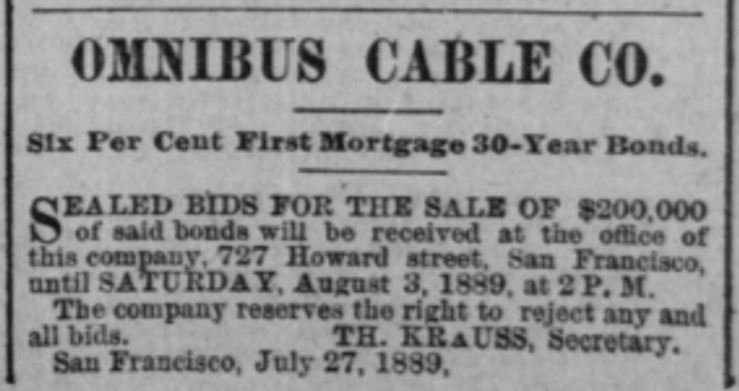
|
Can't find someone to sell you the Brooklyn Bridge? Buy Omnibus Cable Company bonds. From the 01-August-1889 Daily Alta California. |
By Thursday of next week it is expected that the lines ot the Omnibus Cable Company on Howard and other streets will be in operation. A large force of men are at work closing up the gap on Post street and completing the road from the engine house on Howard street to the Twenty-sixth street terminus. The eastern part of the cable, stretching from the engine house to the water front, will be placed next Saturday night. The equipment for the road will be ready when needed.
Go to top of page.
It is expected that the Howard-street cable of the Omnibus system will be in operation by the 1st of September. The Eastern end of the cable has been put in.
Go to top of page.
Yesterday morning the new cable-cars of the Omnibus Cable Railway Company's Howard-street system were run on that thoroughfare from the ferries to Twenty-sixth street, and the smooth working of the cars and roadway proved highly satisfactory to the officers in charge.
The first car selected from the ninety now in the company's building on Howard and Tenth streets was No. 30, and the first trip to the ferries was made without a hitch, Superintendent M. M. Martin manipulating the grip in person.
There were also present President Gustav Sutro, Assistant Superintendents Morrison and Richards, G. W. Douglass, Chief Engineer of Construction; Chief Engineer Fairchild of the Motive Department; J. C. H. Stut, Head Draughtsman; A. L. Anderson, the Civil Engineer; M. D. Stein, son of Vice-President Stein; Directors Eugene Le Roy and A. Hull and others.
After the first car had been successfully started the others were run by the experienced gripmen. No accident of any kind occurred. The passage of the cable cars along Howard street brought out a line of spectators from Twenty-sixth street to the ferries.
The cables were not run to their full speed, which, west of Tenth street, is eight miles an hour (the maximum allowed by law) and east of Tenth street seven and a half miles an hour.
The company expect to displace the horse cars by the end of the present week. Twenty-two additional cars are expected to be received by that time, making the present complement 112.
The other five divisions of the Omnibus Company's extensive system are nearing completion, and as soon as possible will be in operation. Transfers are to be given at every crossing of any of the divisions of the road, so that passengers can reach any quarter of the city for one fare.
Go to top of page.
Tbe machinery of the Post-street branch of the Omnibus cable system was started up yesterday and a car sent over the road. This branch starts from the corner of Montgomery and Market streets, the turn-table being in the latter street alongside of the Hibernia Bank. Thence it runs aiong Post to Leavenwortb, down the latter street and across McAllister into Park avenue, across Larkin into Grove, to Polk, to Market, across the latter thoroughfare at Fell street into Tenth, and thence to Howard street. The length of the cable used in this line is 21,950 feet. It is the expectation of the railroad company to have cars in operation on this branch in a few days, as the machinery yesterday all worked smoothly. The line in question belongs to the southern branch of the system, and will be worked by the engines in the house on Howard and Tenth streets.
Go to top of page.
Sorry about the use of the perjorative name for a person of Chinese descent.
A Chinaman named Ah Bang was thrown from one of the Omnibus cable cars yesterday on Howard street, near Fourth, and sustained a dislocation of the right hip. He states that he told the gripman to stop at Fourth street, but that party paid no heed to his request, and in attempting to alight half way up the block he was thrown violently to the ground. He was taken to the Receiving Hospital.
Go to top of page.
South San Francisco was the southern part of the city, not the current city of South San Francisco.
Gustave Sutro, President of the Omnibus road, has stated that the branch of the line running from South San Francisco and connecting with the Howard-street cable line will be in operation in about one week.
The route will be from Railroad avenue, in South San Francisco, along Fifteenth avenue to the San Bruno road; thence on the San Bruno road to Nebraska street; along the latter thoroughfare uutil a connection is made with the Potrero cars; thence on Twenty-fourth street to Potrero avenue. The passengers will be transferred at Potrero avenue to the horse-cars running to Tenth and Howard streets, where connection will be made with the Omnibus cable system.
Go to top of page.
George Hereford, an aged man, living at 1212 Howard street, was run into by one of the Post-street cable cars last evening on the corner of Post street and Grant avenue. He was thrown violently to the ground and badly bruised about the head and face.
Go to top of page.
Spokane Falls, July 23. -- Early this morning a fire broke out on the north side of the river on Monroe street, destroying property valued at nearly a quarter of a million dollars.
There was a woeful lack of water, one of the mains bursting on the island.
Monroe street bridge, a new structure costing $40,000, was entirely consumed, the department having no water on the north side.
The losses are as follows: Cable Road Company, $50,000; H. W. Greenberg Co., $18,000; Monroe Street Bridge Company, $35,000; Bonne & Co., $12,000; Cascade Laundry, $3,500; Cutler & Curtis, $7,500; Washington Water Power Company, $18,000; S. P. Packer, $2,000; James Jones, $1,000; Miss Ada Howard, $l,OOO. Total loss, $148,000. Insurance -- Cable Road Company, $15,000; H. W. Greenberg, $6,000.
Go to top of page.
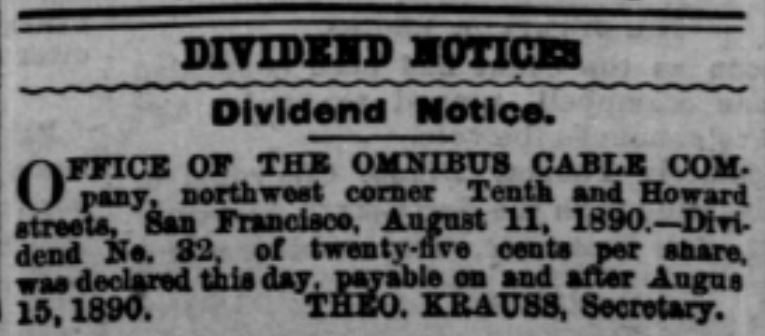
|
A notice that the Omnibus Cable Company had declared a dividend. From the 14-August-1890 Daily Alta California. |
In pursuing inquiries in this city with reference to the Pacific Railway Company of Los Angeles, Cal., which has recently placed its affairs in the hands of a receiver and is now threatened with a number of suits for damages, aggregating $350,000, an ALTA reporter gleaned some facts which are of special interest at the present time.
The Pacific Railway Company is a Chicago corporation, of which C. B. Holmes/a> is the presiding spirit. The manner of its organization and its growth out of the great cable syndicate of Chicago were recently explained to an ALTA reporter by Colonel J . C. Robinson, a former vice-president of the road and its chief constructor. After the completion of the road Colonel Robinson came to this city and established the "California Contract Corporation," with offices at room 24 in the Chronicle building. Colonel Robinson took a three years' lease of the room, and his office fixtures still remain, but inquiries tend to show that he left this city for the East on Sunday last, intending, as he stated, to take a trip to Europe for the benefit of his wife's health. That be contemplated such a trip is known from the fact that he had in his possession letters of recommendation from ex-Governor Waterman and Governor Markham to the United States Ministers in London and Paris. It is known that Mrs. Robinson was suffering from a serious organic affection, and it was understood that his absence might be considerably prolonged by business engagements in England and France in connection with cable-road projects.
Colonel Robinson's statement as to his connection with tbe Los Angeles cable system was to the effect that in the summer of 1888 he met C. B. Holmes, the head of the great cable syndicate ot Chicago, and was offered by him the general management of the numerous systems of cable roads about to be constructed in Los Angeles. Colonel Robinson accepted the proposition and went to work at once, arriving in the month of November, 1888.
The precise nature of the scheme thus inaugurated and Holmes' relations to it appear to have been as follows, according to Colonel Robinson's statement: Before the boom of 1886 the transportation facilities of Los Angeles were of a very primitive and unsatisfactory character. Mule cars predominated, and each passenger had to scramble to the box and deposit his fare in it. There were a few single-horse cars and one or two cable roads, worked in the interests of land agents with the idea of opening up the heights behind the city for residential objects. In 1887 the Presidents of these roads held a consultation, wtth a view to consolidate the system, and to organize the Loe Angeles Cable Railway Company, with a capital stock of $2,500,000. The promoters, after laying about a mile of cable track, found hemselves unable to raise more than $1,500,000. and in the summer of 1888 C. B. Holmes of Chicago was invited to look into the matter. His report determined his syndicate in Chicago to purchase a controlling interest in the company and a majority of the stock was secured. From the commencement of 1889 up to the conclusion of the undertaking the company expended $1,959,140, and the finishing up showed a total capital expenditure on the whole system, including horses and mules, of $3,000,000. Besides the cable-roads, twenty-one miles in length, there were connecting lines of horse cars, twenty-four miles in length, making a total of forty-five miles on the system.
The construction of the road was attended with phenomenal difficulties, owing to floods and washouts, besides the necessity of constructing costly viaducts at the crossings of three lines of steam railroads, and the viaduct across tbe Los Angeles river, having a length of 578 feet. The length of the principal viaduct over all was 1535 feet. In the great conduit there were used 36,000 barrels of Portland cement, and the track rails weighed 1444 tons; the solid rails the same. The total annual expenditure on the road, including horses and mules on the branch roads, was estimated at $300,000. During the first eleven months of the year the roads carried close on 5,000,000 passengers and covered a total distance of 1,500.000 miles.
In December, 1889, Colonel Robinson, who had been till then Vice-President of the road, was given a banquet by the city and county officials of Los Angeles, Governor Waterman being President. In January, 1890, in commemoratian of the completion of the construction and organization of the cable system, the employees of the Los Angeles Cable Company presented Mr. Robinson with a valuable diamond ring, accompanied by an illuminated address, as a token of esteem.
Colonel Robinson is an Englishman and came to this country about four years ago. He traveled nearly all over the United States and Canada before going to Los Angeles. In the autumn of last year he was actively engaged in negotiations with an English syndicate for the laying down of a cable system in Valparaiso and Conception, but the unsettled state of Chilian (sic - JT) politics, and especially the disastrous failure of Baring Brothers and the financial panic in the Argentine Republic, aborted the scheme. It is a curious circumstance that Colonel Robinson received his training in street-car traffic away back in the sixties, from George Francis Train, then visiting Birkenhead.
Personally Colonel Robinson is a genial and most intelligent gentleman: a man of temperate habits, and an astute financier. He did not convey, when speaking of Mr. Holmes last week, that he anticipated any financial disaster to the Los Angeles cable-road enterprise, or to Mr. Holmes personally. Colonel Robinson did not possess an extended circle of friends in this city, and hence it is only his departure for the East at the time of the crisis in the Chicago corporation's affairs that euggests any connection between the events. It seemed to be inferable from Colonel Robinson's general remarks that he had severed his relations both with Los Angeles and Chicago. The office of the California Contract Corporation has been closed all the past week.
Go to top of page.
This road was never built.
The recent announcement of the incorporation of another cable syndicate to run cars westward to the ocean on streets south of Howard has stirred up considerable speculation as to the effect likely to be produced on Rincon Hill, South Park, and adjacent sections covered with buildings which have considerably depreciated in value of late years. As an illustration of this depreciation, a case was brought under the notice of an Alta reporter where a house for which the owner had paid $2000 was sold for $600, in consequence of the condition of Second-street bridge. It is believed by local property owners that if the new cable road is run by way of Market and Steuart to Second, thence to Brannan, to Harrison, and so to the section in which Market street is to be extended to the ocean, an immense impulse will be given to improvements in the whole of the district south of Folsom street, down to Channel street: while Rincon Hill and South Park will regain some of their old-time prosperity. A local resident pointed out to an Alta reporter that since the Omnibus Cable Company constructed its Howard street line very few passengers are carried on the Mission street cars, and still fewer on the horse-car line running from California and Montgomery, by way of First street, to Folsom. There has been a talk of a cable road on Folsom street for some time, but it would not afford nearly the same conveniences to Rincon Hill and South Park residents as a line running by way of Second and Brannan. Despite the neglect of this portion of the city in recent years there are many beautiful residences on Rincon Hill, and quite a populous section is traversed after the crossing of Third street. The new line would also furnish a swift and easy approach to the Pacific Mail Dock, which is at present very poorly provided with such service. A number of citizens interviewed by the Alta reporter agreed that the new road would open out numerous inducements for real estate investments on the extensions of Harrison and Bryant streets, as well as insuring, the removal of the slums at the city end between Bryant and Channel streets. The turning of the first sod of the new road is anxiously looked for.
Go to top of page.
Richard Doyle has sued the Omnibus Cable Company to recover $5000 damages for injuries sustained when a car ran into a hack in which he was riding on December 31st, on Howard street, near Twenty-fourth. Davidson & Elliott, the owners of the hack, have also sued the company to recover $500 for damages douo to the vehicle. Negligence in not ringing the gong is avowed by both plaintiffs.
Go to top of page.
The time table of the horse car line running from Tenth and Howard to South San Francisco has been changed. The last car connecting at Twenty-fourth street and Potrero avenue with the yellow Howard-street cable cars will leave the points mentioned at 12:40 a. m. instead of midnight as formerly. The last car from South San Francisco for Twenty-fourth street leaves at 1:10 a.m. Theater goers are enabled to spend forty minutes additional seeking pleasure. Formerly there was little margin to catch the last car after a performance.
Go to top of page.
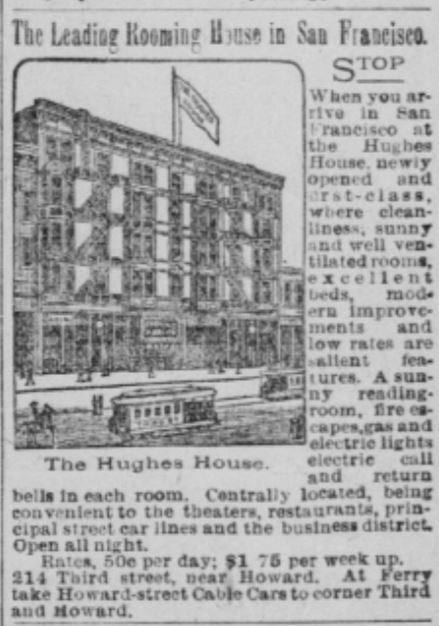
|
An advertisement for the Hughes House, "The Leading Rooming House in San Francisco." It was located at the corner of Third Street and Howard. "At Ferry take Howard-street Cable Cars to corner Third and Howard." From the 03-July-1894 Sacramento Record-Union. |
A recent number of the Street Railway Journal of New YorK, under the head of "The Doom of the Cable in San Francisco," has some interesting things to say concerning the development of the electric street railway in San Francisco and the possible supplanting of the cable by electricity throughout the entire Market-street system, and, indeed, the whole City.
In the Hobart building the Journal's deductions were not accepted. "The Market-street Railway Company," say the authorities, "has substituted electricity as a motor on four horsecar lines and on one cable line. "What we will do further is another question. We do not claim to know -- in fact we do not know. There are some lines upon which the cable will probably always be used, because it will always be the best and most economical power."
Of the cable the article in the Journal says that started twenty-two years ago the cable road was a success mechanically and financially from the first, and its fundamental features were quickly copied on other roads in this City and in other cities. The Journal continues:
Articles have appeared in Eastern journals from time to time to encourage San Franciscans in the belief that the cable system was really more economical than the electric, except on long suburban lines, but for about a year and a quarter the Market-street Railway Company has owned electric roads of its own and has been making data for itself. Snow has not bothered the company at all on its cable roads, nor has the frost closed up the slot. The expense for cables has not been abnormal, and the original construction was most substantially done in iron and concrete. In fact, the conditions for cable-road traction in San Francisco are the equal of any in the world, and the construction and operation of these roads are unsurpassed. The Market-street Company, however, has become convinced that the people prefer to ride on the electric-cars, and that the electric-cars carry the people more cheaply than does the cable.
These results were not obtained from a few electric-cars run on level lines and at high rates of speed, but from the operation of upward of 150 cars at from 1 1/2 to 2 /12 minute headway at times and on lines havihg grades as high as 14 1/2 per cent. Most of these cars are subject to frequent interference from the heavy wagon traffic on the downtown streets, and all of them are governed by the rule ordering a reduction of speed at the crossing of each intersecting street.
The company began cautiously by changing its old horsecar lines to electric lines. Later it decided to equip with electricity the route of a franchise designed to be a cable road and for which $30,000 worth of cable material had already been bought. The routes of all new franchises were then ordered to be equipped as electric roads, and finally it was decided to abandon the use of the cable on one line -- Ellis street -- and substitute electricity.
This last decision is considered significant and one foreshadowing the changing of not only all cable roads on the level to electric roads, but the changing of all cable roads accessible to electric cars, and not only the cable roads of the Market-street system, but also those of the other cable roads in the city. The Market-street Company maintains at present six cable power-houses and each has its two large monthly items of fuel and labor. Every time a cable power-house can be dispensed with and the lines operated by electricity that power-house item, labor, is wiped out and the item of fuel is reduced both on account of the less fuel required per car mile for an electric road as against a cable road and because the cable-houses are usually run non-condensing, whereas In the electric power-house the engines are run condensing.
* * * There is a cable line on Oak street requiring a cable 26,000 feet I long that is now under reconstruction as an electric road. When this road is changed the large cable power-house at Oak and Broderick streets, from which both Oak and Ellis have been run, will be shut down.
The grades on the Howard, the Post and the McAllister street lines are all perfectly practicable for electric cars, and in case they are changed from cable to electricity two more power-houses can be dispensed with.
Electricity has, perhaps, replaced the cable on the level and on easy grades, some cable men say, but on heavy grades the cable will always be retained.
When we see the dally spectacle of electric-cars unaided climbing 14 1/2 per cent grades in San Francisco and 15 per cent grades in Oakland, and by means of a simple auxiliary device ascending a 25 per cent grade in San Francisco, where no cable grip could be made to hold, the impregnability of any cable proposition is open to question.
Go to top of page.
The Park and Ocean steam road mostly ran on H Street (now Lincoln Way).
SAN FRANCISCO, Aug. 4. -- Work will be soon commenced reconstructing the cable and steam roads operated by the Market street systems. The first improvement that the company has in contemplation is the reconstruction of the D street, or Park and Ocean steam road, that runs south of the park, connecting the Haight street cable with the Cliff house. The dummy line on California street north of the park will also be transformed Into an electric road. The substitution of electricity for the cable roads on Post, Leavenworth, Tenth, Howard and Twenty-fourth streets will be completed before the end of the year. The Post street line will be extended to MontgomeTy street and other changes are contemplated.
Go to top of page.
Messrs. d'Artenay and Wynne reported that Manager Vining had no intention of taking the cable cars off Twenty-fourth street and operating the Howard street cars on Twenty-sixth street. It is the intention of the railroad company to change the Howard street cable system to an electric line. If it be decided to run the Sixth street line down Post from Taylor to Montgomery it will be the means of hastening the reconstruction of the entire Post street system. It is contemplated by the company to change the Sansome and Montgomery street horse systems to trolleys.
Go to top of page.
The long-contemplated reconstructioo of the Howard and Post street cable lines into a trolley system is about to materialize at last. By to-morrow morning a gang of men will be put at work under the supervision of Chief Foreman T. B. Egan of the Market street combine to effect the change on Howard street frum the ferry to Tenth street. While this branch of the road is being reconstructed all cable cars of the Howard street line will stop at Tenth street, to which the passengers from the Post and Leavenworth street lines will be transferred as usual and carried from Tenth to Potrero avenue over the present route.
On the completion of this the first section, the cars will then be run from Tenth street to the ferry and the services of the Mission street line will be invoked to carry passengers southwest with the aid of the Bryant street trolley line. The passengers patronizing the Howard street system will be carried to East Mission along Twenty-sixth street.
Immediately on the finishing of the Howard street line the work of transforming rhe lines on Post and Leavenworth streets will be commenced.
Valencia street cable will soon follow into the rusty pile of castaway wire cable. It is only a question of time, and brief at that, when cable service through the Mission will be a thing of the past.
In addition to the changes mentioned there are a few more which will be hailed with delight by the residents of the Mission road. In future between 5 and S:3O a. m. and from 4 to 7 p. m. cars will be operated every six minutes to China avenue. Every other car will run to Ingleslde, which will give the people of that section a 12-minute schedule from Twenty-ninth street to the ferry a three-minute service will be maintained. From 8:30 a. m. to 4 p. m. there will be a six-minute service to Twenty-ninth street and a 12-minute service to China avenue.
Better service, both by faster time and more frequent trips, has been scheduled for Folsom street. The travel over this line since the trolley service was extended along the San Bruno road justifies a better service than formerly.
Go to top of page.
With a working force of 200 men Foreman Thomas B. Egan of the Market Street Hallway Company made a start yesterday morning on East street for the reconstruction of the Howard street cable line into an electric service. Previous to this commencement of doing away with cable service on all streets south of the slot. Chief Constructor H. H. Lynch had connected the San Francisco and San Mateo trolley line with the Howard street track at Spear and Howard. A suitable spur has been connected with the Spear street track of the two-county electric line by which the San Francisco and San Mateo cars will switch into Howard from Spear and by this facility gain a final terminus on the big checkered turntable right In front of the ferry building This, however, will not take place until the lower portion of Howard street undergoes its reconstruction, which will be but a few weeks at the utmost.
As soon as this change takes place that portion of Spear street between Howard and Market, over which the Harrison street cars now run. will be discontinued and all the electric and cable cars terminating at the front will congregate on the big checkered turntable.
By the beginning of next month the Post street cars will be pulled off and the work of reconstructing this branch of the Howard street line will be commenced and prosecuted to a finish. After the entire work has been completed the Post, Leavenworth and Tenth street brunches will be extended to Bryant street and the Howard street branch will run three blocks further east on Twenty-fourth street, which will bring that line to Rhode Island street.
The power and carhouse at the corner of Tenth nnd Howard street will still remain standing and become the carhouse of all cars running over the newly constructed roadways.
Go to top of page.
In a communication sent from the San Francisco Labor Council to Chief Constructor H. H. Lynch of the Market Street Railroad Company, who is employing non-union pavers in the reconstructing of the Howard and other cable lines into trolley service, it was shown that the non-union pavers are more expensive than their brothers belonging to the union. It was shown that a block of 412 1/2 feet paved by non-union pavers costs $2l5.50, as against the cost of the same number of feet paved by union pavers at $132. With this showing the communication urged the Market Street Company, as a matter of economy, to employ union hands,
Go to top of page.
SAN FRANCISCO, Dec. 6 (AP) -- A relic of the Barbarry Coast, one of San Francisco’s earliest cable cars, will leave aboard the Army transport Republic Saturday, bound for the National Museum at Washington, D. C.
Go to top of page.
A complete "cable car" -- the last word in urban transportation half a century ago but now almost completely forgotten -- has been presented to the Smithsonian Institution by the city of Seattle, it was announced today.
Built in 1887 in Stockton, Calif., the cable car remained in actual operation in Seattle until 1915. It was pulled through the streets by an endless cable operated by steam power from the end of the line. The cable moved between the tracks just below the level of the street. A mechanical grip arrangement beneath the car gripped the moving cable and could be released by a lever to stop the car.
Carl W. Mitman, Smithsonian head curator of arts and industries, said the cable railway is characteristic of a quaint phase in the history of urban transportation, "which in less than half a century has been almost completely forgotten." For a time it seemed the best answer to the urban transportation problem as successor to the "horse car" of Civil War days.
Go to top of page.
Republican Maurice Carey Blake was Mayor of San Francisco from 1881 to 1883. This is not the Telegraph Hill Railroad that was eventually built.
San Francisco, May 12th. -- This afternoon Mayor Blake returned to the Board of Supervisors, with his veto message, the order granting the Telegraph Hill Railroad franchise.
The mortuary report for the week shows the total deaths to be 126 -- males, 73; females, 53. Corresponding week of last year, 72.
San Francisco, May 12th. -- Zachariah Anderson, a Swedish sailor, was run over and cut to pieces by a train on the Townsend street trestle early this morning.
Telegraph Hill Railroad Company has incorporated to construct, maintain and operate a cable railroad from the intersection of Pacific and Kearny streets, along Kearny to the northerly line of Chestnut, there to connect with elevators descending on Kearny street to the lower levels, and from the foot of said elevators along Kearny street to the wheat slides at North Point.
Go to top of page.
Articles of incorporation have been filed with the Secretary of State of the Telegraph Hill Railroad Company of San Francisco, The capital stock is $100,000, divided into 1,000 shares. Directors -- F. O. Layman, Gustave Sutro, C. Denervana, M, Gray, D. E. Mellie, O. H. Frank, H. D. Cogswell. Also, of the Etervanda Water Company. Directors- J. C. Dunlap, C. N. Ross, Thos. Hendry, Chas. F. Chaffy, R. A. Cunningham, Capital stock $500,000, divided into 5,000 shares.
Go to top of page.
At noon on the Fourth the Pavilion at the top of Telegraph Hill, recently erected by the Telegraph Hill Railroad Company, was thrown open to the public. The building, in its present stage of construction, consists of a two-story circular-shaped structure, the lower story being divided into neatly furnished parlors and drawing-rooms, a kitchen and other culinary departments. The second floor is used as a general hall, where refreshments are served. Around the outer side of the structure is a balcony for promenading, and from which a fine view of the city and the islands and shipping of the bay may be had, as may also from the windows of the private parlors.
Go to top of page.

|
A notice that the Telegraph Hill Observatory offered concerts every Sunday at 2pm. The last part of the climb up Greenwich must have been a stiff hike. From the 09-July-1882 Daily Alta California. |
The Telegraph Hill Railroad Company, by its President, F. 0. Layman, has filed an application in the Supreme Court for permission to disincorporate. The application sets forth that all the claims against the road have been discharged.
Go to top of page.
Department 6 -- Application of Ihe Telegraph Hill Railroad Company to be dissolved and dlsincorporated. Granted.
Go to top of page.

|
A notice that the Telegraph Hill Railroad was looking for bids from contractors to build the line. From the 16-December-1883 Daily Alta California. |
The new cable railroad up Telegraph Hill is about ready to commence operations. Yesterday one of the new cars was placed on the road for the first time and ran np and down the hill several times snccessfully. The road is to be operated on the plan of an inclined elevator. Two cars, permanently attached to a strong wire cable, similar to those in use on other cable roads in this city, will ascend and descend alternately on the same track, and meeting at the half way point, pass each other on a turn out-track. The road is over one-third of a mile long and runs from Powell and Greenwich street, where it connects and transfers with the Omnibus Street Railroad, to the top of Telegraph Hill. Here extensive alterations have been made in the handsome turret-shaped building, which has been lengthened fifty feet and another story added, besides an observatory from which an excellent view of the city, bay and Golden Gate can be had. In the main hall of the building musical entertainments will be given during the season. The road will be opened to the public on Sunday, June 1st, when all of the arrangements for the accommodation of the public will be completed. The motive power of the railroad is situated at the top of the hill, in a large excavation hewn out of the solid rock and in which are placed a large boiler and engine and the drum or wheel upon which the cable winds and unwinds. The engineer is located in a little house on the top of the hill, overlooking the entire road, and directs the movements of the two cars by levers, and can stop the machinery instantly by a foot brake as well as by the lever. Two employes will be on each car, one as conductor and one as pilot, with a patent safety brake on each end. To stop the car, the engineer is signalled by an electric wire running through the cable and attached to an indicator in the engine-room. Every precaution has been taken for safety, and a trip to the top of Telegraph Hill can now be taken with pleasure and comfort. The following are the officers of the company: F. O. Layman, President ; Gustav Sutro, Vice-President; Charles Kohler, Wm. Thomas; Andrew Baird, Secretary; Wm. H. Milliken, Engineer.
Go to top of page.
The receipts of the Telegraph Hill Railroad Company average $60 per day.
Go to top of page.
By order of the Omnibus Cable Company there will be offered at the auction of Yon Rhein &. Co., on the 24th inst., a large piece of property on Tenth street near Mission, 200 x 113, with improvements, renting for $325. The property is owned by the Omnibus Cable Company, and is disposed of by that corporation because it is no longer needed for the conduct of the road. It will be offered as a whole or in five subdivisions. Also, the property of the Telegraph Hill Railroad on Greenwicn-street Hill, corner Greenwich and Kearny streets, consisting of nearly two fifty-varas, with the large observatory, with a magnificent view overlooking the harbor. This property is sold to close out tbe affairs of the Telegraph Hill Railroad Company.
Go to top of page.
|
|
A notice that the Telegraph Hill Railroad was looking for bids from contractors to build the line. From the 16-December-1883 Daily Alta California. |
Telegraph Hill, lifting its gray castled ruin 270 feet over the water front, and for years the resort of the rock-throwing small boy and the lawless Wm. goat, is to be other than a subject for the festive paragrapher; other than a mark of derision. The medieval imitation known as the Observatory is to be repaired and restored, and the crest of the elevation leveled for a promenade by its new Eastern purchasers. A visit to the hill proves how well adapted that old landmark is for a natural resort, and what small effort could make it a grand lookout station for the city
From its summit one can see the gleam of the ocean through the open Golden Gate and the broad level of the bay below. The green hills of seven counties sweep around the horizon from point to point, a view grand and unsurpassed.
The observatory building, with its turrets and mural ornamentation, while showing evidence of decay on its exterior, has been cared for, and even the colored windows are in good repair. Down under the sidewalk in front of the edifice is the furnace and engine that ran the cable which hauled the two cars to the top of the hill, when Telegraph Hill was crowded with visitors. The two cars have lain quiet in the Howard-street roundhouse for many years. The stone and cement wall that was erected around the parapet of the hill has fallen in many places and great masses of masonry are in danger of rolling down on the buildings at the foot of the slope.
It is not known what will be the full extent of the improvements which the owners will make in the building, but they are well aware that no great outlay will put the place in perfect repair, and give to the city a unique place of observation.
Go to top of page.
The ship Seminole, discharging at Vallejo street wharf, has landed three larye cables. One of these, 12,000 feet long, is for the Oakland cable road, another, 11,800 feet in length, is for the Sutter-street road, and the third, weighing seventeen tons, is for the Geary-street road.
The narrow gauge South Pacific Coast Railroad and the Oakland Cable Railway.
It is again rumored in San Francisco that Senator Fair has sold to the Southern Pacific company, for $6,0OO,000, the Santa Cruz steam road and the Oakland cable system.
x
x
x
x
x
x
x
x
x
Go to top of page.
x
Go to top of page.
x
Go to top of page.
x
Go to top of page.
x
Go to top of page.
x
Go to top of page.
x
Go to top of page.
x
Go to top of page.
x
Go to top of page.
x
Go to top of page.
x
Go to top of page.
x
Go to top of page.
x
Go to top of page.
x
Go to top of page.
x
Go to top of page.
x
Go to top of page.
x
Go to top of page.
x
Go to top of page.
x
Go to top of page.
x
Go to top of page.
x
Go to top of page.
x
Go to top of page.
x
Go to top of page.
x
Go to top of page.
x
Go to top of page.
x
Go to top of page.
x
Go to top of page.
x
Go to top of page.
x
Go to top of page.
x
Go to top of page.
x
Go to top of page.
x
Go to top of page.
x
Go to top of page.
x
Go to top of page.
x
Go to top of page.
x
Go to top of page.
x
Go to top of page.
x
Go to top of page.
x
Go to top of page.
x
Go to top of page.
x
Go to top of page.
x
Go to top of page.
x
Go to top of page.
x
Go to top of page.
x
Go to top of page.
x
Go to top of page.
x
Go to top of page.
x
Go to top of page.
x
Go to top of page.
x
Go to top of page.
x
Go to top of page.
x
Go to top of page.
x
Go to top of page.
x
Go to top of page.
x
Go to top of page.
x
Go to top of page.
x
Go to top of page.
x
Go to top of page.
x
Go to top of page.
x
Go to top of page.
x
Go to top of page.
x
Go to top of page.
x
Go to top of page.
The article calls the ferry "Marin City", but her owners called her "Marin". The steamer Requa burned and Marin was rebuilt on her hull with an internal combustion engine.
The Northwestern Pacific's new ferryboat, Marin City, built to take the place of the "Requa" which was destroyed by fire several months ago, will make a trial trip from Sausalito this afternoon and if everything works smoothly will be placed on the Sausalito, Tiburon, Belvedere run at once. It is a sister ship of the Requa, as far as construction is concerned, and will take the place of the James M Donohue, the vessel put on after the loss of the Requa, and against which Tiburon and Belvedere residents recently complained to the state Railroad Commission. Contrary to reports, the Northwestern Pacific is not going to renew direct ferry service between San Francisco and Belvedere and Tiburon. It will retain the present routing between those points and Sausalito unless compelled to change by the Commission. Tiburon and Belvedere residents expressed their grievances against the railroad company, it was alleged, were accentuated when they were forced frequently to stand for many minutes at the train at the Sausalito transfer point.
Go to top of page.
The article calls the ferry "Marin City", but her owners called her "Marin". The steamer Requa burned and Marin was rebuilt on her hull with an internal combustion engine. I think California City was part of Point Richmond, but I could be wrong.
The Northwestern Pacific's ferry steamer Requa, partially destroyed by fire several months ago and now rebuilt, improved and named the Marin City, was given a trial trip at Sausalito yesterday by officials of the company. The vessel left Sausalito, made the run from Tiburon to Angel Island, thence through the Raccoon Straits to California City and back to Sausalito in unusually quick time. So successful was this trip that the Marin City will be placed in the Sausalito-Tiburon-Belvedere run tomorrow.
The Marin City, ninety-eight by fifteen feet in dimensions, has been equipped with all modern conveniences according to officials of the company, and its speed demonstrated satisfactorily yesterday. It will hold 200 people comfortably and has a 150 horsepower engine. It is a touch more comfortable than the James M Donohue, the present steamer on the Sausalito run, against which the Tiburon and Belvedere residents have been complaining for some time.
Among other guests on the trial trip yesterday General Manager W. F. Palmer and Superintendent W. J. Hunter of the Northwestern Pacific had, as a guest, Captain Fisher of the steamer Korea.
Go to top of page.
The North Chicago Street Railroad was built cheaply.
Chicago, Aug. 2. -- A mob invaded the general offices of the North Side cable road last night, demanding the return of fares, and threatening to assault the president of the road, Charles T. Yerkes, late of Philadelphia, and familiarly known here as Baron Yerkes. The demonstration occurred when for the second time within twenty-four hours the new cable collapsed through ill-working machinery, and the cars on the entire system stopped. They were crowded with thousands homeward bound. The nickels had been paid, and, as the people were tired, many patiently waited for an hour. As the cable continued motionless they then disembarked and poured down the sidewalks. The cabmen who have recently been reaping a harvest on the north side, galloped their horses along the tracks merrily, calling out: "Have a cab, sir." Vehicles were quickly filled. Tab is kept on the cable by many hackmen, and as soon as a break is announced they rush along the line looking for patronage.
The passengers on the long train that happened to be halted at the corner of Division and Clark streets, at the headquarters of the company, gave vent to their feelings in wholesale profanity. A fine looking, well-dressed old gentleman declared he would stand "the slow robbery" no longer, and proposed to get what he paid for or his money. He started for the cashier's office and was followed instantly by fifty equally angry and determined passengers. Cashier Swartz nervously replied to the loud demands that he had "only authority to take in money." The awkward reply infuriated the crowd, and yells for "Yerkes" went up from dozens of throats. By this time the office and street was filled with hundreds of excited citizens. Fortunately for the officials of the road they had left, but the secretary and superintendent of the construction com pany were in their office. They heard the commotion down stairs, though, and knew what was coming, for they barred the door and lost no time in making their escape by the rear stairway with as much dignity as circumstances would allow. While the attention of the crowd was diverted, the cashier grabbed up the money box and escaped. The mob lingered for an hour, but finally dispersed without carrying out their threats to wreck the company's office.
Go to top of page.
The Halsted line belonged to the West Chicago Street Railroad.
CHICAGO, Feb. 24. -- A collision on the Halsted street cable line this afternoon caused a great deal of excitement, and resulted in three women being badly bruised, although at first it was thought a number of persons had been seriously injured. The accident was caused by the gripman being unable to release his grip from the cable, on account of a broken strand becoming entagled in the grip, and the train crashed into one ahead. Many passengers escaped by jumping, while a number were thrown to the floor of the cars by. the collision. Those injured are: Mrs. Ellen Cronin, Miss Margaret Cronin and Miss Ida Martin.
Go to top of page.
The North Chicago Street Railroad was not known as a good corporate citizen.
A. C. Garsia, at the Imeprial yesterday, said: "There is a good illustration of a too common situation in American municipal government offered by Chicago just now. The Chicago River is to be widened and deepened, a step made imperative by the growing trade of the port, for Chicago is a port as much or even more than Liverpool, for instance. Under the river are three tunnels, used now by the North Chicago cable car lines to bring their cars and traffic down into the heart of the city. The tops of these tunnels are now so near the surface that deep draught vessels sometimes stick in them. To deepen the channel these tunnels must be lowered, at a cost of some $250,000. An order is now pending before the Chicago Common Council to compel the traction company to have this lowering done. The company does not want to go to that expense, nor the trouble of transferring passengers over bridges while the work is being done. They are fighting the order by the usual methods. It is a case of private interest set against the growing needs of trade and the public welfare. Of course, the public must win in time."
Go to top of page.
Robber baron Charles T. Yerkes owned the North Chicago Street Railroad and the West Chicago Street Railroad.
Chicago is in the midst of a cable car row. The complaint against Mr. Yerkes, the owner of the Chicago cable car line, is that he refuses to give transfer tickets from one line to another, and that when his cable ropes break he charges passengers full fare, although they have to get out and walk to the end of the line. The Chicago populace are always opposed to extortion unless it is done by a Chicago man. Yerkes is a Philadelphian.
Go to top of page.
x
Go to top of page.
x
Go to top of page.
NEW YORK, N. Y., Oct. 10. -- Billiard lovers will delighted to hear of Jacob Schaeffer's entire recovery of the use of his right wrist, which was fractured some months ago, when he was thrown from a Chicago cable-car. A couple of years ago "The Wizard" broke the same wrist by falling downstairs in the dark. He was laid up a long time before be regained the use of his arm. The more recent injury threatened at one time to disable him for life as a skilled player of billiards.
Skilled surgery has again triumphed and saved him from sad disaster, Schaeffer bas been playing in something of his old dashing form at his Chicago billiard-hall, and is again anxious to jump into the professional arena and play for the public instruction and entertainment. This is a good thing for billiards and the public too. There is a chance that he may be seen in tournaments soon with the other stars.
Go to top of page.
There is one Chicago woman who deserves a medal and a monument for heroine courage and brilliant achievement. Her name is Sadie Williams and the story of her exploit is told in the telegraphlc news columns
Miss Williams was one of four passengers in a Chicago cable car which was attacked by two robbers who were having a fierce encounter with the conductor who determinedly stood his ground.
Two passengers having the outward semblance of men and the gripman saw the conductor struggling with the robbers without making an effort to aid him though with their help there would have been four to two instead of one to two. Miss Williams, small of figure but with a courage which made up for lack of physical force, saw that the conductor was being worsted and gallantly went to his rescue. Taking the long hat pin from her hair she began to ply it vigorously until she had sent one robber screaming with pain from the car. Then she turned her attention to the other, jabbing him in the face and in the solar plexus with her hat pin until he was glad to join his companion in flight and leave the plucky young woman in undisputed possession of the field.
Then Miss Williams calmly surveyed the situation There were but two persons left on the car, the conductor bleeding and half unconscious on the floor and herself. She bent over him and asked if he was hurt and finding that he was not and that there was nothing more to be done she promptly fainted just like a woman. She was equal to the emergency while it lasted but collapsed as soon as it was till over.
There have been numerous instances of train holdups and street car robberies vhen just such craven fear as was exhibited by the gripman and the two male passengers in the Chicago incident permitted two or three men to intimidate and rob several times their number and when some courageous determined person among them might have saved all. Miss Williams deserves to be reckoned among the heroines of the hour. -- San Antonio Express
Go to top of page.
Clara Lane, the rather pretty girl who sang at the Park Theater in "The Pearl of Pekin," and afterward in "Mynheer Jan," was run over and hurt by a San Francisco cable car recently.
Go to top of page.
The new cable railroad to Manhattanville will be opened to the public on Monday next. A crowd of politicians and a brass band will make the trial trip interesting this afternoon.
Go to top of page.
After eighteen months of elaborate preparation the Third avenue Railroad Company, of New York, announced that its cable road would be in operation to-day from One Hundred and Twenty-fifth street and Third avenue to One Hundred and Eighty-seventh street and Tenth avenue in that city. A trial trip which was a failure was made on Saturday last, yet the management announced that everything would be made right and that the public could enjoy a cable road ride this morning.
A reporter for the EAGLE was sent to view the workings of the new road this morning. At One Hundred and Twenty-fifth street and Eighth avenue he found that the track was in readiness for the cable, but that no preparations had been made for laying it. At the depot of the cable company, Tenth avenue and One Hundred and Twenty-eighth street, everything was in confustion, horses were hitched to come of the cable cars and were drawing them around the switches, while men were at work on others taking off and adjusting grips. Mr. J. H. Robinson, the superintendent, was everywhere trying his best to learn exactly why it was that the system did not work. Colonel Paine, of the bridge, was there expressing the hope that in a few days everything would be made straignt and the road would be in successful operation. Mr D. J. Miller, the chief engineer of the road, was at home sick and ??? One of the many stockholders of the Third avenue line, who made the trip which took over three hours on Saturday, was present.
At half past nine o'clock two cars were pulled out of the station and got in readiness to open the road to the public. About fifty men and small boys crowded into the cars and by yells and cat calls indicated their willingness to make the trip. The man in charge of the grip pulled the levers of his machine, but the cars refused to start. After a time, however, they started with the assistance of some of the passengers. Just above the depot and beginning at One Hundred and Twenty-ninth street is a hill about nine blocks long, the incline of which is very steep. After half a dozen ??? The cars mounted this hill and proceeded on their journey to One Hundred and Eighty-seventh street and return. The whole distance traversed is less than seven miles and nearly two hours were consumed in the journey. Upon the return of the cars it was found that the grip was defective. The weight of the passengers pressed down the springs. Men were put to work to remedy the defect and it is said that the road will be successfully operated in a day or so.
The grip in use on this line is similar to that used in Chicago and San Francisco. The cable runs along the center of the track in a tunnel eighteen inches wide and twenty six inches deep, and is caught by the grip on the side. The cable is now raised, as on the bridge, when in use. It is operated by a two Wright engines of 350 horse power each.
The arrangements of the road are nearly perfect. In the main depot are duplicate cable machines, so that when the cable gets out of order the second one can be used immediately. It is the intention to run the line from river to river and to have connections with al the routes from the city proper. Colonel Paine, who is greatly interested in the working of the cable system, said:
"These failures are only caused by the lack of proper preparations. When the grips are satisfactorily adjusted the road will be a decided succcess, and will demonstrte the practicability of the cable as a means of transit. I believe that before the end of the week the road will be running very satisfactorily."
Go to top of page.
President Lyon, of the Third avenue Railroad, New York, in his annual report to the directorys yesterday intimated that the cable system would soon supersede the use of horses on all the routes of the company.
Go to top of page.
The California street line will operate on Thursday of next week. Superintendent Harris has been busy since the fire in straightening things out, and a trial of the machinery made yesterday revealed the fact that everything is in good order. One shaft was sprung by the heat of the fire, but that will be repaired in a few days and the line will be ready for operation. The cable slot and tracks along California street are in good order, and as soon as the crossing at Polk and California streets is fixed cars will be ready to run. The switch at that place was being installed by the United Railroads, but the strike of the trackmen retarded the work, and it will be finished by the California street Cable Railway Company.
Twenty new cars ordered by the company are beginning to arrive and these are in the barn at Hyde and California streets and will be ready to run in a few days. The first trial car will be sent over the route on Monday next and a few days will be required to attend to the details and get everything in order before service is restored permanently.
The cars will start at the ferry and run out California street to Presidio avenue where transfers will be made to the United Railroads for the Cliff House.
The machinery at the power-house at Hyde and California streets, although somewhat damaged by the fire is now in better order than ever. The triple engines have been turned over and all the weak points have been found and repaired. The slots in which the cables move have been smoothed out, and it is thought that the cars will run smoother than ever.
Go to top of page.
A trial trip over the California-street line yesterday demonstrated that the cable slot was in the best of condition, and had been injured by the fire to a slight extent only. One of the new cars was run over the entire line. The machinery in the power house at Hyde and California streets stood the strain easily, and literally jerked the cable car over the steep hills.
The line will be in operation for passengers on Thursday morning unless the plans of Superintendent Harris miscarry. He is unwilling to resume operations unless he has a sufficient number of cars in service to supply all demands. At present there are only eight of the new cars in the barn and these are being painted up. Twenty have been ordered, but the remainder of the shipment has not yet arrived. At a pinch the line will operate with the eight cars already on the ground, but it is doubtful whether these can be put into shape by the appointed time.
The line is in condition for traffic now, and the machinery is kept in motion. Two or three of the new cars will be sent over the line to-morrow, both to test the line again and to see that the cars themselves are in working order. The officials are unwilling to start it unless all the cars are ready and the schedule can be carried out without a hitch.
Cars will start at the ferry and go out California street to Presidio avenue, where transfers will be made to the United Railroads.
Go to top of page.
Cal Cable Test
For the first time since the fire a car was run over the California street cable line yesterday afternoon. Cheers greeted the car's appearance all along the line.
The car started from the barn at California and Hyde streets promptly at 1 o'clock and ran out to the western terminus of the road. It then returned and crossed the hill to the other end of the road, at Drumm and California streets. The trip was made to test the road and the new cable, and proved in every respect satisfactory.
Among the passengers on the car were: John B. Stetson, president of the road; Alfred Bowes, master mechanic; J. W. Harris, superintendent; George Hare, adjuster; A. McLean, chief engineer; John T. McGee, assistant superintendent; John C. Coleman, a director; Albert Simpson, assistant superintendent; Daniel Buckley, the builder, and Chief of Police Dinan.
"The cars were built by J. Hammond & Co. and I think they deserve a great deal of credit for their quick work," said President Stetson. "They are the first cars to be built in San Francisco since the fire, and were constructed in less than ninety days. We will have four cars carrying passengers tomorrow, and we expect to have eight running by Saturday. Four of these will go out unpainted. We are to have twenty cars built.
"We want to speak a word in appreciation of the conductors and gripmen, who set to work cleaning bricks or doing anything they could to help us get straightened out."
Go to top of page.
Note that the Brooklyn Heights line began by using a cable made up entirely of steel wires, rather than steel wires wrapped around a hemp core. The cable had to be welded rather than spliced.
Groups of interested people this morning surrounded a handsome new street car on Montague street bearning the inscription, "Brooklyn Heights Railroad Company, Wall Street Ferry and City Hall. No. 1."
It was the first car of the new cable line from city hall to Wall street ferry, but its appearance did not mean that the line would be opened to-day. The car was being used to draw into place in the underground conduit the steel cable which will furnish motive power to the line, and the cars will not be running until some day next week. The preparation attracted much attention. The cable itself is 9,100 feet long, 1 1/8 inches in diameter, and is of solid twisted steel, instead of being wound around a manilla heart, as the bridge and Harlem cables are. It weighs 2 1/2 pounds the foot or something over eleven tons. Getting it into place was an ingenious operation and began yesterday afternoon. The work will occupy all told about twenty-four hours. The conduit in Montague street is connected with the power house of the company in State street, opposite Willow place, by a brick circular conduit running from the corner of Montague and Hicks streets through Hicks to State and down State to the power house where are engine and spool that will keep the cars in motion. The end of the cable was introduced at the power house and it was done in this way: the conduit through State and Hicks street is seventeen inches in diameter and is only connected with the street by a series of iron convers like those over manholes in a sewer. The covers open upon the pulleys which hold the cable up, like the cable pulleys upon the bridge. A boy started through the conduit from the power house dragging the end of a manilla rope. The boy crawled all the way from the power house to Hicks and Montague streets, dragging the rope behind him to the place in which the cable was to go. As the load became too heavy for the lad men would reach down the conduit holes behing shim, catch the rope and pull it from the power house, leaving the line behind the boy slack. Then the rope was spliced to the end of the cable and this was pulled through by a force of men.
When Montague street was reached a different motive power could be used. A slot through the surface of the street connects with the conduit, through which the grip on the cable underneath connects with the brakes on the car. The end of the cable was made fast to this grip and the car was then drawn along the track by horses, stringing the cable underneath as it went. The course was from Hicks street thorugh Montague to the Court street end of the line on the up track; then to the Wall street ferry on the down track and back to Hicks street on the up. That work was done last night. This morning the agile boy was called into requisition again to draw the guide rope back through the conduit to the power station while men dragged the cable behind him. When that is done nothing will remain at the power station but to weld the two ends of the cable into one, making it an endless chain. That will probably be done Monday by a new process under the supervision of Allen Rodgers, the superintendent of the line brought from the West, where he has had much experience with cable roads in Denver and Cleveland. The grip underneath the cars is not the spool grip in use on the bridge, but an invention which Mr. Rodgers considers an improvement.
There will be eight cars on the line, running every two and a half minutes during the busy hours of the day, and less frequently after the rush is over. They are handsome affairs, painted on the outside in black and gold, with compartments on each end for the gripmen, and twenty-five feet long, with a seating capacity of from forty-four to forty-eight people. The cars are finished inside in polished oak, and are handsomely upholstered. They were built by Lewis & Fowler of this city.
Go to top of page.
Note that "brakeman" is used for gripman.
An accident that occasioned a great deal of excitement and injured three persons occurred this morning on the Montague street cable road. Car No. 6 was rolling down toward the Wall street ferry house at 9:30 o'clock in charge of B. Jay Raymond, conductor, and Thomas Halliday brakeman, when just at the turn of the hill approaching Montague terrace the brake chain slipped and the vehiclestarted on a bound and jump for the ferry house. Brakeman Halliday blames an obstinate coach driver for the trouble. He says that for several days he has been annoyed by a private coachman who persistently drove down ahead of his car in the morning and doggedly kept in the tracks, thereby obstructing the road. The wicked coachman was at his old tricks this morning. He was taking his employer to the ferry and he drove in ahead of car No. 6 and kept jogging along at a tantalizing rate just in from of the brakeman. Halliday shoulted to him to get out of the way, but the driver refused to clear the track. The cable was rolling in its sheaves at a uniform speed as usual and Halliday saw that when the steep hill was reached he would inevitably smash into the coach with his car. So, in order to avoid an accident he dropped the cable and allowed the car to travel on its own momentum, goverened by the brakes, until the coachman finally pulled out of the tracks. Then Halliday tried to pick up the cable again, but in this he failed and the car began to roll down the hill in a threatening way. He attempted to apply the brakes but they would not work, and then the brakeman saw that there was trouble ahead, but he stuck manfully to his post. The six passengers and the conductor were not by any means comfortable and they huddled together at the far-away end of the car. In the meantime pedestrians were becoming interested in the conveyance and its occupants as it rolled down the hill. At one time it seemed as if the vehicle would jump the tracks and crash into the ferry house, but luckily the wheels kept on the rails. There is a bumper or stop about two feet high across the track at its termination near the ferry and this brought the vehicle to a standstill. But the car struck it with an awful thump which threw the occupants in a heap and sent glass and splinters flying in all directions. It is a wonder that Halliday was not killed, for the inclosure where he stood was shattered. He was thrown violently against the dashboard and he is now sufferring from shock and injuries to his side. William Byrnes, aged 43, of 803 Putnam avenue, recieved a scalp wound, and Edward O'Grady, aged 37, of 135 1/2 Greene avenue, was also cut on the head. There was a woman on the car, Mrs. Eliza Woodruff, of 6 Prospect street, but she escaped without injury.
Several people ran to the assistance of the passengers when the car stopped, and an ambulance was sent for. Surgeon Miles attended the injured, and they were all able to proceed to their houses. Superintendent Rogers of the railroad company made an investigation, but no arrest was made. The disabled cr was laid up under the arch at Montague terrace, pending its removal to the shop for repair.
The driver of the coach was identified by the policeman at the ferry as Ferdinand Cobb, who is employed, it is said, by E. F. Knowlton, of 201 Columbia heights. It is said that Cobb has been warned repeatedly about his alleged habit of obstructing the cable cars.
Mr. E. F. Knowlton was seen by an EAGLE reporter and said:
"While myself and Mr. Buffum were riding in my coupe down Montague street this morning from the Brooklyn trust company to Wall street ferry, near Hicks street, we passed a car on the down track, which appeared to be unable to proceed from some trouble with the grip and which was being pushed backward toward the hill, under the bridge. We drove by and down the hill, under the bridge, turning out to the right on the side of the track as quick as the width of the street would allow it, looking back all the while, fearing that they would carelessly risk running down the incline with the grip out of order. We soon saw the car coming, apparently beyond the control of the brakeman. It rushed by us and down the hill, the passengers leaping out and being thrown rolling into the dirt. It smashed into the stopping post or obstructions at the foot of the hill. We most fortunately escaped being run over. but is not this road, thus managed, a dangerous affair? Only yesterday we saw a car stopped for similar reasons, but waiting to be aided down the hill by the car following and then held up for repairs. I hope your paper will fairly ventilate the subject.
Go to top of page.
Something unexplained happened at 8:15 o’clock this morning to car No. 5 of the cable line, which runs down Montague street from the city hall to the ferry. The car had just started on its way down the hill toward the hill when it stopped suddenly with a jar which threw all the passengers about like corn in a popper. Herman Beck, aged 15 years, of 188 Van Buren street was standing looking through the glass of the front door at the moment of the accident. He was thrown through the window but escaped with a cut chin.
Go to top of page.
Hugh McCraken, 30 years old, of 231 East Fifty-eighth street, New York, was severely injured early this morning by an explosion in cable car No. 319 of the Broadway line. McCraken was filling the cylinder beneath the car with illuminating gas. In some unknown manner the gas exploded and blew out the cylinder and also a portion of the flooring. McCraken was blown half way to the door of the car, and when he was picked up it ws found that his face, neck and hand s had been badly burned. A fire alarm was turned in, but there were no flames, and the engines returned to their houses.
Go to top of page.
Brooklyn's first cable car line did not open in February.
The proposed cable road of the Atlantic avenue Railroad Company on Park avenue is nearing completion. On Wednesday two immense Corliss engines will be in position on the corner of Grand and Park avenues and will supply the power for the operation of the road. About a week later the cable cars will have been completed and it will be in operation early in February. Mr. William Richardson, the President of the Atlantic avenue Railroad, has been giving the cable project his personal supervision, and expresses himself as highly gratified with the manner in which the work is progressing. This morning he said to an EAGLE reporter: "The company is now asking the consent of property owners on Fifth avenue with the view of operating its line there by cable power. If we get the necessary consents and the cable road on Park avenue proves satisfactory the system will be introduced generally."
Go to top of page.
Tom L Johnson was a politician and street railway executive from Cleveland, Ohio.
The Atlantic avenue Railroad Company has leased the Park avenue Cable Road to Tom L. Johnson, of Cleveland, and Alexis L. du Pont, of Wilmington, Del. This line is now being constructed, and begins at Washington and Park avenues, and runs through Park avenue, Broadway, Park street, Beaver, Bushwick avenue, Jefferson street and Central avenue to Evergreen Cemetery. Johnson and du Pont were the contractors, and agree to pay the company 14 per cent. of the gross receipts. They have also agreed to have the road finished and in operation March 15, 1887. They will have the use of the company's tracks from Washington Avenue to Fulton Ferry, and will run horse cars thereon until they can build a cable road. The company reserves the right to use these last named tracks for cable cars on the payment of a pro rata of interest on the cost of construction. The lease was signed April 6, but was not filed with the County Clerk until yesterday.
Go to top of page.
Prof. Charles Bryant FAICHILD, 76 years old, formerly editor of "The Street Railway Journal" and a veteran of the Civil War, died last Friday at his country home in Williamstown, Mass. His home was at 752 Greene Avenue. He was a professor of mathematics at Brockport Normal School for some years,after which he went to Raleigh, NC, where he operated a large truck farm and organized and became principal of the first graded school in that city. Then he returned to New York and was a teacher in Public School 31 until he became editor of "The Street Railway Journal," which position he held until ten years ago. He is survived by one son, Charles B., Jr., of Philadelphia, and two daughters, Calphurina, of Brooklyn and Mrs. H. WENTWORTH, of Jamestown, NY. The funeral services will be held tomorrow afternoon in the chapel at Woodlawn Cemetery.
Go to top of page.
Before it was famous for trolleys, Brooklyn was famous for horsecars.
The work upon the Court street railroad was suspended for a day or two this week, for want of Iron. On Fulton street, near the ‘ferry, we see that the Company are making arrangements to lay down the track.
Go to top of page.
Horace Greeley, editor of the New York Tribune, was an abolitionist, who supported the Free Soil movement in Nebraska.
The Railroad Company placed several of the new cars on the routes on Saturday for a trial trip. The stockholders and a number of other gentlemen were invited to join in the experiment. The cars came down Fulton street about three o’clock in the afternoon, the horses decorated with plumes and the cars shining in all the splendor of a first coat of paint. The young democracy were "tickled to death" at the sight of the new vehicles, and as the cars remained some time at the foot of Fulton street the boys evidently believing in the squatter sovereignity (sic - JT) took possession of the cars as Mr. GREELY’s (sic - JT) troop threatened to do with the soil of Nebraska; The gentlemen present entered the cars and the whole number of vehicles, some six or seven, whirled along through Fulton street and Myrtle avenue as far as the track is laid. It will soon extend to Division avenue where the new plank road to Jamaica commences. The people everywhere seemed to regard the cars with wonder and delight; in fact they exhibited as much animation and excitement in crowding the sidewalks and store doors as if they had never seen anything on wheels before, beyond the structure of a wheelbarrow.
A smile was on every face, and the babies crowed lustily in the nurses’ arms. The trip established the success of all the arrangements and the adaptation of the cars to the rails. The Company proceeded over the Fulton avenue track, the Court street track, Sands street, &c. In some places the gravel lodged around the rails had not been cleared away sufficiently to make the movement perfectly smooth, but a few runs will remedy all that. Never was any public improvement inaugurated amid a more universal feeling of favor than these railroads. Every citizen regards their introduction, the low fare and superior accommodations with marked approbation; and the entire success of the undertaking, in every point of view, is absolutely certain. Every thing seemed to work in favor of the railroads from their commencement; no injunctions, no delays in procuring materials for the work, no rival interest; nothing was to be encountered that tended to thwart the prosecution of the enterprise. The vigor manifested by the Company, and their punctuality in having the work so far completed at the expected time, affords the proof that the interests of the community will never suffer in their hands.
Go to top of page.
Cable operation on Broadway lasted into the Twentieth Century.
The last cable car will be run on the Broadway line, Manhattan, on Saturday nght next, and the whole Metropolitan system will be then operated by electricity. It was thought that the cable would be cut last night, but, owing to a delay in the perfection of the plans, the work had to be postponed for a week. The Lexington avenue road changed from cable to electricity two weeks ago and the Columbus avenue one week ago.
The work on the Broadway line has been going on for some time and the officials of the Metropolitan fear no serious suspension of traffic after the cutting of the cables. They say that all the cars will be operated by electricity on the following Monday morning. At the offices of the Metropolitan Traction Company it was Said that possibly horse cars would be run over the Broadway line to Fifty-ninth street while the work of adjusting the electric wire was going on. This, however, has not been definitely decided upon.
Go to top of page.
Miss Lauretta V. May is suing William J. Cockle, a real estate dealer at 164 Montague street, in the Supreme Court, for $1,700 damages and the basis of her suit is an alleged bath of red paint which the fair plaintiff says she received on June 4 last and to which the defendant contributed because of his runaway horse. Miss May says she was damaged $200 to her clothing, $500 injuries done her hair and skin and that the nervous shock, ridicule and embarrassment caused a further injury of $1,000.
According to the story disclosed by the papers Miss May was walking along Montague street on the day of the accident when she heard the noise of a running horse. Looking about she saw that the animal had been frightened by a cable car, and, attached to a wagon, he had taken to the sidewalk and was coming her way. She quickly withdrew to one side but the flying heels of the runaway came in contact with a pot of red paint standing on the sidewalk and it rained a deep carmine upon the plaintiff. It ruined her dress and hat and caused her cheeks to blush vermillion. Miss May says that the accident caused her much mortification and mental distress.
The case was sent to a Sheriff’s jury by Justice Dickey late yesterday afternoon and the damages, if any, will be assessed by a panel of jurors drawn by Sheriff Dike.
A view of Market street before the fire, from the front of a cable car traveling from Castro street to the ferries, was shown by the moving picture machine at the Orpheum theater Thursday night and won the greatest applause that the Orpheum has known since its reopening, the enthusiasm being mingled with tears of many in the audience who knew and loved the busy thoroughfare depicted on the screen before them.
The picture was presented during the intermission in the middle of the performance, and was intended merely as a special feature in recognition of the anniversary of the fire. But while hearty cheers greeted the familiar scenes as they followed one after the other, the pathos of the ravages of the great fire touched many hearts and there were tears in the eyes of scores of onlookers.
Every well known building and corner shown in the moving picture won applause, but the Palace hotel, the Sutter street horsecar seen crossing the city's main artery at the Sutter junction and the final view up Market street were greeted with outbursts of hand clapping which broke the Orpheum record for plaudits.
The film for the picture was taken just prior to the fire and had never been shown before. It was intended to use it only once, Thursday night, but the demands made yesterday for a repetition caused the managers of the theater to decide to continue the picture at every performance this week and next.
Go to top of page.
Go to top of page.
Go to top of page.
Go to top of page.
Go to top of page.
They call an engineer on a cable car in San Francisco Agrippa.
Go to top of page.
A southbound Third avenue cable car ran into a team and wagon of the Pittsburg Plate Glass Company, 49 Lafayette place, this morning at Twenty-eighth street, Manhattan. The wagon was smashed to pieces and the car was badly damaged, every window in it being broken. The gripman of the cable car, John Moran, had his right hand broken. The driver of the wagon, Hugh McCleary, was thrown off but was uninjured. The only other person injured was Arthu White of 321 East Thirty-Fifth street, who was trying to clear the street after the accident. Part of the wagon fell on him, breaking his leg. He was removed to Bellevue Hospital.
The driver of the wagon was crossing Twenty-eighth street when the accident occurred. The gripman had his hand on the brake and was slowing up, but the horse attached to twagon lurched and the car struck the wagon, driving it against the pillar of the elevated road.
Gripman Moran tried to put on the brake suddenly. He would have been able to stop the car but the read of the wagon struck the hand with which he held the brake and crushed it. The car crashed the wagon against the elevated pillar and made kindling wood of it. Every window in the car was broken, its side was broken and the passengers were thrown to the floor by the shock. There were about a dozen passengers in the car, half of them women. All were flung to the floor and the women shreiked with terror. Some of the men tried to get out of the car. The driver of the wagon was pitched to the street by the shock, but he was picked up and found to be all right. The motorman could not extricate himself from the broken dashboard and door of the car, which pinned him down and was taken out by the police.
The excitement among the passengers was quited after a time and they left the car. None of the passengers was injured. The road was blocked, and in tearing apart the wagon to remove it, White was knocked down and his leg fractured. He was removed to Bellevue Hospital. Moran had his hand attended by an ambulance surgeon and then went home.
Go to top of page.
St. Paul, Minn., October 27 -- The street car situation remains about the same. No attempt has been made to run cars on any of the lines, with the exception of the Silby ("Selby" - JT) avenue cable line and the Interurban electric line to Minneapolis. The latter carries the United States mails. It has been kept running under police protection. The company claim that the cars will be running as usual to-morrow morning, but the statement is not credited. The men have not yet decided to order a general strike and the situation still remains a lockout.
Go to top of page.
Cables replaced by conduit electrics.
Shortly before 9 o'clock last night workmen began the work of substituting electricity for cable power on the Broadway car lines. With the removal of the cable from Broadway the entire system of the Metropolitan Street Railway Company will be operated by electricity.
The work of changing the motive power on the cable line was started four weeks ago, when the cable was removed from Lexington avenue. A week later the cable was removed from Columbus avenue, and for the past two weeks the cable line has extended only from Fifty-ninth street to the Battery.
The work of substituting the motive power has been going on for many months. Owing to the character of the work involved, the engineers have been extremely careful in having every detail worked out before stopping traffic. They expect that the entire line will be opened by Tuesday, but in the meantime they hope to operate the road as each section is completed.
According to the engineers in charge of the work there are under the road nearly five thousand moving parts, all of which must be taken out in pieces. Besides there are 3,500 sheave wheels on which the cables rested and which will be taken out through the various manholes.
Before the electric current can be turned on more than 200 connections will have to be made, 8,000 plugs removed, and about 40,000 bolts set. one of this work can be done, however, until the cable has been removed.
The last car that carried passengers on the lower section of Broadway left Houston street shortly after 8 o'clock and the Battery at 8:27 o'clock. Starter Thomas Doyle, instead of giving the signal to start the car with his whistle, discharged a revolver. The car contained sixteen passengers.
Go to top of page.
Charles Keeler's book San Francisco and Thereabout was published in 1902 by "The California Promotion Committee of San Francisco". The full text is available at San Francisco Genealogy.
VIGNETTES OF CITY STREETS
Oh the bewilderment of a first view of a big hustling American city! To be dropped off the ferry into the very center of the maelstrom of life, where every mortal is bent upon his own task, where streams and counterstreams of humanity hurry in and out and round about, and all seem at first glance like the chaos of life. After the repose of the country, the wide serenity of the hill-encircled bay, to grapple with the noise and stir of the city! But what a sensation of exhilaration, this elbowing with the eager crowd, this trotting with the pack after the quarry, this pressing on with the tumult of men in the rush for place! Here life and effort are focused, and the great organic forces of the State are centralized and defined. The wheels of the Juggernaut Progress roll along the street and their victims are many, but the victories of peace atone for all the strife, and humanity goes its way, cursing and praying, weeping and singing, fighting and loving, but on the whole advancing from the beast to the angel.
At the foot of Market Street the long low Ferry Building of gray
Colusa stone commands the view, and its graceful clock-tower rises above the
commotion of the city highways. To right and left stretches the waterfront
street, where big docks and wharfs are lined with shipping. Heavy freight
vans rattle and bang over the cobble-stones. Bells are clanging on cable
cars, newsboys are piping the sensation of the hour; there is an undertone
of many voices, a scuffling of hundreds of feet on the cement walks, a
hurrying of the crowd for first place on the cars. From this point of
vantage one might parody the well-known lines of Tennyson into:
Cars to right of you,
Cars to left of you,
Cars in front of your clatter and rumble.
The Market Street cable cars bear the most bewilderingly diverse inscriptions. No two seem alike, yet all roll merrily up the same broad highway. The novice soon discovers that for all practical purposes one is as good as another unless his journey be into the higher residence portions of the city, and he furthermore learns that by a most extensive system of transfers he can keep traveling almost ad lib for one five-cent fare, journeying thus from the bay to the ocean. There is a great parade of cars in front of the Ferry Building. The red and green cable cars of the Washington and Jackson districts come sweeping around a loop out of a side street with clanging bells and a watchman preceeding them. Beyond their stand are electric and horse cars, all off to the right of Market, while to the left several important south-of-Market electric systems start. Here are the fine big cars that run down the peninsula to San Mateo, as well as the Mission and Harrison Street lines.
About the only distinctive feature in the laying out of San Francisco's streets which relieves the prevailing prosaic checkerboard system of American cities, is found in the direction of Market Street which slants boldly across the center of the town. The streets to the north of it were stupidly laid out on the points of the compass, up hill and down dale, but a direct route from the mission to the bay following down the valley, was a matter of so much importance in the early days that this highway was perpetuated in the permanent scheme for the city. The streets of the section south of Market are parallel or at right angles to that thoroughfare, while the district to the north is laid out in streets which run on other lines, making gore blocks at every intersection with Market.
Nearly everyone seems bound up Market Street, either a-foot or a-cable, so why not follow the crowd? Cars of many colors are swinging around on the turn-table one after another, and the man in the house of glass, who I trust never throws stones, is giving them the cue for starting up town. A big underground gong is clanging its warning as the cars swoop upon the turn-table; bells are jangled at the imperturbable crowd, and in some mysterious way people manage to escape being run over.
Jumping on the first car to start, I find an outside seat on the dummy. The bell rings, the gripman throws back his lever which clutches the cable. You can hear the grip work amid the rumble of the start. He hammers away at his foot gong and off we roll! There is a rush of wind down the street, a whirl and confusion of traffic. Wholesale houses and office buildings line the way, mostly landmarks of the old regime with much gingerbread ornamentation, but here and there a fine modern building of stone or terra cotta shows that the city is alive and growing. There is time for but a glance up the streets that shoot off from Market at an acute angle; California, Pine, Bush, are passed in a trice and the corner is reached where Post and Montgomery impinge upon Market. The fine Crocker Building is squeezed in on the gore block between Post and Market while across the way on the south side of Market a whole block is taken up with the Palace Hotel--a monument of bay windows. A sort of Bridge of Sighs crosses New Montgomery connecting the Palace with the Grand Hotel. On the northeast corner of Market and Montgomery Streets, a modern terra-cotta office building is occupied by the business departments of the Southern Pacific Company. Up Montgomery Street, past the Lick House and the Occidental Hotel, both in the architecture of two or three decades ago, is the magnificent Mills Building, one of the most substantial and well proportioned structures of the City. Another massive edifice of fine design is the Hayward Building, a block behond the Mills Building, but the clanging car is rolling up the street and there is no time to itemize the many modern buildings which are daily climbing up on steel frames from the noisy city pave.
Another block of navigating the grip and the coign of observation, the navel of San Francisco is reached. It is the corner of Third, Kearny, and Geary Streets, where the busy life of the city centers. So many people leave the car at this point that 'tis evident there is something doing, and meekly enough I fall in line with the crowd. The three morning papers seek companionship upon the corners here--the Chronicle, whose building is of red sandstone and brick, with its clock tower--a well-known landmark of the city; the Examiner Building, in Spanish style, with simple plaster walls, deep recessed portico at the top, and tile roof; and the Call tower, rising fifteen stories to a fine dome, the most commanding architectural feature of the business district. At this meeting of the ways is Lotta's drinking fountain, a token of which San Franciscans are fond from its association with the soubrette who, in early days, first made fame and fortune here by winning the hearts of the pioneers.
Kearny Street is the highway for shopping, and hosts of fair ladies trip its stony pavements, looking with absorbed attention at window displays of silks and laces, coats and curtains, or casting glances at the latest walking exponent of fads and fashions. Some are lured by the fragrant aroma or tempting window exhibition into the sanctuary of ices and candies; others succumb to the florist, and thus money circulates by the caprice of feminine fancy.
At the Kearny Street corner, right in the shadow of the Chronicle Building, is a bright and attractive feature of the city streets--the flower sellers. They are ranged in a long row on the curb, men and boys standing beside their baskets and holding out bouquets to tempt the wayfarers. The busy stream of humanity sweeps by with fluttering skirts and laughing voices. Electric cars clang up and down, a coachman snaps his whip as a glistening carriage with jingling harness rolls over the asphalt pavement and the horse's hoofs clatter merrily. It is a democratic procession--the negro with his pipe, the traveler with dress-suit case, an officer just returned from the Philippines, and above all, the women, over whom even Rudyard Kipling, with cynic eye and caustic pen, could not but indulge in rhapsodies. Mid all the din and grit of the city, alike in winter as in summer, the flower sellers are at their post, and the perfume of the violet, the sweet-pea and the rose, or whatever may be the flower of the season, steals upon the senses, while the brilliant array of bloom makes an oasis in the desert of stone.
San Francisco is commonly divided into north and south of Market Street. In the early days of the city the aristocratic part of town was in Happy Valley and on Rincon Hill, to the south, but when a citizen, Mr. A.S. Hallidie, successfully solved the problem of climbing the steep hills north of Market by inventing the cable car, people flocked to the heights commanding a view of the bay and the Golden Gate. Then it was that California Street became the nob hill where palaces of ample dimensions were built by the Stanfords, Hopkins, Crockers, Floods and other millionaires, while people of more moderate means settled upon the adjacent hills and slopes. The south of Market section became the home of the artisans for the most part, and certain cross streets, notably Third, Sixth and Eighth, have developed into secondary shopping centers. Mission Street, the first thoroughfare south of Market, is becoming the great wholesale street of the city, and numbers of splendid modern structures, solid, substantial, and simple in design, are being constructed upon it.
The residence district is today reaching out over the hills between the Presidio and Golden Gate Park, while the business section, once crowded down on the made land of the waterfront, is expanding up the residence streets, especially on Geary, Post and Sutter. Post Street is to me one of the most attractive shopping highways, owing to the number of artistic stores which have of late years been established there. The idea, which originated with a picture dealer who commenced in a very modest way, has grown with surprising rapidity. Book stores, bazaars where Oriental brasses and rugs are displayed, collections of artistic photographs, Japanese embroidery and prints, Egyptian embroidery, jewelry, carved and antique furniture are among the displays noted in passing the shop windows. I know of no other American city, not excepting Boston and New York, where on may find the equal in taste and refinement of some of these stores.
To go into a picture house where every detail of furniture, from the carved chairs and simple tables to the lockers with big brass strap hinges, are works of art, studiously harmonious, where wall decoration is considered as well as the pictures selected with so much taste to adorn them--surely this is as inspiring as it is unusual! Then to be led into mysterious back rooms, reserved for sequesrating choice collections of oil paintings, displayed with more generous wall space than any art gallery affords, and other rooms lined with soft Japanese grass-cloth for showing watercolors and etchings! Verily it is enough to surprise the tenderfoot who thinks of San Francisco as the metropolis of the wild and woolly west, where whiskered men in top boots and flannel shirts carry six-shooters in their belts. Some people have slipped a half-centurey cog in picturing California from the other side of the continent. Culture and art have taken on a new lease of life here, and like the exuberant vegetation are already bearing the fruit of the Hesperides. Let us frankly confess that it is to be found only in spots, like oases in a desert of the commonplace, but every wind that blows is scattering broadcast the seeds.
Where but in San Francisco can one find a bookstore like an aesthetic library? Here are books in glass cases, books upon finely designed tables, and, scattered about the room, exquisite antiques in brass and bronze, choice vases and bits of pottery, with a few well chosen photographs and cards on the walls. Other rooms adjoin the main apartment--the old book room where many quaint and curious books in rare bindings are treasured, the children's room and the old furniture room with its quaint fireplace. Another bookseller on the same street, a man of years' experience and standing, has gone extensively into the publication of books by San Francisco authors, and the works which bear his imprint will compare with the output of the best Eastern houses in workmanship and style.
Many cable cars go into the residence district on the heights. We may travel on the California Street cars through the business quarter, even more exclusively the haunt of men than Kearny Street is of women, and up the steep ascent past the Hopkins Art School, looking backward down the street to the bay with the Berkeley Hills and Mount Diablo beyond; or we may be hauled up Clay Street through Chinatown, holding on to our seats the while as best we may to prevent sliding down upon our neighbor, and ultimately get up into the Western Addition out on Jackson Street or Pacific Avenue. There are countless blocks of the older residence portion of the city to be passed en route, built up of painted board houses out of which rows of bay windows bulge vacantly, ornamented with diverse whimsicalities that are as meaningless as they are wearisome. But the cable car jogs on up the hills and down the valleys. An occasional dracaena flutters its ribbon leaves, or a eucalyptus sways its stiff hanging foliage in the fresh sea breeze. Then, as we climb, the vista to the north discloses the blue water of the bay with the purple flanking hills of Tamalpais upon the farther shore. Up steep cobble-stone streets ascends the car, with isolated knobs to the north and northeast--Russian and Telegraph Hills, crowned with buildings. Straight ahead, oceanwards, are more hills up which a series of cars may be seen moving at measured intervals.
Van Ness Avenue is crossed--a broad asphalt street lined with costly homes and large church edifices. Many of the houses are truly palatial in size and style, and an air of wealth pervades the thoroughfare. On clatters the car, rumbling over a crossing and starting up another streep ascent. Here stands an elegant mansion of rough red sandstone, with tile roof, there a quaint brick house with the distinctive features of the Renaissance in domestic architecture. Down the side streets on the lower hills, the city roofs crowd in a gray mass.
Just off from Jackson Street is a simple little brick chruch which has been an inspiration to a growing number of lovers of the genuine and beautiful in life. It matters not whether they are Swedenborgians as the minister of the church happens to be, or have other creedal affiliations. The spirit of the place, with all its quiet restfulness, its homelike charm, its naive grace, has sunk deep in the lives of a small but earnest group of men and women. Within, the stranger is impressed with a certain primitive quality about everything. The heavy madroño trunk rafters left in their natural state, the big open fireplace, the massive square-post, rush-bottom chairs, and the large, grave allegorical landscapes of seedtime and harvest, painted with loving care by William Keith, combine with the simplicity of design and the fitness of every detail, to make a church, which, without any straining after effect, is unique in beauty. The message of its builder has reached his mark, and here and there through city and town, homes have been reared in the same simple fashion--plain, straightforward, genuine homes, covered with unpainted shingles, or built of rough brick, with much natural redwood inside, in broad unvarnished panels. The same reserve which has characterized the building of these homes has likewise been exercised in their furnishing. A few antique rugs, a few good pictures or photographs of the masters, and many good books, with plain tables and chairs, constitute the furniture. To find this spirit, which would have been a delight to William Morris, so strongly rooted as to assume almost the aspect of a cult, is, I take it, one of the most remarkable features of a civilization so new as that of modern San Francisco.
For a bird's-eye view of the city, no point of vantage is more commanding than the summit of Telegraph Hill. An electric car out Kearny Street goes past the base of the hill, but the height must be gained on foot. Just where Kearny Street leads into Broadway, in that tatterdemalion Latin quarter where Mexican and Italian restaurants crowd about the old jail, and the window of every two-penny shop has a name inherited from Spain or Italy, we leave the car and climb the steep road. Many of the side streets are passable only for pedestrians. Flights of steps or broad chicken-ladders lead to houses perched on rocky heights. It is a famous place for goats, which graze on old newspaper and shavings, looking at you the while with wistful expressions on their bearded countenances.
Panting, we reach the summit and gaze abroad for the first impression. What a view is spread about within the wide sweep of horizon--of life with all its varied activities--commerce, manufactures, homes! It is like sitting down with a whole metropolis wriggling under the microscope! The great frame barn-like dilapidated castle interrupts a portion of the view to northward, but otherwise the whole varied panorama can be taken in by a turn of the head. To the east and northeast, lies the expanse of blue water bounded by the far-away green hills of the Contra Costa shore, rising gradually to the highest point in Grizzly Peak of the Berkeley Range. Goat Island, a green mound in the center of the bay, is humped up in front of Berkeley. To the south of it, Oakland lines the bay shore.
Around northwestwardly stands the Bolinas Ridge, with the waters of the Golden Gate at its base. Fort Point protrudes on the south, with Point Bonita beyond it on the north shore, and still farther off, just a glimpse of the glistening blue ocean. So much for the bay view which curves around the marvelous panorama of the city! At the wharves is a fringe of shipping. Men and horses move about the docks like black pygmies. The rumble of vans ascends from the cobble-stone pavement, and the explosive puffs of a gasoline engine are heard.
But the city, oh the city, how it crowds the hills with a wilderness of gray walls and windows, cleft here and there by the lines of parallel streets which dare to climb the most forbidding heights! How it is spread out there on the slopes, with lofty tower buildings rising from the plain, and a line of pale hills fading beyond into purple behind a veil of smoke! Near at hand, in front of the Greek church, with its green, copper-capped turret, is a little patch of grass. Beyond it, on Russian Hill, are some artistic homes with a bit of shrubbery on the adjacent hillslope. Clothes are hanging out to dry on flat roofs far below. The clang and din filters up from the plain in subdues tones, with the shrill voices of children caught by a veering gust of wind. What a chaos of dull houses, thrilling with life, each enclosing its family history, its triumph or tragedy, but all so immovable and unindividual as I look upon the mass!
Go to top of page.
Frank Norris' novel, Blix, is a love story, which bears little resemblance to his other novels. In these excerpts, an anonymous cable car line and a Union Street train of the Presidio and Ferries Railway are important parts of the scene.
Chapter III
Just then his eye was caught by a familiar figure in trim, well-fitting black halted on the opposite corner waiting for the passage of a cable car. It was Travis Bessemer. No one but she could carry off such rigorous simplicity in the matter of dress so well: black skirt, black Russian blouse, tiny black bonnet and black veil, white kids with black stitching. Simplicity itself. Yet the style of her, as Condy Rivers told himself, flew up and hit you in the face; and her figure--was there anything more perfect? and the soft pretty effect of her yellow hair seen through the veil--could anything be more fetching? and her smart carriage and the fling of her fine broad shoulders, and--no, it was no use; Condy had to run down to speak to her.
Chapter IX
The old-fashioned Union Street cable car, with its low, comfortable outside seats, put Blix and Condy down just inside the Presidio Government Reservation. Condy asked a direction of a sentry nursing his Krag-Jorgensen at the terminus of the track, and then with Blix set off down the long board walk through the tunnel of overhanging evergreens.
Frank Norris's Blix was published in 1899. The full text is available at On-Line Books.
Go to top of page.
Jack London's novel White Fang is an adventure story set in the Alaskan Gold Rush.
White Fang landed from the steamer in San Francisco. He was appalled. Deep in him, below any reasoning process or act of consciousness, he had associated power with god-head. And never had the white men seemed such marvelous gods as now, when he trod the slimy pavement of San Francisco. The log cabins he had known were replaced by towering buildings. The streets were crowded with perils-wagons, carts, automobiles; great, straining horses pulling huge trucks; and monstrous cable and electric cars hooting and clanging through the midst, screeching their insistent menace after the manner of the lynxes he had known in the northern woods.
Jack London's White Fang was published in 19xx. The full text is available at Bibliomania.
Go to top of page.
With the three hundred dollars he had got for his book, less the price of his passage, changed into German bank-notes and gold pieces, and safely buttoned in the breast pocket of his waistcoat, he felt as safe from pillage as from poverty when he came out from buying his ticket; he covertly pressed his arm against his breast from time to time, for the joy of feeling his money there and not from any fear of finding it gone. He wanted to sing, he wanted to dance; he could not believe it was he, as he rode up the lonely length of Broadway in the cable-car, between the wild irregular walls of the canyon which the cable-cars have all to themselves at the end of a summer afternoon. He went and dined, and he thought he dined well, at a Spanish-American restaurant, for fifty cents, with a half-bottle of California claret included. When he came back to Broadway he was aware that it was stiflingly hot in the pinkish twilight, but he took a cable-car again in lack of other pastime, and the motion served the purpose of a breeze, which he made the most of by keeping his hat off. It did not really matter to him whether it was hot or cool; he was imparadised in weather which had nothing to do with the temperature.
Go to top of page.

|
Senator Dianne Feinstein. |
Dianne Feinstein was mayor of San Francisco during the Great Reconstruction of 1983-84.
Go to top of page.
Robert Gillham was born in 1854 in New York. Trained as an engineer, Gillham moved to Kansas City in 1878. He proposed a cable railway to connect Union Depot with Quality Hill. The Kansas City Cable Railway's Ninth Street incline became a city landmark. Gillham later built the Eighth Street Tunnel of the Interstate Consolidated Rapid Transit Company. In 1891, Gillham designed the Brooklyn Heights Railroad. Gillham also organized and served as chief engineer of many railways, street and mainline. He built the Kansas City, Pittsburgh, and Gulf Railroad and served as its general manager. Robert Gillham died of pneumonia in 1899.
The Kansas City Public Library has an article about Robert Gillham.
Go to top of page.

|
18-Mar-2002 marks the 150th anniversary of Wells Fargo |
|

|
27-Jan-2002 marks the 125th anniversary of cable traction on the Sutter Street Railway. Visit the San Francisco Cable Car Museum site for Walter Rice's article "Celebrating 125th Anniversary of San Francisco's Second Cable Car, The Sutter Street Railroad - History & Technology". |
|

|
Do you remember when Santa arrived at the Emporium by cable car? Read Joe Lacey's Christmas on the Cables to find out more. |
|

|
I offer my respect to the brave people of London who defied the attacks of terrorists and carried on with their lives after the bombings on July 7, 2005. I offer my sympathy to the families of those who were killed or injured. I remember the words of Winston Churchill during another time of terror: "London Can Take It". |
|