| Where Should I Go from Here? Visit the Map |
- Philadelphia Companies
- Pittsburgh Companies
Pittsburgh had more hills than San Francisco, but its streets had a lot of curves, which made cable traction difficult.
- Pennsylvania Miscellany
- Pittsburgh Inclines
- The Inclined Planes -- an article from the October, 1891 Street Railway Journal
- "American Inclined Plane Railways," by Samuel Diescher, Cassier's Magazine, June, 1897.)
- Pittsburgh and Allegheny. -- an article from the October, 1891 Street Railway Journal
- Johnstown Inclined Plane
- Mauch Chunk Switchback Railway
- Allegheny Portage Railroad
- Horseshoe Curve Funicular
- Pittsburgh Inclines
Philadelphia Traction Company

|
A Philadelphia Traction ticket, showing a cable train hauled by one of its unusual round-fronted, enclosed grip cars. August, 2000 Picture of the Month. |
line: Fairmount Park
opened: 07-Apr-1883. Columbia Avenue from Twenty-third Street to a loop at the east entrance of Fairmount Park.
revised: 26-Jan-1885. Columbia Avenue to Seventh Street. Seventh to Master Street.
revised: ??-Oct-1886. Seventh from Master to Locust Street. Locust to Ninth Street. Ninth Street to Spring Garden Street.
revised: 10-Jan-1888. Seventh to McKean Street. McKean to Ninth Street. Ninth Street to Locust.
powerhouse: Twenty-Third Street and Columbia.
powerhouse: Ninth and Sansom.
grip: Low and Grim (really) top grip
gauge: 5'2 1/2"
cars: grip and trailer trains
turntables: loops
crossings:
| Intersection | Company | Status |
|---|---|---|
| 7th/Market | PTC | inferior |
| 9th/Market | PTC | inferior |
| 7th/Spring Garden | PTC | ? |
line: Market Street
opened: 26-Jan-1885. Market Street from 20th Street to 41st Street to about Haverford Street.
opened: 30-Jun-1885. Market Street from 20th to City Hall. Around City Hall to Front Street.
revised: 1889. Market Street from Front to Delaware.
powerhouse: 19th and Market.
grip: Low and Grim (really) top grip
gauge: 5'2 1/2"
cars: grip and trailer trains
turntables: loops
crossings:
| Intersection | Company | Status |
|---|---|---|
| 7th/Market | PTC | superior |
| 9th/Market | PTC | superior |
notes:
Philadelphia was the third US city with cable cars and the first to use non-trust technology. The system was not a success for several reasons. The weakly built conduit squeezed shut when the ground froze. The line was poorly designed, requiring four pull curves each direction to get around City Hall. The hatches for servicing pulleys were very thin and bent under traffic. Many design problems were made worse by the Low and Grim (really) top grip.
The cable system was promoted by Peter Widener, who liked the idea of cable traction, but did not like the idea of paying royalties to the Trust. Under his encouragement, on 18-Mar-1882, the directors of the Union Passenger Railway decided to test cable propulsion on their Columbia Avenue branch. The Union Passenger Railway became the Philadelphia Traction Company in 1882.
Engineer Andrew D Whitton had to design and build the system with many constraints.
On 07-Apr-1883, cable operation began on Columbia Avenue, from Twenty-third Street to the east entrance of Fairmount Park. Unlike a typical San Francisco iron and brick or concrete conduit, the Columbia Avenue conduit was made entirely of wrought iron and resembled a slotted pipe. The test line did not work very well; it closed after a short time, but the company was happy enough to push on.
On 20-Jun-1884, the Philadelphia Traction Company leased its lines to the Union Passenger Company for nine hundred and ninety years.
Philadelphia Traction chose to rebuild the conduit on Columbia Avenue. On 26-Jan-1885, cable operations resumed on Columbia Avenue and began on Market Street. Cold weather caused the slot to squeeze shut on 18-Mar-1885.
from The American Railroad-Journal, March, 1884Cable Roads in Philadelphia. THE Record says that the contracts for constructing cable roads to be made for some time by the Philadelphia Traction Company have been entered into, and the work will be proceeded with immediately. The lines are to be completed by the first day of July by the contractors, under a penalty of $250 per day for each day after that date that the companies are debarred from using them. The building on Market street will be seventy-nine feet in front and 176 feet in depth, and three stories in height. The first floor will be devoted to machinery, and the second and third to the storage of cars. At each of the stations there will be two Corliss engines of 250 horse power each, that can be run up to 300 if necessary. Next season the cable road will be extended on Seventh and Ninth streets to the southern terminus of the line, on Sansom and Filbert streets, and on Lancaster avenue as far west as the Park. There are now in course of construction at the shops of the Market street company, in West Philadelphia, a number of new cars especially designed for the cable roads. They are designed to run in couples, and will weigh about two and one-half tons each. The front end of the clutch car and the rear end of the connecting car will be closed. Passengers will enter by the back platform of the first car, and then pass into either one of the coaches they desire. The platforms will be inclosed and there will be guards about the wheels. Stops will only be made at the main street crossings to take on or leave off passengers. The same grip as is now used will still be continued, but it will be attached and detached by a mechanical device that will obviate the raising of the trap-door in the floor of the car, as is the case on the experimental Park line.
|
from The Wonders of Modern Mechanism, a Résumé of Progress in Mechanical, Physical, and Engineering Science at the Dawn of the Twentieth Century by Charles Henry Cochrane, 1909P. 205 When the first Philadelphia cable-road was built, it was thought that several hundred thousand dollars could be saved by constructing the casing of the conduit of comparatively thin sheet-iron. This was used, and did very well until the frost began to work in the ground, when the sheet-iron was warped out of shape, and had to be taken out and thrown into the scrap-heap, heavy castings being substituted. |
The loops at Fairmount Park and Market and First were operated with separate cables powered by reduction gears. These failed periodically and stopped the system. The company eventually removed the reduction gears.
The Fairmount Park line crossed Market at Seventh (southbound) and Ninth (northbound). These crossings, at flat intersections, barely worked with a top grip, which required a great distance to drop and pick up the cable. The company used horses to help cars which could not coast across.

|
An 1892 San Francisco Call newspaper article satirically jabs at the asymmetical development of Philadelphia gripmen. |
The company made improvements in 1889 when it replaced some of the light rail it had originally used and strengthened the conduits. The lines were converted to electricity over the course of 1895.
On 22-Jul-1895, the People's and Electric and Philadelphia Traction Companies consolidated and formed the Union Traction Company.
US History.org has some very interesting excerpts from Early Railroad Transportation by Rudolph J. Walther, which includes a detailed chronology of Philadelphia transit history.
The Penn State Trolley Cars tells the story of the one-mile experimental electric railway operated by Penn State's Electrical Engineering Department during the 1890's and early 1900's. The line was used to train electrical engineering students in electric railway technology. The rolling stock was probably an old cable car donated by the Philadelphia Traction Company. Faculty and students installed the electric motors. In 1901, the department was looking for a new car to replace the old one, which had probably deteriorated from exposure to the weather. In 1905, the United Railways and Electric Company of Baltimore donated another old cable car. There are no records that indicate that the experimental line ran past 1910. The records may have been destroyed in a fire in 1918.
|
Philadelphia Traction cable cars on the narrow balloon loop at the Camden Ferry, foot of Market. |

|
The intersection of Twelfth and Market Streets, where the Market Street cable line crossed a horse car line. August, 2010 Picture of the Month. |

|
An example of the inadequate all metal conduit used in Philadelphia. The slot squeezed shut when the ground froze. This illustration is from "The Cable System of Street Railways", from Manufacturer and Builder / Volume 16, Issue 7, July 1884. |
excerpt from DIAMOND DASHES.Notes About Players in Many Leagues.From the Saint Paul Daily Globe / Sunday, March 23, 1890. Page 6.Wes Curry, the old umpire, is a conductor on a Philadelphia cable car. |
from Poor's Directory of Railway Officials, 1887P. 257 * Philadelphia Traction R.R. co. operates 100 miles of road, owns 2,550 horses and 595 cars. Directors, William H. Kemble, P. A. B. Widener, Wm. L. Elkins, Thos. Dolan, Jas. McManes, James B. Altemus, Philadelphia, Pa. -- Wm. H. Kemble, Pres., P. A. B. Widener, 1st Vice-Pres., Wm. L. Elkins, 2nd Vice-Pres., D. W. Dickson, Sec. & Treas. -- GENERAL OFFICE, Forty-first and Haverford Sts., Philadelphia, Pa. |
Go to top of page.
Pittsburgh Traction Company

|
A cartoon from the 01-January-1889 Pittsburg Dispatch shows the new and the old of Pittsburg. "Cable cars to all parts of the city" is part of the new. September, 2013 Picture of the Month. |
line: Fifth Avenue
opened: ??-September-1888. Outer section. Fifth Avenue in Oakland district on Fifth Avenue to loop on Shady Avenue, Penn Avenue, Highland Avenue back to Fifth Avenue
revised: 09-October-1888. Inner Section. Fifth Avenue in Oakland district on Fifth Avenue to balloon loop at Fifth Avenue and Liberty Avenue
powerhouse: Fifth Avenue and Washington Street (now Place)
powerhouse: Fifth Avenue in Oakland district
grip: Whitton top grip
gauge: 5'2 1/2"
cars: single end, double truck closed cars
later cars: single end, grip and trailer
terminals: loops
crossings:
| Intersection | Company | Status |
|---|---|---|
| 5th/Grant | Central | superior |
| 5th/Wood | Central | superior |
notes: Pittsburgh, Pennsylvania (often spelled "Pittsburg" in the late 19th and early 20th Centuries) is famous for its hills and its incline railways, which do not meet my definition of a cable car. Pittsburgh did have three Hallidie-type cable car lines during the 1880s and 1890s. The first was built by the Pittsburgh Traction Company to connect downtown with East Liberty.
|

|
The double reverse curve on Soho Hill. (Source: "Pittsburgh and Allegheny," The Street Railway Journal, October, 1891.) March, 2014 Picture of the Month. |
The Widener-Elkins company, which had built the Philadelphia Traction Company's awful cable car lines, used the same engineer, Andrew D Whitton. Whitton created a top grip which was an improvement on the Low and Grim (no kidding) top grip he used in Philadelphia. The top grip, which made it very difficult to drop cable on purpose, also made it nearly impossible to drop the cable by accident. This was a useful feature on Soho Hill which combined a double reverse curve with a moderate gradient. The extra-strong and heavy Whitton grip allowed cars to go up the hill in partial release, slower than the speed of the cable, and even to stop, which is very difficult to do on an upgrade in a cable car. George W Hilton reports that the curve in the hill had 290 curve pulleys.

|
The very tight Fifth Avenue and Liberty Street loop of the Pittsburgh Traction Company. Copyright Historical Society of Western Pennsylvania. All Rights Reserved. |
The downtown end of the line, at Fifth Avenue and Liberty, was a balloon loop only 50 to 54 feet in diameter. The single-ended cars, double truck cars that Whitton had also used in Philadelphia were able to get around the curve, but he later switched to single-truck grip cars and trailers.
The Oakland district to East Liberty section of the line opened in September, 1888, and the downtown to Oakland district section opened on 09-October-1888. The line worked well from a technical point of view, which could not be said of Widener-Elkins' Philadelphia or North Chicago lines. The line was successful from a profit point of view until the Dusquesne Traction Company built an electric line on nearby Forbes Avenue.
|
Widener-Elkins and Dusquesne Traction's Magee-Flinn syndicate made a deal to share revenue and then to merge into the Consolidated Traction Company. The Fifth Avenue cable line shut down on August 24, 1896, and was converted to electric operation.
from The Manual of Statistics: Stock Exchange Hand-Book, Volume 17, 1895P. 435-436
|
| - | Gross. | Net. | Charges. | Surplus |
| 1898 | $368,105 | $111,167 | $49,756 | $61,411 |
| 1893 | 429,817 | 163,433 | ....... | ....... |
President, Geo. W Elkins; Vice-President, Christopher L. Magee; Secretary and Treasurer, J. G. Traggard: General Manager, W. L. Elkins.
Directors -- Geo. W Elkins, P. A. B. Widener, Wm. L. Elkins, Wm. H. Kemble, Jos. Z. Wainwright, Thos. S. Bigelow, Geo. C. Wilson.
Office, 310 Fifth avenue, Pittsburgh.
Go to top of page.
Citizens Traction Company

|
Car 211 of the Citizens Traction Company in 1889. Copyright Historical Society of Western Pennsylvania. All Rights Reserved. |
line: Penn Avenue
opened: 01-January-1889. Penn Avenue and Cecil Alley on Cecil to Liberty Avenue. Liberty to Seventh Street. Seventh to Penn Avenue. Penn to balloon loop at Shady Avenue in East Liberty. Return via Penn Avenue to Cecil Alley.
powerhouse: Penn Avenue and Butler Street.
grip: Whitton top grip
gauge: 5'2 1/2"
cars: single end, double truck closed cars
terminals: loops
crossings: N/A
line: Butler Street branch.
opened: 10-January-1889. Butler Street from Penn Avenue to Allegheny Cemetery.
powerhouse: Penn Avenue and Butler Street.
grip: Whitton top grip
gauge: 5'2 1/2"
cars: single end, double truck closed cars
terminals: loop
crossings: N/A
notes: Andrew D Whitton designed the Citizens Traction Company's cable line.
The Penn Avenue line shared the street for two blocks with the outer look of the Pittsburgh Traction Company.
The cable lines operated on a one minute headway during rush hours.
Penn Avenue cars were painted dark red and Butler Street cars were painted yellow and white. This made it easier for illiterate patrons to know which car to get on.

|
Read about the Citizens Traction Company's well designed new carhouse in an interesting article from The Street Railway Journal. (Source: "A Modern Car House," The Street Railway Journal, April, 1894.) October, 2013 Picture of the Month. |
The Citizens Traction Company became part of the Consolidated Traction Company in 1895. After the Consolidated converted the former Pittsburgh Traction Company Fifth Street line to electric traction in 1896, it converted the former Citizens Traction Company line. The outer portion, between the powerhouse and East Liberty, was converted on 09-November-1896. The inner portion remained cable-operated until 14-June-1897.
|

|
| THE PITTSBURGH FLOOD -- VIEW ON PENN AVENUE. |
The accompanying engravings illustrate two street scenes on Penn Avenue, one near Thirtieth Street in the city of Pittsburgh during the recent flood, showing the cars of the Citizens' Traction Co., the only cable line that was affected by the high water, operating through four feet of water. The water reached its height on the eighteenth of February, and notwithstanding the unprecedented depth of water over the tracks, the company operated all their thirty cars on schedule time during the entire day and carried over 40,000 passengers. When passing over the line the water, where it was deepest, came into the cars within two inches of the top of seats, so that the passengers had to sit on the window sills or stand on the seats and hang on the straps. The cars were necessarily moved at a very slow speed and looked more like canal boats than cable cars. The horse car lines of the same company, we understand, could not be operated, owing to the deep water over the portions of the route in Sharpsburg. All the street railway cars of other lines were shut off from getting to Pittsburgh from Allegheny, and transportation was had by means of the Pittsburgh and Allegheny railroad which ran ten-minute trains over the bridge.
It is hard to tell what kind of a calamity would tie up the Citizens' line, as, so far, this Winter, they have succumbed neither to snow nor flood.

|
| THE PITTSBURGH FLOOD -- SECOND VIEW SHOWING HIGH WATER ON TRACKS.
(October, 2013 Picture of the Month) |
from The Manual of Statistics: Stock Exchange Hand-Book, Volume 17, 1895P. 434
|
Go to top of page.
Central Traction Company

|
Car 201 of the Central Traction Company. Copyright Historical Society of Western Pennsylvania. All Rights Reserved. |
line: Wylie Avenue
opened: 24-February-1890. Sixth Avenue from Wylie to Wood Street. On Wood to Fourth Avenue. On Fourth Avenue to Grant Street. On Grant to Sixth Avenue. On Sixth to Wylie Avenue. On Wylie to Herron Avenue. Herron to loop at Herron and Bryn Mawr Road.
revised:
powerhouse: Wylie Avenue and Tunnel Street
grip: Root single jaw side grip
gauge: 5'2 1/2"
cars: single end, double truck closed cars. Later trailers.
terminals: loops
crossings:
| Intersection | Company | Status |
|---|---|---|
| 5th/Grant | PTC | inferior |
| 5th/Wood | PTC | inferior |
notes:
The Central Traction Company was well-named. Its Wylie Avenue line ran down the middle between the lines of the Pittsburgh Traction Company and the Citizens Traction Company. Designer George Rice chose to use a side grip instead of a top grip because the inner terminal loop crossed the Pittsburgh Traction Company's line twice in an inferior position, meaning the Central car would have to drop the cable and coast over the crossing. This was much easier with a side grip.
In 1890, the company tested air brakes on a car.

|
In 1892, two Wylie Avenue cable cars ran into a political parade. Read Pittsburgh Dispatch newspaper articles about the accident. November, 2013 Picture of the Month. |
The Central was combined into the Consolidated Traction Company in 1896. Widener=Elkins stopped the cable on 30-August-1896 and converted the line to electric traction.
The Carnegie Library has a rare photo of a Wylie Avenue cable car.
from The Manual of Statistics: Stock Exchange Hand-Book, Volume 17, 1895P. 434
|
Go to top of page.
Pittsburgh Inclines

|
Pittsburgh Directory, RL Polk, 1895. |
Pittsburgh expanded rapidly during the latter half of the Nineteenth Century. Industries moved into the flat areas near the rivers and the growing population of workers needed places to live. They found places on steep hills like Mount Washington. To help people reach their homes, companies began to built passenger-carrying funiculars, usually called inclines in Pittsburgh. Earlier inclines had hauled coal and other freight. Pittsburgh eventually had 17 passenger-carrying inclines. By the 1960s, only two were left.
Cincinnati, Ohio had five passenger-carrying inclines.
Monongahela Incline

The Monongahela inclines. The freight incline is on the left and the passenger incline is on the right. December, 2013 Picture of the Month. The first passenger-carrying incline in Pittsburgh, and probably in the United States, the Monongahela Incline, opened in 1870. It is near the Smithfield Street bridge. It was designed by John Endres. Endres went on to build a Hallidie-type cable car line in Hoboken, New Jersey.
In 1882, the incline was rebuilt with a steel structure.
In 1885, Samuel Diescher and John Endres built a freight incline parallel to the original passenger incline. The freight incline shut down in 1935.
Also in 1935, the passenger incline converted from steam to electric power.
The Mon Incline survived the closing of most of its sisters. Today it is operated by the Port Authority of Alleghany County.

A token for the Monongahela incline. 
The Mount Washington (Monongahela) freight and passenger inclines. Duquesne Incline

The Duquesne incline. The Duquesne Incline, designed by Samuel Diescher, opened in 1877. It climbed Mount Washington to allow people to reach residential areas that were being developed.
In 1932, electric power replaced steam power.
The Duquesne Inclined Plane Company operated it until 1962. The incline closed that year, but a group of riders got together and formed the Society for the Preservation of The Duquesne Heights Incline. The Society operates the incline and the Port Authority of Alleghany County owns it.
The incline uses cars built in 1889 by J. G. Brill and Company.

A token for the Duquesne incline.


|
Read about American inclined railroads in an interesting article from Cassier's Magazine. (Source: "American Inclined Plane Railways," by Samuel Diescher, Cassier's Magazine, June, 1897.) |
Go to top of page.
The Inclined Planes
From The Street Railway Journal, October, 1891.
The Inclined Planes.
A FEATURE OF RAPID TRANSIT THAT IS PECULIAR TO THE CITIES OF PITTSBURGH AND ALLEGHENY.
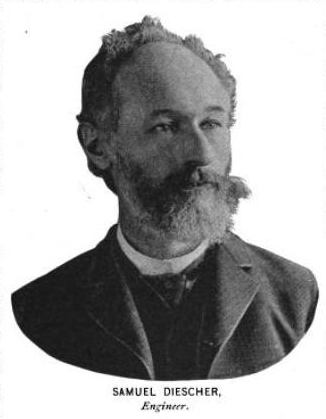
Of the many engineering features that are offered by Pittsburgh, there is no one that is likely to have more interest for a stranger than the inclined planes which afford access to the high lands that surround the city. There are eleven of these planes in the two cities; seven on the south side of the Monongahela river in Pittsburgh, two rising to the top of the central table in Pittsburgh proper, and two in Allegheny. The utility of these planes is especially apparent on the south side, where the rise of the bluffs is so abrupt that the summits are inaccessible, except by steep and circuitous roads. The first plane was built in 1870, and since that one went into operation they have increased steeply in favor. Nearly all of them carry teams as well as foot passengers, and on some of them the travel is very heavy. The rates of fare for foot passengers range from one to five cents. The principal dimensions and chief features of interest of each plane are presented briefly in the articles that follow and their position is indicated on the map, page 9. We also present, in this connection, a portrait of Mr. Samuel Diescher, the engineer who has designed and built most of the Pittsburgh inclines, as well as many others in various parts of the country.
THE MONONGAHELA INCLINES.
The oldest of the inclines, and the one that is likely to attract first attention on the South Side, is the Monongahela passenger incline, which rises from Carson Street, just below the southern end of the Smithfield Street bridge. This plane was designed and built by John J. Endres, in 1870, the original structure being of wood. In 1882 it was rebuilt, and the present iron structure, designed by Samuel Diescher, was then erected. The plane is 640 ft long, and is built on a grade of seventy-one and one-half per cent., with a total rise of 375 ft About 250 ft. of the lower portion of the structure is built over the tracks of the "Pan Handle" railroad, and this portion of the structure is built of five feet plate girders in spans of sixty feet. The remainder of (he plane is constructed of fifteen inch I beams, the supports being both piers and posts. The gauge is five feet, and the track is laid with forty-five pound steel T rails. The hoisting plant consists of two 12x20 ins. connected link motion engines, built by J. & J. B. Millholland, of Pittsburgh. Although one car ascends while the other descends, after the fashion of a gravity road, each car has a separate hoisting rope and drum. These drums are eight feet ten inches in diameter, made of cast iron with wooden lagging on the hoisting surface. This surface is plain with no grooves. The hoisting rope is one and one-quarter inches in diameter, made of crucible steel. The speed is about 600 ft. per minute, and the rope has an average life of five to seven years. This average fairly represents the life of cables on all of the inclines. There is a safety rope of the same size, which passes round a single large sheave at the top, from one car to the other. The cables are supported on the plane by rollers of gum wood. This incline is operated continuously, at five minute intervals during the day, and fifteen minutes during the late and early hours. The passenger traffic amounts to upwards of 1,000,000 per year. The cost of the original structure was about $75,000, and about $30,000 was spent in rebuilding.
Close beside the Monongahela passenger incline is the freight plane, owned by the same company. This was built by Endres in 1883, and cost about $125,000. The structure is similar to the passenger incline, but made stronger, to suit the required purpose. The lower portion, crossing the railroad tracks, is constructed of five foot riveted plate girders, and the rest of the structure is made of thirty inch riveted girders in spans of thirty feet. The gauge is ten feet, and a seventy pound steel T rail is used. The cars are built wholly of iron, with a floor space 17x32 ft. A great amount of heavy teaming goes over this incline, and the cars are calculated to carry a load of fifteen tons. The hoisting engines are a pair of 20x30 ins. Robinson & Rea engines, and the drums are cast iron, twelve feet in diameter, with wooden lagging. There are two hoisting ropes, two inches in diameter and made of crucible steel. The safety rope is the same size. The speed on this incline is 500 ft. per minute. The incline is operated from 7 A. M. to 7 P. M., but no regular interval is maintained between trips, the cars running whenever there is a load.
MOUNT OLIVER INCLINE.
The construction of the first Monongahela incline was immediately followed, in 1871, by the erection of the Mount Oliver plane, which rises from Twelfth and Frederick Streets to the summit of Mount Oliver, also on the South Side. This incline was originally constructed by Endres, with a wooden structure, but it was rebuilt in iron in 1875. The total length is 1,600 ft. and the total rise is 377 ft. There are two grades, the lower 400 ft. rising twenty per cent, and the balance twenty-five per cent. The difference is so small that the weight of the cables is sufficient to keep them down to the carrying pulleys. There is one hoisting rope one and one-quarter inches in diameter and a safety rope of the same size. The cars carry no teams, but accommodate thirty-five passengers with ease. The hoisting engines are 14x24 ins., and there are two drums of the pattern already described, eighteen feet in diameter. The gauge is five feet, and the hoisting speed is 600 ft. per minute. This is one of the best patronized and most profitable of the inclines, as may be judged from the published reports of the company. During the year ended June 30, 1890, there were dividends of $22,000 in cash and $16,000 in stock on a paid in capital of $54,000. This was done on a traffic of 1,269,668 passengers. The cost of the incline, including rebuilding, was about $150,000. The company also operates a short horse car line at the foot of the incline to connect with the Pittsburgh & Birmingham Traction Co s electric line on Carson Street, and at the top of the hill there is another short horse road.
|
DUQUESNE PASSENGER INCLINE.
The Mount Oliver incline was followed by the Duquesne Incline, also a passenger plane, which rises from Carson Street on the South Side, near the Point bridge. This incline was built by Samuel Diescher, and was opened in May, 1877. The first structure was part wood and part iron, but it was rebuilt entirely of iron in 1888. The total length is 780 ft., the grade is fifty-eight and one-half per cent, and the total rise is 400 ft Like the Monongahela inclines, the Duquesne crosses the Pan-Handle tracks, and the lower 300 ft. is built of five-foot riveted girders in spans of sixty feet, the remaining portion being constructed of twenty four inch riveted girders in thirty-foot spans. The gauge is five feet, and the rails are forty-five pound steel T. There is one hoisting and one safety rope, each one and one-quarter inches in diameter. The engines are a pair of Millholland engines, with cylinders 14x25 ins. A novelty of this incline is the location of the hoisting machinery at right angles with the plane,this method being adopted in order to save the purchase of an expensive piece of real estate at the head of the incline. With this arrangement a single drum suffices, as the spacing of the cables can be effected by the guide pulleys at the head of the incline. The one drum is all cast iron with grooved circumference. The cars carry forty passengers at one trip. The entire cost of this plant was about $55,000.
THE FORT PITT INCLINE.
The Fort Pitt incline rises to the central plateau of Pittsburgh from Second Avenue at about the point where Tenth Street would be if Providence had provided enough horizontal surface to build a cross street at this point. The incline was built by Samuel Diescher in 1882, and it rests on solid ground all the way, being built parallel with Second Avenue. The total length is 350 ft. and the rise is 135 ft. The gauge is ten feet and the rails are laid on cross ties with rock ballast, like a surface road, but the ties are fastened to 12x12 ins. stringers, making a solid and secure road bed. The cars are 16x38 ft, built of iron, the traffic of the incline being chiefly teams, and the hoisting capacity is fifteen tons. There are two hoisting ropes one and one-half inches in diameter and one safety rope of the same size. There are two fourteen foot wooden lagged cast iron hoisting drums, driven by a pair of 16x24 ins. engines, built by the Atlas works, Pittsburgh. The cost of this incline, as reported to the State, was $97,936, which is probably above the actual cost of construction.

|
THE PENN INCLINE.
The largest of all the Pittsburgh inclines, and probably the most heavily built plane in existence, is the Penn incline, which rises to the central plateau of the city, from Seventeenth Street, crossing the tracks of the Pennsylvania railroad by a heavy single span. The illustration of this incline (Fig. 1) gives an excellent general idea of the construction. This plane was designed by Samuel Diescher and was opened for business in 1883. When this incline was projected it was intended that it should carry coal to the top of the hill, the purpose being to take an ordinary car with twenty tons of coal to the top of the incline, and thus save the heavy cost of hauling small loads by horses over a long and steep road. This was the original plan and the incline was constructed to fill these requirements, but just about the time the plane was completed natural gas swept coal out of the way and the use of the incline for its first purpose was gone. It is nevertheless an interesting piece of engineering.
The total length is 840 ft., the angle is twenty-three degrees and the total rise is 330 ft. The Pennsylvania Railroad tracks are crossed by a single span of 232 ft; beyond this there is another span of 120 ft to reach the hillside, and the remaining portion of the structure is in sixty foot spans. The road bed is carried the entire length on heavy riveted plate girders, five feet deep. The rails are sixty pound steel T, spiked to 10 x 12 ins. white oak ties.
There is a powerful hoisting plant, consisting of a pair of 24x36 ins. engines, built by the Scaife Foundry & Machine Co. The drums are of cast iron, grooved for ropes, and eighteen feet in diameter. The cars are heavily built of iron, with floors 16x38 ft. There are three cables, two two and one-quarter inch hoisting ropes, and one two inch safety rope. The cables are supported on the incline by ten inch grooved cast iron pulleys. The gauge is ten feet. The entire structure is very massive in its construction, over 750 tons of iron being used in the bridge work alone, but the structure has considerable gracefulness in its bold step from the street to the hillside. The entire cost of the structure was about $320,000. The incline is used for both freight and passenger traffic, but the amount of travel has never been equal to expectations. From the top of the incline there is a superb view of Allegheny and the northern side of Pittsburgh.
THE TROY HILL PLANE.
The first inclined plane in Allegheny was the Mount Troy Incline, which starts at the Allegheny end of the Thirtieth Street bridge and climbs Troy Hill. This incline was also built by Samuel Diescher, who has built nearly all of the inclines in this country, and was completed in 1887. The total length is 370 ft., and the grade is forty-seven per cent. The tracks are laid partly on the ground and partly on wooden trestles. The incline is intended for both freight and passengers, and the cars are 16x38 ft on the floor, a portion of which is occupied by a cabin for passengers. The capacity is fifteen tons. The hoisting machinery consists of a pair of Scaife engines 16X 24 ins., and two wooden lagged cast iron drums twelve feet in diameter. There is one hoisting rope and one safety cable, each one and one-half inches in diameter. The Thirtieth Street bridge is also owned by the same company. The cost of the incline is figured at $94,047 in the reports of the company.
THE NUNNERY HILL INCLINE.
The second of the Allegheny inclines ascends Nunnery Hill from Federal Street on the line of the Pleasant Valley railway. This is one of the recent inclines, having been built in 1887 by Samuel Diescher. It is used for passengers only, and has a total length of 1,100 ft, with a rise of about 300 ft There are several grades, ranging from sixteen to twenty-six per cent, and there is a curve of 250 ft radius, making an angle of seventy degrees in the direction of the plane. The structure is of wooden trestle work throughout. The cars hold twenty-four passengers, and the hoisting is done with a single drum fourteen feet in diameter, made of cast iron and grooved for the rope. Owing to the easy grade of the incline, a single one inch hoisting cable is of sufficient strength, and this is supplemented by a seven-eighths inch safety rope. The drum is driven by a pair of 12 x 16 ins. Scaife engines. The single fare on this incline is five cents, and tickets are sold in packages of seventy-five for $1.50. The cost of the plane and equipment is reported by the company at $90,000.
ST. CLAIR INCLINED PLANE.
This incline is built much after the fashion of an ordinary steam railroad, as it lies on the ground all the way. It rises from Josephine Street on the south side to the summit of the bluff, a total distance of 2,060 ft., with a rise of 361 ft. The incline is not a perfect plane, but is really a section of a parabola. This incline was built in 1886, by J. H. McRoberts, of Pittsburgh, and is used for both freight and passengers. The gauge is seven feet, and the rails are forty-five pound steel T, spiked to white oak ties. The lift ing capacity is twenty-five tons. There is a single hoisting drum sixteen feet in diameter, with cast grooves. This is driven by a pair of 14x30 ins. Robinson-Rea engines, an intermediate countershaft being used between the engines and drum. There is a hoisting rope and a safety rope, each one and three-quarters of an inch in diameter. The cost of this incline was about $60,000.
THE KNOXVILLE INCLINE.
The longest of all the inclines is the Knoxville, which is located near the St. Clair incline, starting from Bradford Street, at the foot of the hill, and rising to Brownsville and Washington Avenues, at the top of the hill. This plane has a total length of 2,640 ft. and a rise of 375 ft. It was built by J. H. McRoberts, in 1890, and has been one of the most successful of these institutions in the two cities. The lower portion of the structure, for a distance of 980 ft. from the bottom, is built of iron bridge work in spans of twenty to seventy feet of plate girders, twenty-four to fifty-six inches deep. Above this the incline is built on solid ground. At a point about 1,000 ft. from the bottom the tracks make a curve of eighteen degrees to the right, this curve continuing 350 ft. The cables are carried round this curve on thirty-six thirty inch pulleys on each track. The gauge is nine feet, and sixty pound steel T rails are used. On the iron structure 8 x 14-ins. oak ties are used, laid sixteen inches between centres, and on the ground the ties are 6x8 ins., laid two feet between centres and fastened to heavy stringers.
The hoisting engines are 18x36 ins., connected to the drum shaft by a pinion and spur gear. There are two drums, one twelve and one-half feet in diameter and the other a trifle larger, in order to compensate for the additional length of cable required for the outer track of the curve. The drums are cast iron, with grooves, and in winding the cables lap back upon themselves once. This is the only incline on which this occurs. The hoisting and safety ropes are both one and three-quarter inches in diameter. Although the different lengths of hoisting cables are compensated by the different diameters of the drums, a different method of compensation is required for the safety rope, which is continuous and attached to both cars. This is accomplished by an ingenious arrangement designed by Mr. McRoberts. The cars are 16x47 ft. on the floor and will carry fifty tons. The fare is only one cent and there is a very heavy travel, both of foot passengers and wagons. The Suburban Rapid Transit electric road connects closely with the upper end of the incline. The cost of the incline and equipment was about $190,000.
THE CASTLE SHANNON INCLINES.
The inclines of the Pittsburgh & Castle Shannon Railroad are among the most interesting of the inclined roads. This railroad is a narrow gauge (forty inches) line running from the south side of Pittsburgh to Arlington, a distance of six and one-half miles. The road reaches Carson Street through a tunnel 1,700 ft. long, but the completion of the inclines will do away with the use of the tunnel, at least for passenger service. The first incline, which was built last year by Samuel Diescher, extends from Carson Street to Bailey Avenue on the hill top, a total length of 1,375 ft.
The grade is thirty-seven and seven-tenths per cent, and the total rise is 451 ft. The gauge is ten feet, and the the track is laid with sixty pound steel T rails. Most of the incline is built on solid ground, but about 300 ft. of the structure is built in spans of sixty feet, of riveted plate girders five feet deep. The cars are for freight and passengers, a cabin being built for passengers. The hoisting capacity is twenty tons, and there is one hoisting rope two and one-quarter inches in diameter, with a safety rope two inches in diameter. There is only one hoisting drum, which is made of cast iron and grooved. This is driven by a pair of Robinson-Rea engines, with cylinders 18x24 ins. The hoisting machinery lies at an angle of seventeen degrees with the inclined tracks. The cost of this incline was about $160,000.
Castle Shannon Incline No. 2, which is now being constructed by the same engineer, partakes more of the nature of a cable road than an inclined plane, as the grade is comparatively light, and an endless cable is used to draw a train of cars. This incline is on the opposite side of the hill, and is intended to bring a train of six loaded narrow gauge passenger cars from the railroad to the top of the hill,' where passengers may change to the No. 1 incline and descend to the city. This inclined road will be 2,112 ft. long, with a drop of 185 ft. in that distance. The estimated cost of this plane is about $60,000.
Go to top of page.
Johnstown Inclined Plane

|
A brochure from the Johnstown Inclined Plane. |
On 31-May-1889, the South Fork Dam situated on the Little Conemaugh River failed and sent a wall of water towards Johnstown, 14 miles down the valley. More than 2200 people died. Inspired by the Johnstown Flood, the Cambria Iron Company built a funicular to allow people to reach a housing development on Yoder Hill and to allow people and vehicles to be more easily evacuated in the event of a flood. The inclined plane performed well during floods on 17-March-1936 and 19-20-July-1977.
Engineer Samuel Diescher designed the Johnstown Inclined Plane. Diescher also designed and built several Pittsburgh Inclines.
The incline started service on 01-June-1891. The line was operated by the Cambria Iron Company, and was generally called the Cambria Incline. Cambria's successor, Bethlehem Steel, sold the operation to the Borough of Westmont for one dollar in 1935. In 1962, Bethlehem stopped supplying electricity to the incline, so the line was shut down for a time. The Borough sold the line to the Cambria County Transit Authority (CamTrans) for one dollar in 1983. CamTrans rebuilt the line in 1984.

|
A postcard view of a car on the Johnstown Inclined Plane. People rode on the lower level with the windows and wagons and teams rode on the upper level with the large opening. January 2024 Picture of the Month. |
The original cars were double deckers, with people riding below and wagons and teams riding above. I hope the floor of the upper deck did not leak. Since 1921, the cars have been single deckers, with people riding on one side and vehicles on the other.
The official Johnstown Inclined Plane website. The incline is currently operated by the Cambria County Transit Authority (CamTrans). The incline is used by commuters and tourists.
The Johnstown Inclined Plane closed for a major rehabilitation project on 07-July-2021. The original plan was that it would reopen in Spring, 2023. Delays in the delivery of sheave wheels pushed the reopening to some time in 2024. At long last, the incline reopened on 10-September-2026, with a month of free rides.
The work was financed by part of a United States Department of Transportation Rebuilding American Infrastructure with Sustainability and Equity (RAISE) grant of $24.4 million dollars.

|
A postcard view of the Johnstown Inclined Plane. |

|
Another postcard view of the Johnstown Inclined Plane. January, 2014 Picture of the Month. |

|
An ad for the 6th Annual Halloween on the Hill at the Inclined Plane. |

|
A 2023 update about the rehabillitation of the Inclined Plane. It did not reopen in 2023. |

|
A 2024 update about the resumption of the rehabillitation of the Inclined Plane. It did not reopen in 2025. |

|
A 2026 announcement about the postponement of the 04-September-2026 reopening of the Inclined Plane. |

|
An announcement about the reopening of the Inclined Plane. |
|
|
Read about American inclined railroads in an interesting article from Cassier's Magazine. (Source: "American Inclined Plane Railways," by Samuel Diescher, Cassier's Magazine, June, 1897.) |
Go to top of page.
Mauch Chunk Switchback Railway

|
A postcard view of the Mauch Chunk Switchback Railway shows both the Mount Pisgah and Mount Jefferson inclined planes. February, 2024 Picture of the Month. |

|
A postcard view of the Mauch Chunk Switchback Railway. "Mount Jefferson plane." February, 2014 Picture of the Month. |
The Mauch Chunk Switchback Railway is often called the second oldest railroad in the United States. I guess this is true if we don't count early experimental lines. The only older permanent railroad in the United States would have been the Granite Railway in Massachusetts, which began service in 1826. The Mauch Chunk line began service in 1827, built by the Lehigh Coal and Navigation Company to haul anthracite coal from mines around Summit Hill to the Lehigh River at Mauch Chunk, Pennsylvania. Since about 1953, Mauch Chunk has been called Jim Thorpe -- long story. The Lehigh River had been improved with dams and locks to allow barges to carry coal down the river to Philadelphia.
A string of loaded coal cars, carrying some mules as well, could coast down from Summit Hill in about 30 minutes. After the coal was dumped into a tipple by the river, the mules would pull the cars back up the hill. This took four hours. The imbalance limited what we now call throughput.
A new up or back track, built in 1846 by Josiah White, used steam-powered inclines at Mount Pisgah and Mount Jefferson to haul the trains of empties up to Summit Hill. Trains continued to traverse the old down track using gravity. They also coasted five miles between the two inclines on the up track.
People became interested in riding the unique line and it grew into a tourist attraction. At one point, the line handled coal in the morning and tourists in the afternoon.
By about 1871 or 1872, the Panther Creek Railroad, which had a tunnel, gave access to the mines without using the switchback gravity railroad. The Lehigh Coal and Navigation Company sold the switchback gravity railroad to the Central Railroad of New Jersey, which leased the line to tourist operators.
At the station in Mauch Chunk, at the bottom of the Mount Pisgah incline, passengers would board an open-sided cross-bench car. The car would coast out of the station to the bottom of the Mount Pisgah incline. At the bottom of the incline, the conductor would pull a wire cable that ran on poles to the powerhouse at the top. This would ring a bell to let the engineer know to start the steam engine. Instead of a cable, the engine wound up a chain or band made of linked iron plates. The chain would pull a small car called a barney out of a pit between the rails. The barney would push the passenger car up the incline.
As the car climbed the incline, a metal lever, like a dog, hinged on the car, would run in a ratchet between the wheels. If the car had became separated from the chain or band, the dog digging into a hole of the ratchet, would have prevented it from rolling back. This system is basically the anti-rollback device still used on roller coasters.

|
A postcard view of the Mauch Chunk Switchback Railway. "Showing Return Track at Five Mile Tree." The overpass of the Back Track is visible beyond the car. |
The passenger car would pass through the engine house at the top, and continue down the back track by gravity five miles to the foot of the Mount Jefferson incline. The back track crossed above the down track at a point called Five Mile Tree.
Another barney would push the passenger car up the Mount Jefferson incline to another short gravity run to the end of the back track, at Summit Hill. After a short stop, the passenger car would begin its long gravity run on the old Down Track. The Down Track passed under the Mount Jefferson incline, and under the Back Track at Five Mile Tree.
On a long stretch of straight track, the cars would exceed fifty miles per hour.
The switchback railroad was a great success for many years until the Great Depression. The railroad stopped running in 1932 and was scrapped later in the 1930s.
Gravity runs appeared on many Nineteenth Century railroads and transit lines. On at least three horse car lines, a horse or mule would pull the car to the top a hill, and the horse or mule would ride down the hill on a trailer or the back platform of the car.

|
John Bogue, driver, stands on the front platform of Denver's Cherrelyn horse car. The horse stands on the back platform. |
Outbound cars of San Francisco's Powell Street cable lines have to drop the cable when they cross the former California Street Cable Railroad line at Powell and California. Because they would have also had to drop the cable at Sacramento and Clay street for the Market Street Railway's Sacramento/Clay line, the Powell Street cars coast down the hill three blocks to the block between Washington and Jackson, where they stop to pick up the Mason Street cable or the Hyde Street cable.
North of San Francisco, the Mount Tamalpais and Muir Woods Railway, the Crookedest Railroad in the World, carried passengers from Mill Valley to Mount Tamalpais, using geared locomotives, from 1896 to 1930. In 1902, the company began to operate gravity cars from the top of the mountain down the Muir Woods branch. This was a very popular ride. In 2009, the Friends of Mount Tamalpais opened a tiny museum at the summit. The Gravity Barn contains a reproduction of a gravity car.

|
A postcard card shows a Mount Tamalpais and Muir Woods Railway gravity train as it passes down the mountain from the summit to Muir Woods. |
Oakland's Consolidated Piedmont Cable Company operated a unique gravity loop to reach Blair Park in Piedmont.

|
A cable car pauses on the gravity loop at the entrance to Blair Park. From "Picturesque Piedmont," an 1891 San Francisco Call article. See this and other newspaper articles about the gravity loop. May, 2009 Picture of the Month. |
The Switchback Gravity Railroad Foundation proposes "rebuilding a portion of the historic Switchback Gravity Railroad on Mt. Pisgah plane and summit for the enjoyment of visitors and locals alike. Mt. Pisgah’s scenic vistas are spectacular, and the SGRF hopes to make those views accessible to the general public and to interpret the historic sites on Mt. Pisgah."

|
A postcard view of the Mauch Chunk Switchback Railway. |

|
A postcard view of passengers waiting at the Mauch Chunk Switchback Railway station. |

|
| From The Official Railway Guide: North American Freight Service Edition by American Association of Passenger Traffic Officers, 1908. |
|
|
Read about American inclined railroads in an interesting article from Cassier's Magazine. (Source: "American Inclined Plane Railways," by Samuel Diescher, Cassier's Magazine, June, 1897.) |
Go to top of page.
Allegheny Portage Railroad

|
"Ascending an Inclined Plane." Source: History of the Pennsylvania Railroad Company by William Bender Wilson, 1895. March 2024 Picture of the Month. |
The Alleghany Mountains separate eastern and western Pennsylvania, cutting Philadelphia in the east from Pittsburgh, with its river access to the Mississippi basin in the west. New York state had built the Erie Canal in about 1817-1825 to give access to the Great Lakes. This quicker, cheaper access to the west gave New York City a leg up on all other financial centers in the country. In order to compete, the state of Pennsylvania create the Main Line of Public Works.
The Main Line of Public Works had five main pieces:
- The Philadelphia and Columbia Railroad, which connected Philadelphia with the Susquehanna River at the town of Columbia in Lancaster County.
- The Eastern Division Canal, which ran from Columbia to the Juniata River at Duncan's Island.
- The Juniata Division Canal, which ran from Duncan's Island to Hollidaysburg in in Blair County.
- The Alleghany Portage Railroad, which ran across the mountains to Johnstown in Cambria County.
- The Western Division Canal, which ran from Johnstown to Pittsburgh.
The whole Main Line of Public Works was finished in 1834.
The Philadelphia and Columbia Railroad used inclined planes to climb up from the Schuylkill River across from Philadelphia and down to Columbia. The Belmont Plane climbed up from the Schuylkill and the Columbia Plane climbed down to Susquehanna. In 1836, William Norris' locomotive George Washington proved it could climb the Belmont Plane pulling a load without cable assistance. In 1840, the western end was realigned to bypass the Columbia Plane.
The Alleghany Portage Railroad used 10 inclines, separated by stretches of railroad, to haul canal boats across the Alleghany Mountains. Horses pulled the barges, mounted on railroad cars, along the flat sections. In later years, locomotives also worked the sections between the planes.
Two steam stationary engines were at the top of each plane, but only one was used at a time to move the endless rope which pulled the boats. The line initially used hemp ropes, but had many problems with fraying and twisting. The line started using wire ropes, made by John Roebling, in 1844.
In 1835, the railroad sections were double tracked to improve traffic flow.
In 1856, the New Portage Railroad, bypassing the inclines, opened for service, but it had already been rendered obsolete by the opening of the Pennsylvania Railroad's line across the Allegheys in 1854.
The Pennsylvania Railroad purchased the New Portage Railroad from the state in 1856. It continued to use parts of the old line, but none are currently used.
The National Park Service operates the Allegheny Portage Railroad National Historic Site.

|
"The Conemaugh near New Florence." Source: History of the Pennsylvania Railroad Company by William Bender Wilson, 1895. |
from A Geography of Pennsylvania by Charles B Trego, 1843P. 155-156 Allegheny Portage Rail Road. This road commences at Hollidaysburg, the western termination of the Juniata canal, and crossing the Allegheny mountain by the summit at Blair's Gap, descends to the valley of the Conemaugh, down which it proceeds to Johnstown and there meets the Western Division of the Pennsylvania canal. On this road there are ten inclined planes, numbered from Johnstown eastward, and eleven "levels," or graded lines of road, the inclination of which is generally from 10 to 15 feet to the mile, except that between Johnstown and the first plane, where it is about 24 feet, and that between the eastern plane and Hollidaysburg, where the maximum is 52 feet. The summit at Blair's Gap is 2,325 feet above the level of mean tide; the ascent from Hollidaysburg to the summit is 1,398 feet in a distance of ten miles, and the descent to Johnstown 1,171 feet in a distance of 26 1/2 miles. There are five inclined planes on each side of the summit; the longest being No. 8, or the third one west of Hollidaysburg, which is 3,117 feet in length, with a rise of 307 1/2 feet; and the shortest, No. 3, the third east of Johnstown, 1,480 feet in length, rising 130 1/2 feet. At the head of each inclined plane are two stationary engines of about thirty-five horse power each, which move the endless rope to which the cars are attached. Four cars, each loaded with a burden of 7000 pounds, can be drawn up at once, and as many let down at the same time; this operation can be performed from six to ten times in an hour. An ingenious contrivance, called a safety car, is attached to the rope below the road cars, which stops them in case of accident to the rope or fastenings. But one of the stationary engines is used at a time; the other being provided in order to prevent delay from accidents or repairs. On the short levels between the planes, horses are used for drawing the cars; but on the longer ones locomotives are preferred. A viaduct over the Conemaugh, about eight miles east of Johnstown, is much admired for its boldness and beauty of design and execution. It is a single arch of 80 feet span, at a height of 70 feet above the water of the stream. In order to pass through an abrupt ridge near the head of the first plane east of Johnstown, a tunnel has been constructed 901 feet in length, 20 feet wide, and 19 feet high within the arch. The entrances have ornamental facades of cut stone, and the tunnel is arched with stone for 150 feet from each end, beyond which the rock is sufficiently solid to form a roof. This road was opened for use in March, 1834. Length 36 1/2 miles. Cost $1,783,176. Revenue to 1840, rail road tolls $413,504, motive power $443,480: expenditures, road $293,135, motive power $539,507, engines, ropes, &c. $122,236. |
from American Notes for General Circulation by Charles Dickens, 1842Charles Dickens visited American on a lecture tour in 1842. He wrote American Notes for General Circulation about his experiences, including a ride on the Alleghany Portage Railroad. P. 192-193 We had left Harrisburgh on Friday. On Sunday morning we arrived at the foot of the mountain, which is crossed by railroad. There are ten inclined planes; five ascending, and five descending; the carriages are dragged up the former, and let slowly down the latter, by means of stationary engines; the comparatively level spaces between, being traversed, sometimes by horse, and sometimes by engine power, as the case demands. Occasionally the rails are laid upon the extreme verge of a giddy precipice; and looking from the carriage window, the traveller gazes sheer down, without a stone or scrap of fence between, into the mountain depths below. The journey is very carefully made, however; only two carriages travelling together; and while proper precautions are taken, is not to be dreaded for its dangers. It was very pretty travelling thus, at a rapid pace along the heights of the mountain in a keen wind, to look down into a valley full of light and softness: catching glimpses, through the tree-tops, of scattered cabins; children running to the doors; dogs bursting out to bark, whom we could see without hearing; terrified pigs scampering homewards; families sitting out in their rude gardens; cows gazing upward with a stupid indifference ; men in their shirt-sleeves looking on at their unfinished houses, planning out to-morrow's work; and we riding onward, high above them, like a whirlwind. It was amusing, too, when we had dined, and rattled down a steep pass, having no other moving power than the weight of the carriages themselves, to see the engine released, long after us, come buzzing down alone, like a great insect, its back of green and gold so shining in the sun, that if it had spread a pair of wings and soared away, no one would have had occasion, as I fancied, for the least surprise. But it stopped short of us in a very business-like manner when we reached the canal; and, before we left the wharf, went panting up this hill again, with the passengers who had waited our arrival for the means of traversing the road by which we had come. |

|
"Ruins of Old Portage Roadbed." Source: History of the Pennsylvania Railroad Company by William Bender Wilson, 1895. |

|
"Conemaugh Viaduct." Source: History of the Pennsylvania Railroad Company by William Bender Wilson, 1895. |

|
"Allegheny Portage Tunnel -- West Facade." Source: History of the Pennsylvania Railroad Company by William Bender Wilson, 1895. |

|
"Old Passenger Car, Portage Railroad." Source: History of the Pennsylvania Railroad Company by William Bender Wilson, 1895. |
Go to top of page.
Horseshoe Curve Funicular

|
A postcard view of the Pennsylvania Railroad's famous Horseshoe Curve about 1919. |
Go to top of page.