
|

|
|
|
- What Is In a Name?
- What Is a Horse Car?
- What Was the First Horse Car?
- Horse Cars Spread Out
- Putting the Horse Car Before the Horse
- What Happened to the Horse Cars?
- Horse Cars in San Francisco
- Horse Car Lines in Florida
- Motion Pictures Which Feature Horse Cars
- Horse Car Collectibles
- Horse Car Tokens
- Where Can I Ride a Horse Car?
- Walt Disney World's Main Street Horse-Drawn Streetcar - a new book by David Leaphart
- Horse Car Bibliography
If you came to this page from an outside link, you may want to see the Picture of the Month and visit my main page.
What Is In a Name?
I have seen horse cars called by different versions of the name:
- horse car
- horse-car
- horsecar
The most commonly used term in current times seems to be "horsecar". It is the name I have used many times in my websites. However, in preparing for this article, I surveyed Nineteenth Century literature and have found that "horse car" and "horse-car" were far more commonly used. So on the analogy of "cable car", I have decided to use "horse car".
Go to top of page.
What Is a Horse Car?
Before cable cars, there were horse cars. A horse car is a horse- or mule-drawn transit vehicle which runs on rails. Horse cars replaced omnibuses, which were essentially urban coaches, which had a slow, rough ride on the cobbled or unpaved streets of the Nineteenth Century. The minimal friction of steel wheels on steel rails (or iron on iron) allowed a horse to pull a larger load and make better time than he could with a road vehicle.

|
A John Stephenson ad shows a bob-tailed car, a standard car, and an omnibus. |
Tramways had used animal power, human, horse, or other, to pull or push carts which ran on wood or stone rails as early as the 16th century. The Baltimore and Ohio Railroad, which is considered America's earliest common carrier railway, began by using horses to pull its trains. Steam power did not begin to become common on railroads until well into the 1830's.

|
Around 1830, the pioneering Baltimore and Ohio Railroad, which had used horses to pull its trains, tried a locomotive in which the horse walked on a treadmill, which drove the wheels through gearing. |
Go to top of page.
What Was the First Horse Car?

|
John Mason, which is considered by many to be the first horse car. |
On 27-November-1832, a horse-drawn railcar named "John Mason", built by a young carriage-builder named John Stephenson, rolled down the New York and Harlem Railroad's Fourth Avenue line. When the railroad requested a franchise to operate the line, it was required to use horses rather than steam locomotives. John Mason was the first president of the New York and Harlem Railroad and the founder of the Chemical Bank. Many consider the John Mason to be the first horse car.
The Fourth Avenue horse car line was not a success. Steam-driven trains replaced the horse cars in 1837. Horses returned to Fourth Avenue in 1845, but no further lines were built until 1852. John Stephenson went on to build transit vehicles for the rest of his life.
People may question whether the Fourth Avenue line was truly a horse car line, and the John Mason was truly a horse car, since many mainline railroads were using horses. At least we know the date it first ran.
|
From Wonders and Curiosities of the Railway by William Sloane Kennedy, 1884. p 169-170. The first street railway in the world was the New York and Harlem, incorporated 1831. The first cars were run in November, 1832 from Prince street to Harlem Bridge. These cars were curious structures, from the point of view of people of this generation -- being very much like the stage coaches of the time, each having three compartments with side doors; there were leather springs, and the driver sat on an elevated seat in front, and moved the brake with his foot. The car represented in the cut was one of the first two that were built for the Harlem line, and was made by John Stephenson. The opening of the road, says W. H. Brown, excited a good deal of interest, and the streets along the route were crowded with curious spectators. The bright new car, the "John Mason," led the way, and the ribbons were handled in gallant style by a well known knight of the whip, named Lank O'Dell, who always drove a pair of gray horses. Both the cars that figured on the occasion contained city officials (the mayor and members of the city council) and invited guests. It was thought by many that there would be great difficulty in stopping the cars quickly enough to avoid accidents to street vehicles. But the vice-president of the road, being very desirous of convincing people how ungrounded were their fears in this regard, determined to give them ocular proof of the ease with which the cars could be brought to a dead stop. So on the trial day, he posted himself with a number of witnesses somewhere about the corner of the Bowery and Bond street, having previously ordered the drivers of the two cars to watch for his signal, and then stop the cars with all the haste they could. Now, when O'Dell came dashing along and saw the signal, he easily brought up the car, since he had previously some experience in hauling materials for the road; but the hackman who drove the second car, forgetting the lever of the brake, only drew hard on his lines and shouted, "Whoa!" But in vain; his car slid inexorably forward, and the tongue went crashing through the rear end of the "John Mason," causing the dignified inmates to beat an unceremonious retreat, amid the laughter of the bystanders. No one was hut, however, and soon the triumphal train moved on to Harlem Bridge. This is the first street-car collision on record, and it occasioned a good deal of merriment among the citizens, and considerable annoyance to the vice-president; since for several days afterward, the roguishly inclined among his friends would imitate his attitude and gesture on that unlucky street-corner, and raise their arms for him to stop, as he had done to the car-drivers. The fares were paid in silver sixpences of the old Spanish currency then in circulation. In 1837 the road temporarily succumbed to steam cars, but resumed work in 1845. The old Harlem Railroad Corporation still owns the right of way through the Bowery and Fourth avanue, and receives a large income from the street railraod, as well as from the Hudson River and the New Haven railroads, in return for a cession to them of right of way. |

|
An 1886 John Stephenson ad shows the John Mason and a modern horse car. November, 2007 Picture of the Month. |
Go to top of page.
Horse Cars Spread Out

|
A Grand Rapids, Michigan horse car. |
When horse cars were revived in the 1850s, they quickly spread across the United States, and to many other countries. Manhattan went on to have the longest and most heavily patronized set of horse car lines in the country.

|
This 1887 Carter-built horse car ran for the Oakland Railroad and then a line in Berkeley. It is preserved at Ardenwood Historic Farm. The Society for the Preservation of Carter Railroad Resources (SPCRR) hopes to build new running gear to replace the rubber tires. September, 2006. |

|
An end view of the horse car at Ardenwood Historic Farm. September, 2006. |

|
This horse car, built around 1880 and preserved at Travel Town in Griffith Park, ran in Los Angeles. It needs restoration. July, 2007. |
Go to top of page.
Putting the Horse Car Before the Horse
From 1883 to 1910, an unusual horse car line ran in Englewood, south of Denver, Colorado. A horse pulled a car from Hampden and Broadway up a steep hill on Broadway to Quincy. At the top of the hill, the horse backed onto the rear platform, and the car proceeded down the hill by gravity. This line became a major tourist attraction and was a popular subject for postcards. I understand the car is still on display in the Englewood Civic Center.
Similar lines ran in West Denver and Southern California.
It is a popular story that when the horses used on these lines were sold to farmers, that they would pull plows uphill, but not down.

|
John Bogue, driver, stands on the front platform. The horse stands on the back platform. |
Go to top of page.
What Happened to the Horse Cars?
Horse cars spread rapidly, but they had problems.
- Horses deposited tons of feces and gallons of urine on the streets every day
- A horse could work only part of the day, but would eat all day
- A horse car could run all day, but it would require many changes of horses
- A line's investment in horses could be wiped out by diseases like the Great Epizootic of 1872.
- Horses could not pull cars up steep hills
Busy lines like those in Chicago found it very expensive to maintain service with horse cars. They found cable cars to be cost effective, despite their much higher intial cost. Read P. G. Hubert, Jr's article The Cable Costs much Less to Run than Horse Cars.
Cable cars were too expensive for most cities, but electric streetcars were inexpensive enough to operate in cities and towns of almost every size.
These tables, from a January, 1889 Manufacturer and Builder Magazine article, "The Bentley-Knight Electric Railway System", are probably a bit skewed because they were intended to promote electric traction over horse or cable, but they give an idea of the cost ineffectiveness of the horse car.
* Car bodies cost from $700 to $1,200.
|
By the beginning of the Twentieth Century, almost all horse car lines in the United States had been converted to electric operation. There were few survivors.
The Bleecker Street horse car line continued to operate in Manhattan until 26-July-1917. Read a newspaper report about the last trip.

|
This postcard says it shows the last horse car in New York, photographed at Broadway and Bleecker on 26-July-1917. Note the horse car behind it. |
The Sarah Street line in Pittsburgh, Pennsylvania, was the last regularly operated transit line operated with horse cars in the United States, running until 27-October-1923.

|
This item from the 19-June-1923 Indianapolis Times interviews FB Campbell, the "Skipper" of Pittsburgh's last horse car. Transit systems that were rickety, either physically or financially, were often referred to as "Toonerville Trolleys." |
Horse cars continued to operate in Central America for many years.

|
This mule car was photographed in Matamoros, Tamaulipas, Mexico around 1910. |
Go to top of page.
Horse Cars in San Francisco

|
An Omnibus Railroad horse car passes South Park, on Third Street (Source: San Francisco Public Library, San Francisco Historical Photograph Collection, AAC-8187). |
San Francisco's first horse car line was the Omnibus Railroad, which started operations in 1861. It operated broad gauge lines on Third Street and Howard Street. Many other operators started within the next few years, including the North Beach and Mission and the Central Railroad.

|
Union Hall, on Howard near Fourth. The ground floor was used by the Omnibus Railroad as a horse car barn from 1862 until 1895, when the horse lines were converted to electric (Source: [group 8:73], Roy D. Graves Pictorial Collection, ca. 1850-ca. 1968, BANC PIC 1905.17500--ALB, The Bancroft Library, University of California, Berkeley). |
Horse car lines were limited to relatively flat streets, although Andrew S Hallidie is claimed to have conceived of the idea of the cable railway while watching horses struggle to haul cars up Jackson Street, from Kearny to Stockton Street. The horses had to be whipped cruelly. They would sometimes slip and be dragged back down the hill.
The Sutter Street Railroad, unprofitable as a horse car line, became a great success as a cable car. Read more about it in "The Sutter Street Railway - San Francisco's Second Cable Car Line" by Walter Rice and Emiliano Echeverria.

|
Henry Casebolt built the famous balloon car for the Sutter Street Railroad in 1876. It saved the expense of building a turntable at the end of the line. (Source: San Francisco Public Library, San Francisco Historical Photograph Collection, AAC-8118). |
Cable car operating companies used horse cars to operate service in less-populated areas. After electric traction became common, a few horse car lines survived to protect franchises. Read an 11-March-1906 newspaper article about Michael Houlihan, who drove the United Railroads' franchise-protecting horse car line on California.

|
Mayor Rolph holds the reins of the last franchise-holding horse car on Sutter Street on 03-June-1913. The startled horses pulled a heavier load than they had in many years. (Source: San Francisco Public Library, San Francisco Historical Photograph Collection, AAC-8182). |
The Sutter Street Railway's horse car line which connected the end of the cable line at Sutter and Market with the Ferry Building, survived the conversion of the cable cars after the 1906 Earthquake and Fire. The city fought with the United Railroads over ownership of the outer tracks used by the horse cars. The horse cars survived until URR made a deal with the city. The last run on 03-June-1913 turned into a mob scene as Mayor Sunny Jim Rolph took the reins of car 45 and drove the car all the way to the barn with a much larger crowd than the horses had ever pulled. Read an 04-June-1913 newspaper article about the last horse car to run in San Francisco in regular service.
|
|
Mayor Rolph gives some oats to one of the horses (Source: "After Years of Waiting Last Horsecar is Driven to Barn, While Thousands Line Route", San Francisco Call, 04-June-1913). |
So far, the last horse car to operate in San Francisco was Sutter Street trailer 54, which operated on the outer tracks on Market Street in a parade after the last streetcar lines used the tracks in July, 1949.

|
Central Railroad 7. July, 2014. |
In August, 2014, we visited the History Park at Kelley Park in San Jose. In the Trolley Barn, we saw Central Railroad 7, an 1863 San Francisco horse car built in New York by John Stephenson and shipped around the Horn. I had a nice chat with the docent about its operation. They used to borrow Tucker and Jiggs from Ardenwood, but now a man from Placerville brings down two Clydesdales.

|
Central Railroad 7. The rear platform. July, 2014. |

|
Central Railroad 7. A detail of the curved roof and door. July, 2014. |
Go to top of page.
Horse Car Lines in Florida
Robert Mann is the author of The Streetcars of Florida's First Coast (2014, History Press). Thank you to Robert for sharing this list of Florida's horse car lines. He mentioned that it can take a lot of detective work to find information about early transit lines. More lines may turn up in the future. Some of the lines were converted to electric traction and some of the lines were abandoned.
| Name | Date of Incorporation (If Known) | City | State |
| Altamonte Springs Street Railway | -- | Altamonte Springs | Florida |
| Arcadia Street Railway and Improvement Company | 1881 | Arcadia | Florida |
| Bartow Street Railway | 05-August-1885 | Bartow | Florida |
| Fort Meade Street Car Company | 01-January-1887 | Fort Meade | Florida |
| Gainesville Street Railway | -- | Gainesville | Florida |
| Green Cove Street Railway | 03-August- 1891 | Green Cove Springs | Florida |
| Jacksonville Street Railway | 1880 | Jacksonville | Florida |
| Jacksonville and LaVilla Street Railway | 24-January-1885 | Jacksonville | Florida |
| Pine Street Railway (became-Main Street Railway) 1882 | -- | Jacksonville | Florida |
| Jacksonville and Suburban Street Railway | 01-July-1882 | Jacksonville | Florida |
| Key West Street Railway | 1881 | Key West | Florida |
| Leesburg Rapid Transit Company | -- | Leesburg | Florida |
| Mulberry Street Railway | -- | Mulberry | Florida |
| Ocala City and Suburban Street Railway | 1888 | Ocala | Florida |
| Orlando Street Railway | -- | Orlando | Florida |
| Florida East Coast Ormond | -- | Hotel Ormond Beach | Florida |
| Florida East Coast PaIm Beach Hotel Line | -- | Palm Beach | Florida |
| Palatka and Heights Street Railway | -- | Palatka | Florida |
| Panacea and Sopchoppy Railway | -- | between Panacea and Sopchoppy | Florida |
| St. Augustine and South Beach RaiIway | -- | St. Augustine | Florida |
| St. Augustine and North Beach RaiIway | -- | St. Augustine | Florida |
| Tallahassee Street Railway | -- | Tallahassee | Florida |
| The Winter Park Company | 06-February-1885 | Winter Park | Florida |
The Panacea and Sopchoppy Railway has my favorite name of the group.
Go to top of page.
Motion Pictures Which Feature Horse Cars
I'd be happy to hear about other fiction movies which feature horse cars.
The Bell Boy
In 1918, comedian Roscoe Arbuckle directed wrote and starred in a two-reeler called "The Bell Boy".
Roscoe, Buster Keaton and Roscoe's real-life nephew Al St John are bellboys, desk clerks, horse car drivers, elevator operators and barbers in the Elk's Head Hotel.

|
After some guests check out of the Elk's Head Hotel, Al St John prepares to drive them to, I presume, the train station. |

|
After bringing a new load of guests from the train station, Al St John oils the horse. |

|
A group of crooks, foiled by Roscoe, Buster and Al in their attempt to rob the bank, run away and steal the horse car. The blue tint indicates that this scene takes place at night. Ignore the heavy shadows. |

|
The crooks, pursued by Roscoe, Buster and Al, drive the horse car up a steep hill. |

|
The horse breaks away and the horse car rolls backwards down the hill and crashes into the lobby of the Elk's Head Hotel, where Roscoe, Buster and Al capture the crooks. Roscoe gets the girl and Buster and Al get the money. |
The movie is full of funny acrobatics. Buster Keaton smiles once.
Released: 1918
Directed by: Roscoe Arbuckle
Written by: Roscoe Arbuckle
Check the Internet Movie Database
Speedy
Harold Lloyd's 1928 Speedy was his last-released silent movie.

|
Harold Lloyd and his horse car (Source: Photoplay, November, 1927). |
This movie is unusual for the period because it features extensive location shooting in New York City. It tells the story of the last horse car in New York. A wicked street railway company (!) is trying to consolidate all the lines in the city and needs to buy the horsecar franchise, but the owner, Pop Dillon, won't sell. To maintain the franchise, he has to run the car on its tracks once a day. Harold Lloyd's character Speedy Swift, who is in love with baseball and Pop's cute granddaughter, foils the thugs who steal the car and he gets Pop $100,000 for the franchise. No one is sad that this marks the end of the horse car line.
Released: 1928
Directed by: Ted Wilde
Written by: Al Boasberg, Albert DeMond, John Grey, Jay Howe,
Lex Neal, Howard Emmett Rogers, Paul Girard Smith)
Check the Internet Movie Database
The Shootist
The Shootist was John Wayne's last movie.
John Wayne plays a gunfighter who is dying of cancer. He wants to live his remaining time in peace, so he finds a quiet boarding house in Carson City, run by widow Lauren Bacall. The movie features a horse car.
Released: 1976
Directed by: Don Siegel
Written by: Glendon Swarthout (original novel), Miles Hood Swarthout, Scott Hale
Check the Internet Movie Database
Go to top of page.
Horse Car Collectibles

|
A set of transportation stamps includes the John Mason and a bobtail car from Arkansas. |
Go to top of page.
Horse Car Tokens
Thank you to Yosef Sa'ar, who is making a study of horse car transit tokens. He belongs to the Transportation Token Collectors Facebook group.

|
A token for the Chemin de Fer American in Geneva (Genčve), Switzerland. It has a beautiful image of a two-horse, double deck horse car. I believe that Chemin de Fer American (American Railroad) was a popular French-language term for a horse-drawn railway. Collection of Yosef Sa'ar, All Rights Reserved. |

|
A token for the Darlington Street Railroad Company, Limited, which operated from 1862-1865. It was one of American George Francis Train's efforts to introduce horse-powered street railways to Great Britain. Like the lines in Birkenhead and London, it was not a success. One of the many problems it faced was people forging its tokens. Source: Darlington Railway Museum, All Rights Reserved. |

|
A token for the Marshalltown City Railway in Marshalltown, Iowa. Collection of D. Grinolds, All Rights Reserved. |

|
A well-worn token for the Brooklyn and Fruitvale Railroad Company in what is now Oakland, California. Brooklyn and Fruitvale later became part of Oakland. Source: ebay. |
Also see Cable Car Transfers, Tickets, Tokens and Signage for many items collected by the late Doctor Walter Rice.
Go to top of page.
Where Can I Ride a Horse Car?
I'd be happy to hear about other places where people can ride horse cars.

|
In 2026, the Douglas Bay Horse Tramway celebrated its 150th anniversary. (source: Isle of Man Railways) |
The Douglas Bay Horse Tramway has operated along the promenade in Douglas, Isle of Man since 07-August-1876. The line was closed briefly during World War Two, but it continues to operate every summer. It is operated by the Douglas Borough Council.

|
On 22-January-2016, the Douglas Borough Council decided that since the line was losing money, it would be immediately terminated and would not begin service in its 140th year. This short-sighted decision drew a storm of controversy from the Manx and from around the world. Many people who would have visited Man to ride the trams will not go there.
On 26-January-2016, the lower house of the Manx Parliament, the House of Keys, appointed a committee to look for alternatives that could preserve the horse-drawn trams.
The Friends of Douglas Bay Horse Tramway are "an independent volunteer community group established in September 2014 to help promote, support and retain in operation the world's last remaining 19th century original horse-drawn passenger tramway, running the length of the seafront promenades of Douglas, capital of the Isle of Man, since 1876.
"On 22 January 2016, owner and operator Douglas Borough Council announced its decision to discontinue operation of the Tramway due to 'financial constraints'.
"Friends of Douglas Bay Horse Tramway believes that the Tramway forms an intrinsic part of the Island's heritage offering to visitors; it is an icon for both Douglas and the Isle of Man, part of the nation's identity."
I signed two online petitions.
A March, 2016 report from the Friends of Douglas Bay Horse Tramway states that the horse tramway will operate for its 140th season in 2016. There is no guarantee as to what will happen after that.
On 20-July-2016, the Isle of Man's parliament, the Tynewald, decided that the Isle of Man Horse Tramway can continue to operate through the 2018 season, and stated that the terminal should stay at the Sea Terminal.

|
The cover of the Douglas Bay Horse Tramway 2016 Timetable. (source: Isle of Man Railways) |
Download the 2016 Isle of Man Horse Tramway Timetable.

|
The cover of the Douglas Bay Horse Tramway 2017 Timetable. (source: Isle of Man Railways) |
Download the 2017 Isle of Man Horse Tramway Timetable.

|
The cover of the Douglas Bay Horse Tramway 2018 Timetable. (source: Isle of Man Railways) |
Download the 2018 Isle of Man Horse Tramway Timetable.

|
The cover of the Douglas Bay Horse Tramway Visitor and Journey Guide for 2019. (source: Isle of Man Railways) |

|
The cover of the Douglas Bay Horse Tramway 2022 Timetable. (source: Isle of Man Railways) |
Download the 2022 Isle of Man Horse Tramway Timetable.

|
The cover of the 2026 Isle of Man Railways Timetable. (source: Isle of Man Railways) |

|
A detail from the cover of the 2026 Isle of Man Railways Timetable. (source: Isle of Man Railways) |
Download the 2026 Isle of Man Railways Timetable.

|
The Isle of Man Horse Tramway will play an important part in the opening of the 2017 CAMRA Isle of Man Beer and Cider Festival. The Lieutenant Governor of the Isle of Man, Sir Richard Gozney, will ride to the festival opening on tram car 18, a double decker built in 1883. The Festival will take place from April 6 to 8.
The Isle of Man Horse Tramway suspended operations for a time in May, 2017 because of an infection that was going around among the horses.

|
I would love to take a tour of the stables and meet the horses. (source: Isle of Man Railways) |
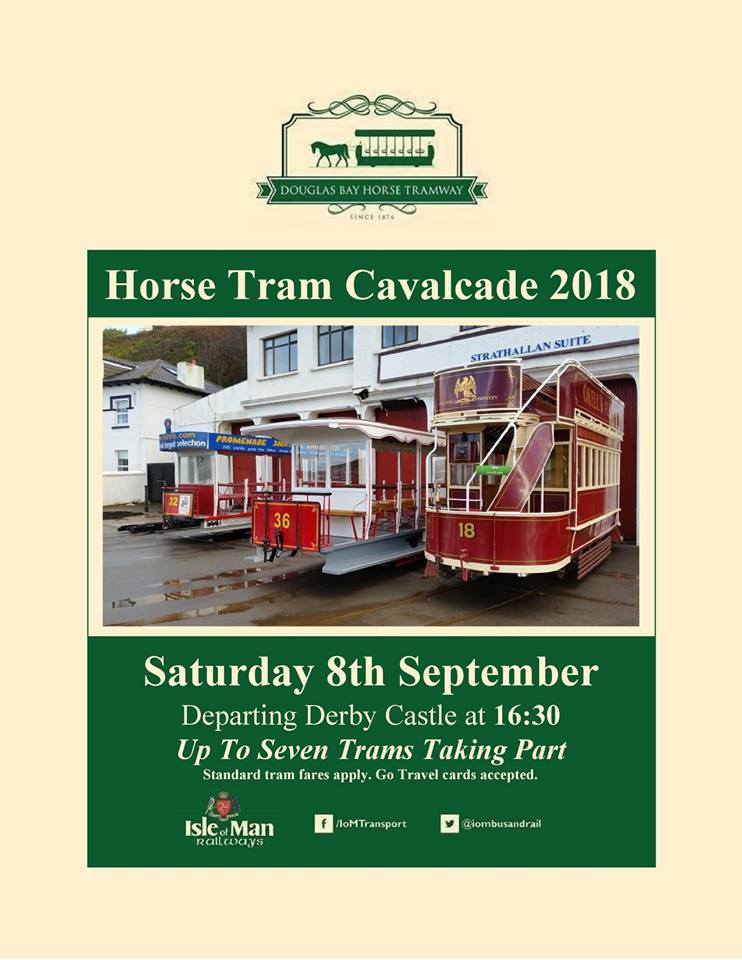
|
As part of the 125th anniversary celebration of the Manx Electric Railway, up to seven trams will take place in a Horse Tram Cavalcade on Saturday, 08-September-2018. |

|
On 14-July-2026, King Charles III, the Lord of Mann, visited the island, addressed the Tynwald and rode on horse tram 18.
The Victor Harbor Horse Drawn Tram operates double decker trams in the town of Victor Harbor, South Australia. Most of the route runs over a wooden causeway.
The Tourist Tramway of Iquique, Chile has operated a horse tram and a double decker battery tram since 2004.
Thank you to Leroy W Demery, Jr for letting me know about the Historical Village of Hokkaido in Sapporo, Japan. According to the village website: "A horse-drawn trolley provides transportation along the main street, which is lined with old wooden and stone buildings." ( http://www.kaitaku.or.jp/info/info.htm). They appear to have two cars.
Thank you to Yosef Sa'ar of the Facebook Transportation Token Collectors group, I know about another operating horse tramway and a horse tramway museum in Germany. The Döbelner Straßenbahn (Döbeln Tramway) has operated since 2007 along part of the route which operated from 1892 until 1926. The town government hoped that the tramway would attract visitors after a 2002 flood damaged the town center. Traditionsverein Döbelner Pferdebahn e.V. operates the line using a tram from Meißen that had served as a henhouse.
Döbeln is also home to what may be the world's only horse tramway museum, the Pferdebahnmuseum.
The English version of the Association of the Traditional Horse Tramway of Doebeln website.
The Society for the Preservation of Carter Railroad Resources (SPCRR) operated a horse-drawn railway at Ardenwood Historic Farm, just across the Dumbarton Bridge in Fremont. This was a tribute to the South Pacific Coast Railroad's horse-operated Centerville branch. Read more about it, and see some videos, on my Park Trains and Tourist Trains site.
The trains at Ardenwood are now pulled by an internal combustion locomotive except during the annual Labor Day Railfar, when visiting steam locomotives pull the trains.

|
At Ardenwood Historic Farm, Jiggs the horse pulls the horse-drawn car into Deer Park. September, 2006. |

|
The loading arrangements for the horse-drawn car at North Park. Note the fire extinguisher, there in case the horse bursts into flames ;0). September, 2006. |
A fleet of four horse-drawn streetcars has operated at Disneyland in Anaheim, California since opening day in 1955. Many of the other Disney parks also have horse trams. Read more about the Disneyland horse cars on my Park Trains and Tourist Trains site.

|
Disneyland Railroad horse car Number 4, painted gold for Disneyland's 50th anniversary, lays over near Tomorrowland. July, 2005. |

|
Interior of a Disneyland horse car as it circles the Plaza. July, 2003. |

|
Disneyland horse cars 1 and 2 in the passing loop on Main Street. August, 2004. |
Go to top of page.
Walt Disney World's Main Street Horse-Drawn Streetcar

|
I have not yet read Walt Disney World's Main Street Horse-Drawn Streetcar by David Leaphart, but I am looking forward to it. Check his Disney World Railroads website.
Steven says to potential readers: "The book is definitely a labor of love, and I hope it shows if you read it. I wrote it as a journey by you and me through the story of Main Street, horses, and streetcars. On this journey, you will get to know the cast members who create the magic and the wonderful horses who make it happen. I have developed wonderful relationships with both, and these dwarf the book itself."
If you are interested, you can order it through Lulu.
The hardcover:
Walt Disney World's Main Street Horse-Drawn Streetcar hardcover.
The eBook:
Walt Disney World's Main Street Horse-Drawn Streetcar ebook.
Go to top of page.
Horse Car Bibliography
Books
- Fickeworth, Alvin A. California Railroads.
Golden West Books, San Marino, CA. 1992.
To quote the subtitle: "An Encyclopedia of Cable Car, Common Carrier,
Horsecar, Industrial, Interurban, Logging, Monorail, Motor Road, Short Lines,
Streetcar, Switching and Terminal Railroads in California (1851-1992)"
Check Amazon.Com (includes review) - Leaphart, David, Walt Disney World's Main Street Horse-Drawn Streetcar.
Steel Wheel on Steel Rail Studio. 2013.
Horse cars at Walt Disney World's Magic Kingdom.
See ordering information - White Jr, John H, Horsecars, Cable Cars and Omnibuses.
Dover Publications, Inc, New York, NY. 1974.
Builder photos from John Stevenson.
Check Amazon.Com
Newspaper Articles
- Brooklyn Eagle Staff, "First Street Railroad in Brooklyn". Brooklyn Eagle, 03-Jun-1854. Brooklyn's first horse car line under construction.
- Brooklyn Eagle Staff, "The New Railroads in the City -- Trial Trip". Brooklyn Eagle, 03-Jul-1854. Brooklyn's first horse car line tested.
- Brooklyn Eagle Staff, "HORSES DYING/The Cable Cars Too Heavy for Them". Brooklyn Eagle, 07-Apr-1887. Horses can't handle cars on the non-cabled sections of Brooklyn's first cable car line.
- San Francisco Morning Call Staff, "JUMP FOR YOUR LIVES/A Runaway Street-Car Plunges Into the Chicago River.". San Francisco Morning Call, 03-Oct-1890. A horse car slides into the river.
- Brown, W L, "A Relic Of San Francisco's Village Days". San Francisco Call, 11-March-1906. Michael Houlihan drives URR's franchise-holding horse car on California Street.
- New York Times Staff, "NEW YORK LOSES ITS LAST HORSE CAR". New York Times, 29-July-1917. The last run of the Bleecker Street line.
Go to top of page.
Return to Miscellany.
Go to top of page.