|
Where Should I Go from Here?
Visit the Map
If you came to this page from an outside link, you may want to see the Picture of the Month and visit my main page. |
I will add other UK cable tramways to this page as time and information permit. I always welcome suggestions.
- UK Companies
- Birmingham - Birmingham Central Tramways Company
- Douglas, Isle of Man - Upper Douglas Cable Tramway
- Edinburgh - Edinburgh Northern Cable Tramways/Edinburgh and District Tramways Company, Ltd
- Glasgow - District Subway Company
- Liverpool - Liverpool United Tramways
- London - Highgate Hill Cable Tramway
- London - Brixton Cable Tramway
- Matlock, Derbyshire - Matlock Tramways Company, Ltd
- Other Cities
- UK Miscellany
Birmingham - Birmingham Central Tramways Company

|
Birmingham terminus. Source: Tramways: Their Construction and Working, Embracing a Comprehensive History by Daniel Kinnear Clark |
line: Main line
opened: 24-March-1888. Colmore Row to Hockley Brook.
extended: 20-April-1889. To Handsworth.
powerhouse: Hockley Depot
grip: Single-jaw side grip, lever-operated.
gauge: 3'0" (some sources say 3'6")
cars: double bogey, double end, double-deck and single-deck toastracks
terminals: Crossovers
crossings: none
notes: The Birmingham Central Tramways Company began operating horse trams in 1885. A steep grade on Hockley Hill caused the company to convert the Colmore Row line to cable traction. Engineers Edward Pritchard and Joseph Kincaid designed and built the cable tramway.
The Hockley Depot worked two cables, one from Colmore Row and the other the Handsworth. The Colmore Row cable ran at 7 miles per hour and the Handsworth cable ran at 9 miles per hour.
The line was not considered a success. In 1896, the City of Birmingham Tramways Company Ltd took over the Birmingham Central Tramways Company. In 1911, Birmingham Corporation took over the Birmingham Tramways Company and converted the cable line and the city's surviving horse, steam, and battery lines to electric traction. The cable line last ran on 31-December-1911. Electric trams operated until 1953. A new system of electric trams, operated by Midland Metro, opened on 31-May-1999.
|
from A Treatise Upon Cable Or Rope Traction by J. Bucknall Smith - 1887 - Page 105-106 The Corporation of Birmingham, acting under reports and opinions of their Public Works Committee (supported by Sir Frederick Bramwell as their consulting engineer), have unanimously agreed upon the construction of a cable tramway system within their borough. The necessary financial arrangements have been satisfactorily arranged, and the works are progressing. The present system will consist of about four miles of double track; the average steepest gradients being almost 1 in 20 to 1 in 13, and the sharpest curve about 45 ft. radius. It is proposed to construct and work the system in two sections, the first being from Colmore-row via Snow-hill and Holyhead-road to Handsworth, a length of 2m. 7 fur.; the second section extending from Colmore-row to Selby-road via the Bristol-road, this making an aggregate distance of about four miles. The gradients above referred to are upon the first-named section, those in the latter being very light. The gauge of the track will be 3 ft. 6 in. |
|
from The Electrical Engineer - November 25, 1892 - Page 551 1892 NOTES Electric Tram Traction for Birmingham. -- Mr. Ebbsmith, chairman of the Birmingham Central Tramways Company, thinks it prudent to keep an open mind as to the advisibility of using electric instead of cable traction on those routes which are affected by his recent proposals to form separate companies. If, he says, it could be used by means of an overhead wire, the Central Tramways Company would be 'a gold mine.' Cable traction is, of course, an economical thing to use, but the objection to it, especially in the present condition of affairs, is that it involves a large initial expenditure and a prolonged disturbance of the street surface, and consequent suspension of the company's traffic. The introduction of the overhead electric system is by comparison a cheap and simple matter. |
|
from United States Congressional Serial Set by United States Government Printing Office - 1892 - Page 676 BIRMINGHAM
(I) The systems of public transportation in the city of Birmingham are omnibuses and horse, steam, cable, and electric trams. Route: Colmore Row to Hockley Brook (cable)
... The cable and electric car systems are far from being satisfactory, being very irregular and unreliable. The cars on all the tramways are long, narrow, double-decked, ugly, and dirty affairs, having no kind of conveniences or provisions for the comfort of the traveling public. No American city would tolerate such hideous things... ... The cable service is worked by sixteen cars on all the days of the week except Saturday, when there are two extra cars running. All these cars are on the road an average of sixteen hours a day, but relief is given to the drivers and conductors for periods varying from two and a half to three hours and a half hours. Meals have to be taken while traveling, except when mealtime comes around during a man's relief. Men are expected to be at the depot in the morning fifteen minues before starting, and the conductors are occupied from ten to twenty minutes at night in getting their accounts squared by a clerk. Each man works more than thirteen hours a day the week round. Conductors' wages for the first two years are 3s. 6d. (85 cents) a day; after two years, if no complaints have been made against them, they are entitled to 3d. (6 cents) a day more; after three years' service conductors' wages are 4s. (97 cents) a day. Drivers begin at 4s. 6d. ($1.09) a day, and after six month's service rise to 5s. ($1.22) a day, and after one year's service to 5s. 6d. ($1.34) a day. |

|
Terminal pulley and pit. Source: Tramways: Their Construction and Working, Embracing a Comprehensive History by Daniel Kinnear Clark |

|
Pulleys and pulley pit at Hockley. Source: Tramways: Their Construction and Working, Embracing a Comprehensive History by Daniel Kinnear Clark |

|
Longitudinal and transverse sections of pulley pit, Hockley. Source: Tramways: Their Construction and Working, Embracing a Comprehensive History by Daniel Kinnear Clark |

|
Engine house and terminal gear. Source: Tramways: Their Construction and Working, Embracing a Comprehensive History by Daniel Kinnear Clark |

|
Steam engine and driving gear -- elevation. Source: Tramways: Their Construction and Working, Embracing a Comprehensive History by Daniel Kinnear Clark |

|
Steam engine and driving gear -- plan. Source: Tramways: Their Construction and Working, Embracing a Comprehensive History by Daniel Kinnear Clark |

|
Rope-driving pulley -- plan. Source: Tramways: Their Construction and Working, Embracing a Comprehensive History by Daniel Kinnear Clark |

|
Type section of way. Source: Tramways: Their Construction and Working, Embracing a Comprehensive History by Daniel Kinnear Clark |

|
Gripper. Source: Tramways: Their Construction and Working, Embracing a Comprehensive History by Daniel Kinnear Clark. July, 2010 Picture of the Month. |
Go to top of page.
Douglas, Isle of Man - Upper Douglas Cable Tramway

|
| Douglas cable tram 72/73 running on its battery-powered trucks on 20-Aug-1998. Photo courtesy of Geoff Cryer. Visit Geoff's Rail Pages for more excellent pictures. July (Summer), 2001 Picture of the Quarter (copyright G A Cryer, 1998). |
line: Upper Douglas
opened: 15-Aug-1896. From the promenade Clock Tower around the back of Douglas by a U-shaped route and back down to the promenade at Broadway
powerhouse: York Road?
grip: single jaw side
gauge: 3'0"
cars: double ended, double bogied (trucked). One closed saloon, the others with cross benches.
turntables: cross overs?
crossings: N/A
notes:The Isle of Man, in the Irish Sea, is the Lost World of railways. A visitor can ride on a horse car line that has operated since 1876. At Derby Castle, the rider can transfer to an electric car built in 1893. The Isle of Man Railway hauls its trains with tank engines built between 1873 and 1926.
One piece of transportation history that no longer lives in its original form on the island is the Upper Douglas Cable Tramway.
Douglas Corporation wanted better transit service for the hilly Upper Douglas area. They persuaded the Isle of Man Tramways & Electric Power Company, which operated the horse tramway, to build a cable railway in return for an extended franchise.
The line followed a hilly, U-shaped route through Upper Douglas, connecting with the promenade at each end.
Douglas Corporation acquired the horse tramway and the cable railway in 1902 after Dumbell's bank failed.
The cable tramway was abandoned on 19-Aug-1929.
Cars 72 and 73, the only surviving rolling stock, had been turned into a bungalow. They had been built by G F Milnes in 1896. In 1976, the best pieces were joined to form a new car, 72/73. In 1996, the car was put on battery powered trucks. Persistent stories have it that the horses are scared of the car, as they often were of cable cars.
On 21-Jan-2000, sewer excavations on the promenade near Victoria Street exposed the terminal sheave pit. One sheave was destroyed, but the other may be preserved. See the Manx Electric Railway Society site for an illustrated story.
|
from Transport World, Volume 18 - 1905 - Page 81 DOUGLAS. -- At a meeting of the Douglas Town Council on June 14, after a heated debate, it was resolved to extend the cable tramway on to the Victoria Pier, and to proceed with the construction work at once. The general desirability has long been obvious, but, apart from the physical difficulties, it has been delayed and opposed by councillors interested in other divisions of the town. It is estimated that the laying of the lines can be completed in about a fortnight. |
Visit the Isle of Man Tramways site.

|
| A 1988 stamp depicting Douglas cable tram 72/73. August, 2004 Picture of the Month. |
Go to top of page.
Edinburgh - Edinburgh Northern Cable Tramways/
Edinburgh and District Tramways Company, Ltd
Thank you to John Perkin, Alex Dow, and mikeyashworth for providing information and images for this article.

|
Edinburgh cable tram 209, built in 1903 by the Electric Railway and Tramway Carriage Works. Note the pilot wheel on the visible platform, which controlled the grip. Source: mikeyashworth's photostream. June, 2010 Picture of the Month. |
line: Trinity (Edinburgh Northern Cable Tramways)
opened: 28-January-1888. "This first line constructed meets Princes Street in Hanover Street, and proceeds north over the hill in George Street, and then descends the steep incline of Pitt Street. Passing Henderson Row, where the cables branch off to the engine-house, it takes curves of 195 feet and 80 feet radii, and crossing the old bridge of Canonmills, which is the lowest point on the route, it ascends easier grades to the Trinity terminus. The district round the southern half of the line is completely built over, and the northern section is being quickly developed since this line commenced operating. The cable passing along this line traverses eighteen curves, of radii varying from 80 feet to 980 feet, the smallest curve being less than a right angle. It is also diverted at various places by nine large pulleys. The total height ascended is 187 feet. The length of track is 3 miles."
powerhouse: Henderson Row
grip: single jaw side
gauge: 4'8 1/2"
cars: double bogey, double deck with open upper deck, double end
terminals: cross overs
crossings: N/A

|
Gradient Diagram, Trinity Route. Source: Tramways: Their Construction and Working, Embracing a Comprehensive History by Daniel Kinnear Clark |
line: Stockbridge (Edinburgh Northern Cable Tramways)
opened: ??-February-1890. "This line also starts from the main street of Edinburgh, and travels parallel and over almost identical grades as part of the other route. After passing round 100 feet curves into the Royal Circus, the lines are almost entirely a series of curves passing through steep and very narrow roads, thickly populated on all sides. The line then crosses another old bridge at Stockbridge, where the cable leaves for and returns from the engine-house ; the route, though curvy for a time, is almost level. The cable on this line has to traverse 28 curves, of radii ranging from 80 feet to 400 feet; it also is directed by the same number of large pulleys as the other line. The total height ascended on this route is 173 feet, and the length of the track is 2.4 miles."
powerhouse: Henderson Row
grip: single jaw side
gauge: 4'8 1/2"
cars: double bogey, double deck with open upper deck, double end
terminals: cross overs
crossings: N/A

|
Gradient Diagram, Stockbridge Route. Source: Tramways: Their Construction and Working, Embracing a Comprehensive History by Daniel Kinnear Clark |
Please note: All the Edinburgh and District Tramways Company lines listed below are guesses on my part. I'm know I'm missing lines like Gorgie and others. I'd be grateful for better information.
line: Princes Street (Edinburgh and District Tramways Company, Ltd)
Lines ran on Princes Street, but I haven't found any details about them
line: Leith Street (Edinburgh and District Tramways Company, Ltd)
opened: ??-???-????. Princes Street and Leith Walk by Leith Street, Leith Walk to Pilrig
powerhouse: Shrubill
grip: single jaw side
gauge: 4'8 1/2"
cars: double bogey, double deck with open upper deck, double end
turntables: cross overs?
crossings: N/A
line: Abbeyhill (Edinburgh and District Tramways Company, Ltd)
opened: 01-June-1899. Princes Street and Saint Andrews Street by Saint Andrews Street, York Place, Leith Walk, London Road to Abbeyhill
powerhouse: Shrubill?
grip: single jaw side
gauge: 4'8 1/2"
cars: double bogey, double deck with open upper deck, double end
turntables: cross overs?
crossings: N/A
line: Church Hill (Edinburgh and District Tramways Company, Ltd)
opened: ??-???-????. From Salisbury Place, Clerk Street and Grange Road by Grange Road, Beaufort Road, Strathearn Road, Strathearn Place, Greenhill Gardens, Church Hill to Morningside Road
powerhouse: Tollcross
grip: single jaw side
gauge: 4'8 1/2"
cars: double bogey, double deck with open upper deck, double end
turntables: cross overs?
crossings: N/A
line: Joppa (Edinburgh and District Tramways Company, Ltd)
opened: ??-???-????. From Waterloo Place, Leith Walk and Regent Road by Regent Road, London Road, Parsons Green Terrace, Piersfield Terrace, Hoira Terrace, Inchview Terrace, High Street, Abercorn Terrace to Joppa
powerhouse: Portobello
grip: single jaw side
gauge: 4'8 1/2"
cars: double bogey, double deck with open upper deck, double end
turntables: cross overs?
crossings: N/A
line: Craiglockhart (Edinburgh and District Tramways Company, Ltd)
opened: ??-???-1908. Gilmore Place via Granville Terrace, Polwarth Terrace, Colinton Road to Craiglockhart
powerhouse: Tollcross
grip: single jaw side
gauge: 4'8 1/2"
cars: double bogey, double deck with open upper deck, double end
turntables: cross overs?
crossings: N/A
line: Canon Mills (Edinburgh and District Tramways Company, Ltd)
opened: ??-???-1908. Leith Walk and Broughton Street on Broughton Street to Canon Mills
powerhouse: Henderson Row
grip: single jaw side
gauge: 4'8 1/2"
cars: double bogey, double deck with open upper deck, double end
turntables: cross overs?
crossings: N/A
|
from A Treatise Upon Cable Or Rope Traction by J. Bucknall Smith - 1887 - Page 105 ... in 1884 powers were obtained to construct about five miles of cable tramways in Edinburgh, with the view of opening up the northern districts of this beautiful capital. This cable system is designed and located to serve the northern districts of Stockbridge, Trinity, and Newhaven, via Royal Circus and Frederick-street and Cannon Mills, Pitt and Hanover-streets to Princess-street respectively. The steepest gradient will be about 1 in 13 to 1 in 14. The Cannon Mills section is now in an advanced stage of construction. |
notes: Despite having many narrow and curving streets, Edinburgh had the most successful cable tram systems in the UK, operating from 1888 to 1922. Reistance to overhead wires helped to keep the cables in operation.
The Edinburgh Northern Cable Tramways opened the Trinity line in 1888 and the Stockbridge line in 1890. Engineer William Newby Colam was involved in the design and construction of the company's lines. In 1890, he presented a paper on the Edinburgh Northern Cable Tramways.
In 1894, the Edinburgh and District Tramways Company took over the lines of horse tram operator Edinburgh Street Tramways Company. Between 1899 and 1908, it converted most of them to cable traction, and also created new lines. It also took over the Edinburgh Northern Cable Tramways.
In 1897, Colam presented a follow-up paper on the Conversion of Edinburgh, Leith and Portobello Horse Tramways Systems Into Cable Traction.
|
from Transactions of the Seventh International Congress of Hygiene and Demography by Charles Edward Shelly - 1892 - Page 65 For the last 20 years Edinburgh has possessed a horse tramway system which traverses the leading lines of thoroughfare, and for the last two or three years two separate systems of cable tramways have been at work on the northern slopes, affording a pleasant and convenient means of communication. At the present time the alternative questions of the Corporation undertaking the management of the horse tramway system, or granting a new lease under new conditions to the Edinburgh Street Tramways Company, who have worked the system for the last 20 years, are under consideration. |
Edinburgh and District Tramways operated all of its routes under a lease from the Edinburgh Corporation. During the First World War, the company had trouble acquiring new cables and had to patch old ones to keep them in service.
On 01-July-1919, Edinburgh Corporation took over operation of the tramways. The Corporation began to replace cable trams with electric trams in 1919. The last cable tram operated on 23-June-1923. Electric trams operated in Edinburgh until 16-November-1956.
The remains of cable tram 226 were discovered on a farm in 1987 and are in process of being restored.

|
"Calton Hill, Edinburgh." A cable tram passes below Calton Hill and the Dugald Stewart Monument. Source: Tramway and Light Railway Society Photographic Archive. |
A stretch of cable tram track is still visible in Waterloo Place at Princes Street. Alex Dow reports that "Regarding the 'preserved' length of track in Waterloo Place, unfortunately the last time I saw it, it was rusting away and was partially covered by coloured road markings.
"As a piece of track, it is not in its original working position.
"When the (electric) track in that area was being lifted after abandonment, the preserved section was moved from its double-track position, to being centred in the road (say single-track), so is not in its working location.
"I must be one of the few Edinburgh citizens who actually travelled over that section of track, as it was a link for cabling purposes and not in normal traffic use.
"Back in the 1940s, my church Sunday School annual picnic was at Piershill. The church was in McDonald Road, not far from the Dryden Street back door of the Shrubhill Depot. So we walked from the church to two trams which were waiting on the short lay-bye at the top end of the Dryden Street depot track.
"The two trams then proceeded by Pilrig Street, Leith Walk to Princes Street at the Post Office, where they reversed over the little-used link track (including the cable-track section) on to the Waterloo Place track, also there moving over on to the appropriate running line down to Piershill."
An article in the 19-April-2007 Scotsman reported that engineers preparing for Edinburgh's new tram system (Edinburgh Trams) were surprised to discover that many of the streets still contained the conduits from Edinburgh's cable tram system. Further studies had to be made to determine whether the conduits were strong enough to support the new trams. The article made sure to mention that cable tram were invented by a Scot.
Alex Dow reports that "Unfortunately, the bulk of (the Henderson Row powerhouse) was demolished some twenty years back, being replaced by a much larger insurance company building, which did incorporate a little of the frontage of the cable car depot; but otherwise is completely different from the general style of that building.
"Some of the cable wheels were found during the demolition; and are incorporated into a small external display at the south-eastcorner of the "new" building, ie down the side-street at the left-hand end.
"That later building however was generally designed to have a street frontage of about 200 years back, about 80 years earlier than the cable car building!
"Just recently (2007), I was informed that the insurance company had vacated that later building; and it is now converted into flats (living apartments).
"I believe that the underground access passages are under Leith Walk, not Henderson Row. A former colleague remembered being taken to them as the Air-Raid Shelter for his primary school during WW2."
|
from Transport World, Volume 18 - October 12, 1905 - Page 369 Not very much is now heard in the engineering press of the working of the cable tramway system of Edinburgh, which, apart from a few steep-grade lines, now stands alone in this country. The fact is, the Edinburgh cable system did very well from the start, and it has been improving rapidly, while now the improvement is more marked than ever. Only the enormous interest which the Edinburgh District Tramways Company have to pay to Edinburgh Town Council has prevented the payment of dividends on the ordinary shares. This interest, it may be recalled, is 7 per cent, per annum on the cost of construction, and that cost was abnormally, and as many think, unnecessarily high. There is every prospect that dividends will speedily be available. A recent visit to Edinburgh showed one of our representatives that the improvement mechanically in the operation of the system has been more than maintained. The short delays which used to take place at junctions have disappeared completely. The cars cannot spurt to make up time, as electric cars can do, but they maintain such a good equable speed even in the centre of the city that the daily mileage per car is better than that on many electric tramways. In Edinburgh, there is little trouble from traffic blocks. The returns of the traffic receipts continue to show great advances. The financial year begins on January 1, and from the beginning of the present year down to the end of September, the revenue was about £14,000 in advance of that of the corresponding period of last year. Considering the nature of cable traction, this increased revenue should be earned without any material increase in the motive power expenses. We shall certainly look with interest for the next directors' report. The greatest day which the system has yet experienced was on September 18 last, the day on which the King reviewed the Scottish Volunteers in the King's Park, Edinburgh. Besides the immense number of Volunteers who had come from all over Scotland for the Review, Edinburgh was besieged with masses of sight-seers. The result was that the tramways carried no fewer than 450,000 passengers on that day, producing receipts of £1.773. The highest revenue ever obtained before in one day was £1,400, at the time of the Coronation celebrations. On September 18, a full service of cars started at five o'clock in the morning and was continued till midnight. The service was conducted without a hitch, and Mr. Pitcairn, the general manager, was well entitled to congratulate himself and his assistants on the results achieved. The most important matter, however, which has recently transpired in connection with the system is the fact that the speed of the cars is being materially increased. Under the Acts authorising the cable tramways the speed was limited to eight miles an hour, except on the northern lines where only six miles an hour was allowed. The usual arrangement in tramway Acts is that the speed of the cars is to be such as the Board of Trade may fix. Unfortunately for Edinburgh, however, and for the Company, the maximum speeds were, for some reason -- perhaps lack of foresight -- absolutely fixed by the local Acts. When experience had convinced everybody that higher speeds could be used with safety, it was found that the Board of Trade had no power to allow any higher speed unless an Act were passed to repeal the speed provisions in the existing Acts. Edinburgh Corporation early in the present year promoted a Provisional Order under the Scotch Private Legislation Procedure Act to provide that notwithstanding anything in the existing Acts the maximum speeds on the tramways should be such as the Board of Trade might fix. The Order was unopposed, and it accordingly passed without attracting much public notice. The Board of Trade, acting on the powers conferred on them, have now issued maximum speed regulations, under which the cars may travel at twelve miles an hour on most of the routes. On certain lines, however, where the gradients are more severe, speeds of ten and eight miles an hour are fixed. The eight miles an hour applies in particular to the northern lines, where the gradients are excessively steep. At present the arrangements are being carried out in the power-stations for increasing the speed of the cables. An increase of speed of no less than 50 per cent, on most of the lines, and of 33 per cent, and 25 per cent, on others, cannot fail to produce great results. A speed of 12 miles an hour was never allowed before on any cable tramway in this country, though a higher speed than that has been common enough in America, and 12 1/2 miles an hour is the cable speed used on the Glasgow District Subway. The mileage made by each car per day will be greatly increased, and the public, attracted by the higher speed, should patronise the cars more than ever. Under the new conditions the revenue-earning power of the system should be largely increased, and the time required to travel from any one point to another materially reduced. |

|
"Princes Street and N.B.R. Station, Edinburgh." Cable trams run on Princes Street. The North British Railway became part of the London and North Eastern Railway in 1923. Source: Tramway and Light Railway Society Photographic Archive. |
|
from Transport World, Volume 18 - November 9, 1905 - Page 479 Mr. Thomas Hunter, W.S., Town Clerk of Edinburgh, has presented to the Lord Provost's Committee of Edinburgh Town Council a long report which he had been requested to prepare on the subject of the Corporation's tramway policy. Appended to the report is another by Sir Alex. Kennedy on the best mode of traction to be adopted for Gilmore Place line which is at present worked by horses, and any suburban lines which the Council may construct. Mr. Hunter first goes into a detailed history of the tramway policy of the Corporation, leading down to the present time when all lines except that in Gilmore Place are worked on the cable system by the Corporation's lessees, the Edinburgh and District Tramways Company. He also examines the various alternatives which might be suggested in regard to the construction and working of additional tramways, pointing out among other things that though the cable system is a great success it cannot profitably, owing to its high initial cost, be extended into regions where the traffic can only be light. Reference is made to various electric systems, other than the trolley wire method to which the Council are opposed on the score of appearance. The following is an abstract of the main points brought out in the report. The general policy of the Corporation is to own all the tramways within the city, and to make the extensions which the public convenience may require. Accordingly they now own all the tramways within the city with the exception of the line between Joppa and Musselburgh (a continuation of the Musselburgh Tramways), and part of the lines laid by Leith Town Council on the Edinburgh side of Pilrig Street. In the case of these exceptions the Corporation have reserved power to acquire them on six months' notice. For the future, it is suggested that when a new tramway or extension within the city is required, with a reasonable prospect of proving remunerative, the Corporation should themselves construct it. In the event of a Corporation tramway requiring to be carried a short distance into the county, the Corporation may properly seek the requisite powers, and construct it as an adjunct of the main tramway. It is not advisable that the Corporation should construct tramways outside the city boundaries, further than is indicated above. As, however, the city will extend, the Corporation should not let the main avenues to the city be occupied by tramways belonging to outside owners, without taking precautions to safeguard the city's future interests. This may be done by agreement with the companies making such lines, stipulating that the Corporation should be entitled to acquire any portion within the city, and, if necessary, the continuation outside, at any time, on reasonable notice Either ownership or the open-door to ownership at any time should be the Corporation's attitude towards all the tramways within and around the city. Although the right to decide upon the construction of extensions or new lines within the city lies with the Corporation, it is desirable that they should consult their lessees as to these The fact of the lines being worked by the lessees has a material bearing upon (a) working arrangements for running powers or through traffic between outside lines and the Corporation tramways, if and where the system of traction allows this ; (b) the working of continuation tramways outside the city boundaries ; (c) the question of motor 'bus service in so far as that service might be an adjunct or feeder to the tramways ; and (d) the duty of the Corporation as the lease draws to a close, to determine and arrange upon the course to follow for securing efficient service up to the termination, and unbroken continuance of the traffic thereafter For durability and economical cost of maintenance and working, the cable system compares favourably with other systems. With regard to the Gilmore Place route, it is necessary now to decide upon its conversion to mechanical traction. The choice apparently lies between the cable and the electric systems ; and probably in this case, one of the forms of electric traction will be adopted. With regard to the form of traction which should be adopted for lines to he hereafter constructed, consideration should be given (a) to the position of the line in its relation to the working of the rest of the system or to a larger scheme ; (b) the initial cost of the system ; (c) its durability; (d) the expense of maintenance and renewal of the whole undertaking, including rails, equipment, machinery, plant, etc. ; (e) the working expenses ; (f) the comfort of the service, and its effect, if any, upon the amenity of the city. Should any extensions or new lines be proposed it will be desirable to consider how they will fit in with the general working of the cable system if their mode of traction is electric. This points to the importance of the cars being so constructed, if that be possible, as to run over the cable lines as well as their own electric lines or vice versa. The Corporation electric light undertaking may be utilised with advantage in future tramways; and, in any event, its statutory position within the city should be protected. In the case of the tramways owned by the Corporation within the citv, the payment of £5,500 per annum, which the tramway revenue makes to the city rates, may be regarded as rent or wayleave for the streets. Where, however, companies are allowed to come within the city with tramways, on tenure subject to the Corporation acquiring them at any time, on short notice, it is not appropriate to stipulate for payment of rent or wayleave for the streets. If that were done for lines which did not pay, it might prevent the company giving the public service ; and if the lines were profitable, the Corporation ought to take them up. The Corporation should not allow any outside authority or company to obtain statutory or compulsory running powers over lines within the city. Nevertheless, the public convenience may require through traffic where that is practicable ; and, in such cases, working agreements should be made between the owners of the tramways, including the parties working them The report proceeds to point out that the Corporation have agreed to apply for powers to construct an electric tramway in Gilmore Place, etc., running out to Slateford and returning to Fountainbridge They also will seek authority to construct tramways, to be worked by electric or other motive power, in Broughton Road and other streets on the north side. Mr. Hunter goes on to indicate various considerations as to the electric system which should be adopted for Gilmore Place line, and refers to Sir A. Kennedy's report on the subject The following interesting item is, however, added. According to the statements made by the parties interested, the relative costs of the electric systems for track construction would be : Overhead system, £6,000 per mile of single track with an addition of £1,100 per mile of route (whether double or single track) for overhead equipment; surface-contact systems, £1,200 more per mile of single track than the overhead system ; in the case of the Kingsland system a further sum of about £600 per mile of single track would be required. Various local considerations are then pointed out with reference to the other proposed tramways. Sir Alex. Kennedy, in the course of his report, says that whatever system is decided upon for the Gilmore Place route may form the basis of action for other new lines. At the time the cable lines were put down the conduit electric system was only in an experimental stage, but it is now working successfully in London and elsewhere. The capital expense, however, make it unsuitable for any tramways except those in streets where the traffic is very heavy. The system is out of the question for the Gilmore Place line. Even if the traffic justified such an expense, it would probably be better to extend the cable lines than to introduce an entirely different system of equal cost for short distances As to petroleum motor tramcars, these would be very expensive, and there is no trustworthy experience as to the cost of running and maintenance. The choice lies between overhead and surface-contact systems There is nothing new to be said about the former, and the Corporation do not wish to adopt it if they can get some other method. Of surface contact systems, he has specially examined four for the Corporation's purpose, the Kingsland, the G.B., the Lorain, and the Dolter. The first two have not yet anywhere come into practical operation, and he cannot say that either of them is as yet in a form suitable for use with continued traffic. The other two are in a different category. He points to the successful working of the Lorain system for three years in Wolverhampton, and of the Dolter system in Paris. He thinks that with proper care either of the two systems might be used on the Gilmore Place line. Each svstem has specially good points of its own, and in each case the results of working up to the present have indicated pretty clearly the direction in which improvements must be made in future. He is not prepared to say positively that either one of these two systems is better than the other on the whole -- a comparison between the two is a very complicated affair. At the proper time, however, it would be easy to draw up a general specification to which both firms could tender, and each of them could indicate in their offers the improvements which they would propose to make. It would be easy to embody in the specification all necessary clauses for the protection of the Corporation, as to removing the work if it did not prove satisfactory, or as to payment for the work being made only on condition that it did prove satisfactory after a certain time of usage. It might be advisable presently to ask both the Lorain and the Dolter Companies to supply three or four "dummy" studs, which the Corporation might put down at their proper intended level between the rails, and leave there, so as to find out by practical trial whether their shape and their elevation above the general road level causes any practical inconvenience. He believes that it will be found, after the first few days, that neither drivers or cyclists will find any real trouble from them. The above reports were submitted to a special meeting of Edinburgh Town Council on November 2. The Town Clerk made a statement on his report, and defended the Corporation from a charge of undue delay in the construction of the cable tramways which had been brought against them. On the motion of Bailie Clark, a resolution was adopted declaring that the Corporation should be the owners or potential owners, under option of purchase, of all the tramways within the city, and should make such extensions within the city as were required, where they would fit in with the working of the general system. Other resolutions, regarding extensions beyond the city, etc., were sent to the Lord Provost's Committee for consideration and report Conferences, it was stated, would be held with promoters of outside tramways. |

|
Conduit, transverse and longitudinal sections. Source: Tramways: Their Construction and Working, Embracing a Comprehensive History by Daniel Kinnear Clark |

|
Supporting pulleys for cables (Colam's patent). Source: Tramways: Their Construction and Working, Embracing a Comprehensive History by Daniel Kinnear Clark |

|
Horizontal supporting pulley, on curves. Source: Tramways: Their Construction and Working, Embracing a Comprehensive History by Daniel Kinnear Clark |
|
from Report of the Special Committee Appointed to Investigate the Relations Between Cities and Towns by Charles Francis Adams - 1898 - Page 250 EDINBURGH. -- The city has two systems of tramways, which it acquired under provision of the Tramways Act. The principal is let on a lease of twnty-one years to Messrs. Dick, Kerr & Co., at a rental equal to 7 per cent. on the capital outlay. The lines are at present worked by horse traction, but almost the whole of them are being cabled by the Corporation. The Edinburgh Northern Tramway Company work two street cable lines in the north of the city. Capital. -- The capital on May 15, 1896, stood at $919,014.19. Revenue. -- The rental from Messrs. Dick, Kerr & Co. was $64,304.97; total receipts, $69, 748.84; total expenditure, including cost of maintaining lines, interest, sinking fund, etc., $62,345.62; surplus profit, $12,891.94. |

|
Terminal pits and diverting pulleys. -- Vertical section. Source: Tramways: Their Construction and Working, Embracing a Comprehensive History by Daniel Kinnear Clark |
|
from Great Britain: Handbook for Travellers by Karl Baedeker - 1906 - Page 515 Cable Tramways (fares l-5d.). The central point is the Register House (Pl. E, 3), whence lines radiate to Newington (Pl. F, 6) and Nether Liberton, Morningside (Pl. C, 6), Braid Hills (p. 523). Gorgie, Murray field, Pilrig St. (PI. F, 1; change for electric cars to Leith), and Portobello (p. 507) and Joppa (p. 509; change for electric cars to Musselburgh and Levenhall). -- A circular tour, starting from the Register House, may be made round the S. half of the city via the North and South Bridges, Newington, Morningside (Churchhill; change cars), the Lothian Road, and Princes St. (fares 4d.; good view of the city from the top of the cars). -- Cable Tramways run also from the foot of the Mound ( Pl. D, 4) to George IV. Bridge (Pl. E, 4,6), Lauriston, Melville Drive, and Marchmont Road ; from Hanover St. (Princes St.; Pl. D, 4) to the Botanic Gardens and Golden Acre; and from Frederick Street (Princes St. ; Pl. D,4) to Stockbridye (Pl B. C. 2) and Comely Bank. -- Horse Cars run from Toll Cross (PI. C, 5) to Colinton Road, via Gilmore Place. |

|
Terminal pits and diverting pulleys. -- Plan. Source: Tramways: Their Construction and Working, Embracing a Comprehensive History by Daniel Kinnear Clark |

|
Gripper (Colam's patent). Source: Tramways: Their Construction and Working, Embracing a Comprehensive History by Daniel Kinnear Clark. |
Glasgow - District Subway Company

|
| Geoff Cryer photographed these recently retired cars from the Glasgow Subway at the Beamish Museum in County Durham in July, 1977. October 2001 Picture of the Month (copyright G A Cryer, 1977). |
line: Inner/Outer Circles
opened: 14-Dec-1896. Circular route under the city, crossing the Clyde twice. 15 stations.
powerhouse: Scotland Street
grip: single jaw side
gauge: 4'0"
cars: single ended, single and double bogied (trucked) closed-bodied rapid transit grip cars and trailers.
turntables: N/A
crossings: N/A
notes: While "underground" is the term usually used in the British Isles for what an American would call a "subway", the pioneering cable-hauled line in Glasgow was officially the Glasgow District Subway. Only London and Budapest had underground transit lines before Glasgow.
The Glasgow District Subway built two tunnels on a circular 6.5 mile route around the city. The conservative directors chose cable to operate the system because they felt that electric propulsion was not sufficiently developed. This was the only Hallidie-type cable-driven subway in the world. London's Tower Bridge Subway and Istanbul's Tunel were both funiculars.
The subway opened on 14-Dec-1896, but an accident caused service to halt until 21-Jan-1897.
The system had many interesting features. There were no track connections between the Inner and Outer Circles. There was no rail connection with the shops; a crane lifted cars out of the tunnels for servicing. Cars generally spent the night in the tunnels. The platforms were only long enough to handle two-car trains. The cable used was 1.5" in diameter, which was unusually thick for the industry. The cable ran at 12.5 miles per hour. There was no need for a conduit, so the cable ran above the rails.
In 1923, the Glasgow Corporation (city) took over the system. They tested third-rail electrification in 1933. In March, 1935, they electrified the Inner Circle. On 30-Nov-1935, the last cable-driven train ran on the Outer Circle. Both lines used converted cable stock.
The narrow gauge and short platforms made for many capacity problems.
In 1936, the official name changed from "Subway" to "Underground", but Glaswegians still call it "subway". In 1940, the line was damaged by German bombs and closed for four months.
The converted cable equipment continued to run until 1977. The system shut down until 16-Apr-1980. It reopened with new rolling stock, a rail connection from the tunnels to the new maintenance shops, crossovers between the circles, new track, power supply, and signals, and platforms long enough to handle three-car trains. The circular route and the orange color of the new cars inspired "clever" journalists to try to give the system the nickname "Clockwork Orange". The name was roundly ignored. (Thanks to Charles Billette for the information).
|
from The Electrical Engineer - October 27, 1893 - Page 385 NOTES Glasgow. -- The directors are considering the method of haulage to be adopted on the Glasgow District Subway. |
|
from Local Industries of Glasgow and the West of Scotland by the British Association for the Advancement of Science - 1901 - Page 126 The Glasgow District Subway, though not a railway in the sense that its carriages are not propelled by a locomotive, may yet be classed among the iron roads which tend to carry on the great system of inter-communication. It serves one important function in this respect by forming a link between the northern and southern sides of the city. It penetrates under the Clyde at two points, near the Broomielaw and near Partick, and traverses the various districts of Glasgow and suburbs. During the first year of its existence -- 1898 -- it carried 9,628,392 passengers, but the number increased in 1900 to close on 14,000,00. |
Go to top of page.
Liverpool - Liverpool United Tramways
line: Kirkdale
opened: 25-Sep-1883. Kirkdale car sheds.
powerhouse: Kirkdale car sheds.
grip: probably single-jaw side
gauge: 4'8 1/2"
cars: (?)
turntables: (?)
crossings: N/A
notes: Thanks to Andrew D Young and Ron Smith for providing most of this information.
In 1883, Liverpool United Tramways, a horse tramway operator, considered using cable traction on a line on London Road and Prescot Street from William Brown Street to Kensington.
At the urging of the American Cable Railway Trust's representatives, including William E Eppelsheimer, Liverpool United arranged a trial at their car sheds at Kirkdale. The trial took place in the yards at 3:30 pm on 25-Sep-1883.
There are few recorded details about the trial: No one knows how the cable was powered. The grip was probably attached to a horse car, but no one knows which one. No one knows if the installation ran again after 25-Sep-1883.
We do know that Liverpool United Tramways chose not to use cable traction, but this experiment may have led to the construction of the Highgate Hill Cable Tramway in London.
Go to top of page.
London - Highgate Hill Cable Tramway

|
| A model of a Highgate Hill train at the London Transport Museum, Covent Garden, London. Note the double decked trailer. Photo by Stuart Jenkins. December, 1999 Picture of the Month. |
line: Highgate Hill
opened: 29-May-1884. Highgate Hill from the Archway Tavern to Southwood Lane, to a point along Southwood Lane. Most of the line was double tracked, but about 1000 feet of line in the High Street were single-tracked.
powerhouse: "...situated at the top of the hill on the east side of the High-street and
have a substantial frontage, composed principally of red and white brickwork relieved by
plinths, pillars, etc, of worked stone...The outside dimensions of the premises are about
130 ft long by 30 ft wide...The narrow and irregular character of the site would not permit
of the premises being built at right angles to the road, and hence they are unsuitable for
traffic purposes. Indeed, there can be no doubt that the site of the building is very
unsuitable..."
J Bucknall Smith, A Treatise Upon Cable or Rope Traction
grip: Single-jaw side grip.
gauge: 3'6"
cars: dummy & trailer trains. At least some trailers were double-decked.
turntables: cross overs
crossings: none
|
from London and Its Environs by Karl Baedeker - 1889 - Page 32 The Highgate Steep Gradient Cable Tramway, the first of the kind in Europe, opened in 1884, ascends Highgate Hill from Highgate Archway; the cars start every 5 min. (fares 2d up, 1d Down; halfway up 1d.). The motive power is supplied by an endless wire rope, placed in a tube below the surface of the road and kept in motion by a stationary engine at one end of the line. Connection between the car and the rope is effected by means of a 'gripping attachment', passing through a slit in the middle of the track. The rope runs between the jaws of the 'grippper', which the driver closes when he wishes to start the car, reversing the operation and applying the brakes when he wishes to stop. The system works with great effectiveness and a pleasant freedom from noise or dirt. |
notes: The Highgate Hill Cable Tramway was the first cable tramway in Europe. It was meant to demonstrate the Hallidie system.
W W Hanscom, a San Franciscan, was originally engaged to design the line. He gave up and was replaced by William E. Eppelsheimer, who had designed the pioneering Clay Street Hill Railroad and created the grip currently used by San Francisco cable cars. The actual construction of the line was done by J Bucknall Smith, who went on to write the most important contemporary work about cable tramways, A Treatise Upon Cable or Rope Traction. I have quoted him extensively in this section.
The street was not suitable for cable technology because of excessive curvature. "The permanent way does not in all cases occupy the centre of the road; this variation was made in order to ease the curves, which are all more or less objectionable to the cable system." -- J Bucknall Smith.
The company was not a financial success. Service stopped after an accident in December 1892. The line opened again in 1897, and operated until August 1909.
Highgate Hill was the place where Dick Whittington decided to turn back and stay in London. The line ran near the famous Highgate Hill Cemetery, burial place of Karl Marx, Charles Dickens' family (but not Dickens himself) and other famous people.
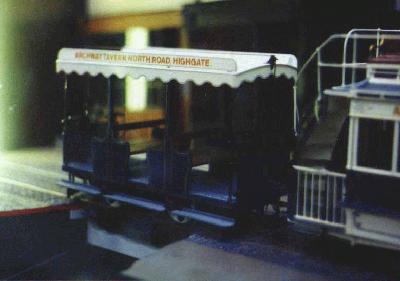
|
| Another view of the model Highgate Hill train at the London Transport Museum. Photo by Stuart Jenkins. |
Thanks to Stuart Jenkins for providing photographs of and information about Highgate Hill.
Go to top of page.
London - Brixton Cable Tramway

|
Kennington Changing-Place, where Brixton Road horse trams received cable grips for the trip up Brixton Hill. From "A Chat on a Cable Car" by The Reverend John P Hobson, M.A. September, 2010 Picture of the Month. |
line: Brixton Hill
opened: ??-???-1888. "near Kennington Park through the busy thoroughfares of Brixton, up Streatham-hill to a point near Streatham-hill Station" (from Tramways: Their Construction and Working, Embracing a Comprehensive History By Daniel Kinnear Clark - 1894)
extended: ??-Jun-1904. "The line from Brixton Cable Depot to Streatham Village was opened in June last" (from The Municipal Year Book and Public Services Directory, 1905)
powerhouse: Streatham
grip: double jaw side
gauge: 4'8 1/2"
cars: Initially single bogey, double deck horse trams pulled by grip cars with no passenger seating ("locomotives"). Later grips were attached directly to the horse trams
terminals: cross overs
crossings: N/A
notes: Brixton is a southern district of London. Horse-drawn trams could not climb the considerable hill towards Streatham, so the London Tramways Company built a cable tramway to carry the horse trams up the hill.
Initially, the horse trams were pulled by grip cars which did not carry passengers.
|
from The American Review of Reviews - Volume 17, 1898 - Page 86 MR. HIRAM S. MAXIM, the inventor, is contributing to the Engineering Magazine a series of articles on various differences in industrial conditions between England and the United States. He has been especially impressed by what he terms an ignorant prejudice in England against American products. This he illustrates with an amusing bit of personal experience : "A short time ago an American cable line was established in Brixton, a suburb of London. Upon first visiting Brixton I failed completely to recognize the system, as each car was provided with a small and extremely ugly locomotive. Upon closer inspection, however, I found that the locomotive carried simply the clamping device. Upon asking the 'driver,' or the man at the clamp, the object of the apparatus, he said: "' Oh, this is the locomotive. This draws the car.' "' Oh,' I said, 'how nice! Please explain it.' "'Well, underground here is a wire rope; this 'ere thing goes down through this 'ere slot and clamps the rope, and the rope pulls the locomotive, and the locomotive pulls the carriage, don't you see ?' "'What is the object of the locomotive?' "'Why, to draw the car, of course.' "'But why not put the clamp on the car and dispense with the locomotive altogether?' "After he had thought the matter over a short time, I asked again: "'What is the use of the locomotive ?' "His reply was: "I'll be hanged if I know.' "Now, if this system had been introduced into a country like Germany, France, or Spain the natives would have had sufficient respect and confidence in American engineers and systems to have put it up in the exact manner that it was imported; but as the English engineers were used to a locomotive and wished to make some change in the American model, they added the 'locomotive,' which certainly looks very awkward, and is, without question, superfluous." |
After some time, a grip was attached directly to the horse tram, allowing it to run on the cable-operated portion of the tramway.
"A Chat on a Cable Car" by The Reverend John P Hobson, M.A. describes a 1902 trip on the line. It includes an illustration of the grip being attached to a car.
|
from The Electrical Engineer - June 19, 1891 - Page 592 I find it ironic that this article about the Brixton Cable Tramway was obscured by a big sticker. This has always been an obscure line. - JT NOTES Cable Tramways. -- The South Metropolitan Tramways Company have begun the laying of the metals of their new extension from Brixton-hill to Telford-park. On this occasion, it is stated, the company will for the time adopt the cable system of traction ...(text obscured - JT) plan. It is understood that it ...(text obscured - JT) carry this system the whole way ...(text obscured - JT) the Streatham-hill terminus. We ...(text obscured - JT) electric traction has been raised in ...(text obscured - JT) than by sundry discussions amongst the company's own directors and engineers. When various systems -- Lineff and accumulators -- are being adopted, it seems rather premature to lay down a whole system of cable traction. |
|
from The Electrical Engineer - December 15, 1893 - Page 553 NOTES They Disliked the Bogies. -- Some of the inhabitants of Brixton have complained of the noise made by the cable cars. Major-General Hutchinson is to report to the Board of Trade as to whether or not a further license is to be granted to the company. |

|
A 1904 postcard shows London's Brixton Hill. |
|
from Tramways: Their Construction and Working, Embracing a Comprehensive History By Daniel Kinnear Clark - 1894 - Page 553-557 (Note: Figures referred to in this section are not available. - JT) The Brixton Cable Tramway of the London Tramways Company has a track length of 5 1/2 miles, to a gauge of 4 feet 8 1/2 inches ; and runs from near Kennington Park through the busy thoroughfares of Brixton, up Streatham-hill to a point near Streatham-hill Station. The depot, situated at the Streatham terminus, is of large dimensions, covering a piece of ground 370 feet by 110 feet. Its arrangement is shown in detail in Figs. 337 to 339 (Plates V. and VI.). It was built to accommodate the machinery and cars necessary for working an extension of the line to Streatham Common : a further distance of about three miles of route. The London tramway line was opened for horse traffic about the year 1875 ; and the cable tramway from Kennington to Telford Park, in December, 1892. The cable, about six miles in length in one rope, was manufactured of special steel, and it weighs about 30 tons. It runs along the road in a concrete tube, constructed centrally along both up and down tracks, somewhat similar to the arrangement in the case of the Edinburgh tramway shown in Figs. 318 and 319 (page 535). The tube, which is properly drained, is 19 inches deep and 9 inches wide. In the road, however, there is but a continuous slot 5/8 inch wide; this slot being formed by rolled steel slot-rails fixed to cast-iron yokes embedded in concrete. The speed of the cable is 8 miles per hour. In the tube on the straight road, at intervals of about 50 feet, vertical pulleys, as in Fig. 320, are placed, and on the curves horizontal pulleys (Fig. 321). at intervals proportionate to the curves. These pulleys carry the cable so that normally it is from 1 1/2 inches to 2 1/2 inches out of the centre line of the slot: no road dirt, therefore, falling on it. Over each pulley a hatch cover (Fig. 319) 18 inches by 9 inches, is placed in the road. This cover is fitted with wood blocks, and is very little distinguishable from the ordinary paving. At the Kennington terminus, large pulleys are provided for the purpose of passing the cable from the up line to the down line, similar to Fig. 322 (p. 538). At Streatham, similar pulleys are provided to pass the cable into the depot. Ordinary horse cars are employed on the line for passenger traffic, coupled to a cable car for the purposes of cable traction. On the cable car the gripping apparatus is mounted. Such a disposition was rendered necessary by the fact that at Kennington the passenger cars are despatched to three different termini by means of horses, and it was thought undesirable to increase the weight of their cars by the gripping apparatus. The cable cars simply carry the gripper and the driver, the Board of Trade objecting to their carrying passengers until after the line had been in operation for some time. Each cable car is provided with a double-jawed gripper, somewhat similar to Fig. 324--that is, a gripper which is capable of use on both the up and the down lines. The gripper is suspended from the car framing in such a way that it is free to move from left to right: a movement which is necessary when rounding the curves in the slot. The shank, which is 12 inches wide and 1/2 inch thick, passes through the slot, and is fitted with upper and lower jaws for gripping the cable. The upper jaw maintains a fixed level in the tube; whilst the lower jaw can be raised or lowered by means of the hand-wheel and screw, as seen, above the car floor, to the extent of 6 inches, thus rendering it possible to pick up the cable at any part of the road. Both jaws are lined with soft cast-iron dies, which are easily renewable. In rounding curves in the road a horizontal roller is provided in the gripper shank, and this then rolls on a recess in the slot rail. There are four double-furnace Babcock & Wilcox water-tube boilers, having a working pressure of 140 lbs. per square inch. They are provided with Vicars' mechanical stokers and coal elevators ; also an automatic arrangement for maintaining the steam steadily at one pressure without interference on the part of the man in charge. The arrangement is worked by a jet of steam from the boiler in such a way that as the pressure rises above the normal working pressure the stokers are stopped, and when it falls the stokers go on. Rain-water is collected in settling-tanks. The engines for driving the line are in duplicate. There are two pairs of high-pressure compound steam-engines with high-pressure cylinders of 20 inches, and low-pressure cylinders of 32 inches in diameter respectively, and the stroke of both is 50 inches. Each pair of engines is capable of driving 12 miles of cable with the necessary cars, and is now developing about half its maximum power, the high-pressure cylinders alone being used. One pair of engines is placed at each end of the first motion-shaft, the two cylinders driving on to a U crank and a disc crank respectively. The valve gear on the high-pressure cylinders is of the Proell type ; the low-pressure cylinders are fitted with Corliss valves. The motion of the engines is communicated to the counter or cable shaft by means of a rope-drive, which forms the chief feature of novelty in the engine-house. The ratio of the gearing is three to one, and the large wheel on the countershaft is 30 feet diameter. Each wheel is grooved for twenty-four 6 1/4-inch ropes, 2 inches in diameter. A rope drive was installed instead of gearing in order to insure a minimum of vibration and noise, the depot being built in a residential neighbourhood. At one end of the countershaft is a Mather & Piatt clutch of the outside grip pattern, which can be worked by means of a lever placed near the engine stop-valve, thus insuring complete control of the machinery from one point The clutch communicates the motion of the countershaft to the grip pulley, the pulley which moves the cable. A similar clutch and pulley are to be placed on the other end of the countershaft to drive the second cable when the extensions are made. The grip pulley is of the solid jaw type ; the jaw being a parallel groove running round the pulley, the cable resting on a small shoulder on either side of the jaw. The jaw, formed of white metal slabs cast in place, and renewable, is found not to do any harm to the cable. This method of drive should be contrasted with the present American practice--two Walker differential drums having three or four complete wraps of the cable, whereas a three-quarter lap is found to do the work in London, and has been found equal to any strain put on it. The cable, after leaving the grip pulley, is conducted by another wheel to the tension pulley, which is mounted on a wrought-iron carriage free to run on rails. A uniform tension is maintained on the cable by a weight suspended from the back of the tension carriage. The rise or fall of this weight is a perfect indicator of the amount of strain on the cable, and by watching its movements a very good idea may be gained of the fluctuations of the load which have to be provided for in a cable tramway, in order to insure the smooth and steady running of the cars on the road. The depot is built on a level 10 feet above the level of the main road, and the cars in returning to the shed have to mount a long incline of 1 in 20. An auxiliary rope is provided here, which is driven by a clutch on the countershaft, at a speed of about 2 1/2 miles per hour. It is so arranged that the cars can take this rope on the main line, mount the incline, and pass on to a traverser which commands the whole width of the car-shed, and is moved by another rope off the main engines. Machinery is provided for changing the cables on the main line, together with the necessary storage drums. Machines are also provided for doing all necessary repairs, such as slotting, planing, drilling, turning. The necessary power for driving all this machinery is obtained from the barring engine. A travelling crane is provided; of 55 feet span to lift 24 tons on two winches. This crane travels the whole length of the engine-house, which is 150 feet. Mr. W. N. Colam was the engineer for the whole of the work, including the buildings; Messrs. Dick, Kerr & Co. were the contractors for the road, gripping gear, engines, and most of the machinery; Messrs. Babcock & Wilcox supplied the boilers; Messrs. Cradock & Co. the cable; and Messrs. Lucas & Aird the buildings. The Company possess in their Brixton route one of the most complete installations for cable traction. They have applied to Parliament for an extension. |
Go to top of page.
Matlock, Derbyshire - Matlock Tramways Company, Ltd
Thank you to John Perkin for providing much of the information and almost all of the images in this article.

|
"Crown Square and Cable Tram, Matlock." The elaborate shelter still exists in another location. Source: Tramway and Light Railway Society Photographic Archive. |
line: Bank Road
opened: 28-March-1893. Bank Street from Crown Square to Wellington and Rutland Streets. Single track with one passing turnout.
powerhouse: Wellington and Rutland Streets
grip: Single-jaw side grip.
gauge: 3'6"
cars: double bogey, double deck with open upper deck, double end
turntables: According to one source, there was a loop at Crown Square. Upper end terminated in depot
crossings: none
notes: Matlock is a district in Derbyshire which was known from the 18th Century to the mid-20th Century for its hydrotherapy spas. Bank Street climbed a steep hill to reach some of the important spas.
Job Smith, proprietor of the Malvern House Hydro (spa) on Smedley Street, about halfway up the hill, visited San Francisco and saw its cable trams. One source said he did this in 1863, but that is not possible, as the first cable tram line, the Clay Street Hill Railroad, started service in 1873. He had the idea that a cable tramway would make life easier for visitors to Matlock. Smith joined with George Newnes, MP to promote a cable tramway for Matlock.
The line up Bank Street opened on 28-March-1893. It was about 5/8 miles long. The line started in Crown Square because the area from Crown Square to the railway station was subject to flooding. They built an elaborate shelter which still exists, having been moved to Hall Leys Park. The cable ran at 5 1/2 miles per hour.
The line was single tracked with a passing turnout and stop at Smedley Street, near Smith's Malvern House Hydro and Smedley's, the largest hydro spa in Matlock.

|
Matlock trams meet at the Smedley Street passing loop. Note the unusual usage of "cable cars" rather than "cable trams." Source: Tramway and Light Railway Society Photographic Archive. |
The line ended in the yard of the depot (Powerhouse and carbarn for my fellow Americans - JT), which still stands. The depot had a traverser (Transfer table - JT) to shift cars to storage tracks. The boiler and engine rooms were on a lower level. The boilers fed two horizontal engines, only one of which was used in regular service. In 1920, the steam engines in the powerplant were replaced by a "suction gas plant."
The double bogie, double deck cars carried a grip at each end and had wheel and track brakes.

|
A Matlock tram, lettered "Matlock Urban District Council Tramway." Note the advertisements for contractor John William Wildgoose and W. Pilkington Ph.C., Pharmaceutical and Photo Chemist. He offers a free dark room. Source: Tramway and Light Railway Society Photographic Archive. |
The line was never a great financial success. George Newnes, later Sir George, gradually bought out all of his partners and came to be the sole owner. He offered the company to the Matlock Council as a gift. Considering that the line was an important service to residents and visitors, the council accepted, so on 26-October-1898, the line became municipally operated. Fares at the time were one penny from Crown Square up to Smedley Street and one penny from Smedley Street to the depot. The downhill fare was one penny all the way from the Depot to Crown Square.
In the mid-1920s, a bus began operating from Crown Square to the depot by a winding route. On 23-September-1927, the Matlock Council decided to eliminate the cable tramway. On 30-September-1927, the cable broke for the last time, and service ended.

|
| An image of Sir George Newnes from "The Lynton and Barnstaple Railway," The Railway Magazine, May, 1898. |
|
from Our Railways: Their Origin, Development, Incident and Romance By John Pendleton - 1894 ... Mr. Newnes (George Newnes, M.P., later Sir George Newnes, Bart. - JT) has also given play to his engineering hobby at Matlock, his native place; and in March, 1893, opened at the Bridge an ingeniously constructed cable tramway, which, fitted with garden-seat cars, is a great convenience to visitors, and removes Defoe's quaint reproach, "This Matlock Bath would be much more frequented than it is if a bad stony road which leads to it, and no accomodation when you get there, did not hinder." |

|
Tramcars meet at the passing turnout. Source: Tramway and Light Railway Society Photographic Archive. |
|
from History, Topography, and Directory of Derbyshire By Bulmer (T.) - 1895 - Page 428 Not the least useful addition to Matlock Bank in recent years is the Steep Gradient Tramway, which was publicly opened on the 28th March, 1893, by Mr. George Newnes (now Sir George Newnes, Bart.). The inception of the scheme is due to Mr. Job Smith, and Mr. George Newnes, M.P., proprietor of "Tit-Bits," "The Strand Magazine," and other papers, and a native of Matlock, offered to finance the undertaking, but as several local gentlemen desired to have an interest in it a company was formed, with Mr. Newnes as chairman of the directors. The route selected is very steep, rising upwards of 800 feet in the half-mile length of the tram line. The cars are drawn by an endless cable, driven by a steam engine, and travel at the rate of 5 1/2 miles per hour. The trackway is single, except where the up and down cars pass each other. The cable -- a wire rope of the best steel -- runs in a channel below the surface in the centre of the trackway. This cable channel is wholly enclosed, except a narrow slot between steel rails laid 11/16 in. apart. The cars are attached to the cable by a gripper, which passes through the slot. The gripper is under the control of the driver, who can by a simple contrivance loosen the grip and stop the car, and he can as easily in a moment start it again. Each car is provided with two of the most powerful brakes -- one the ordinary working brake, the other the emergency brake -- and so efficiently does this act that the car can be brought to a dead stop in a distance less than its own length. Cable traction has long been in use on gradients in the mining districts, but this is the first instance in this country where it has been applied to passenger traffic. From the Directory Wildgoose Geo., (a relative of John William Wildgoose? - JT) foreman of works, The Matlock Cable Tramway Co., Litd.; h Church street, Matlock Green
Advertisement Rockside Hydro; Miss A.E. Goodwin, manageress. Elevation, 800 feet above sea level; re-furnished throughout; commands finest view in Matlock; under new management; Cable tram service from Matlock Bridge to front gate |
| Car 3 carries a good load up the hill. Note the gripman at his post on the front platform. Also note the lack of advertising. I would want to ride upstairs. Source: Tramway and Light Railway Society Photographic Archive. May, 2010 Picture of the Month. |

|
| Another view of Car 3, now heavily draped with advertising and lettered for the "Matlock Urban District Council Tramway." I wonder if the Council turned to advertising in an effort to reduce the subsidies to the line. Source: Tramway and Light Railway Society Photographic Archive. |

|

|
A Matlock cable tram breasts the floodwaters in Crown Square. Floods caused serious problems for two cable tramways in Los Angeles, introducing lots of grit into the sheaves. This tram appears to be placidly sailing along. Source: Tramway and Light Railway Society Photographic Archive. |
|
from Matlock Manor and Parish: Historical & Descriptive By Benjamin Bryan - 1903
The cable tramway was stopped owing to the water flooding the underground wheels in Crown Square. |
|

|
| An ad for the Rockside Hydropathic says: "CABLE TRAM FROM STATION TO FRONT GATE." From Black's Guide to Edinburgh, 1903. |
|
from Tramways: Their Construction and Working By Daniel Kinnear Clark - 1894 - Page 552-553 The Matlock Cable Tramway, opened in Easter, 1893, is a short line 5/8 mile in length, presenting unique features of construction and application much appreciated by the residents in the district. The track is all single line, with one passing place, and on the single line are six curves from 180 feet to 1,000 feet in radius. The average gradient is 1 in 7.7, and the steepest is 1 in 5. There is a rise of 300 feet in 770 yards. The width of road is in many places only 20 feet. Car brakes are provided of sufficient power to stop a loaded car on the steepest grade when running free after having left the cable. Each car is provided with two brakes, a wheel and a rail brake. The construction of the track is similar to that of the Edinburgh Northern Cable Tramways, but special pulleys were designed to take the cable round the curves. The gauge of the way is 3 1/2 feet. The speed of the rope is 5 1/2 miles per hour. The driving plant at the depot is in duplicate, and consists of two Sinclair boilers fitted with mechanical stokers, and a pair of high-pressure steam-engines with cylinders of 14 inches diameter and 28-inch stroke, with Proell valve gear. The grip pulley, cable gearing, and car grippers are similar to those supplied for the Edinburgh cable lines. The cars are double-deckers, and have garden seats both inside and outside, seating 31 passengers. The whole of the permanent way, engines, boilers, cars, and cables were provided through Messrs. Dick, Kerr & Co. to the designs of Mr. W. N. Colam. Mr. Croydon Marks was engineer to the company. |
Go to top of page.
Other Cities
|
from The Electrical Engineer - September 23, 1892 - Page 318 NOTES Bradford Tramways. -- The Bradford Tramways Committee report that the engineers of the committee lead them to believe that electric traction, like the cable system, would be too costly for them to adopt, and that steam traction would be the best system. It is a pity some electrical firm could not convince them of the advantages of electric traction, for a (sic - JT) entirely opposite view has been taken in America, where whole sets of steam and cable cars are laid aside for electric cars. |
|
from The Electrical Engineer - December 15, 1893 - Page 553 NOTES Traction at Newcastle. -- A scheme is under consideration for the adoption of cable trams in this town. A local paper dismissed the question a few days ago, and compared the cost of working the different systems of haulage introduced on the lines of the Birmingham Central Tramways Company. |
London - London and Blackwall Railway

|
Marsh Station on the London and Blackwall Railway. A train is visible on the viaduct. I can't find Marsh Station on a map of the line. I wonder if it is Poplar. October, 2010 Picture of the Month. Source: The Literary World, July 11, 1840. |
The Commercial Railway was incorporated in 1836 to build a railroad from the Minories, an area in the City of London, to Blackwall, in the East End. Blackwall was a center of shipping and shipbuilding. The operators were reluctant to use steam locomotives because of the danger of fire in the crowded areas through which the line would pass, and because of a desire to provide service every 15 minutes. "At an extraordinary general meeting of the shareholders of the company, held yesterday, the report of Messrs. Stephenson and Bidder, recommending the use of two stationary engines to work the trains instead of locomotives, was adopted." (Source: Mechanic's Magazine, January 20, 1838).
Robert Stepenson was a pioneering railway engineer who had designed the locomotive Rocket for the Liverpool and Manchester Railway's Rainhill Trials in 1827. George Parker Bidder had been known as a "calculating boy" who could perform complex mathematics in his head. Accoring to the the 1910 Encyclopædia Britannica, it was Bidder "who designed the peculiar method of disconnecting a carriage at each station while the rest of the train went on without stopping, which was employed in the early days of that line when it was worked by means of a cable."
Built and opened in 1840 as the London and Blackwall Railway, the 3.75 mile line (after a short extension from Minories to Fenchurch) had two tracks, which were operated independently. Track gauge has been reported in different sources as 5 feet or 5' 1/2". Almost the entire line was built on viaducts. There was a steam engine at each end of each track, 110 horsepower at the London end and 75 horsepower at the Blackwall end. Trains from Blackwall to London were going generally uphill, so the London engines needed more power to pull them.
Coordinating operations on the line required an early use of William Cooke and Charles Wheatstone's electric telegraph.
When a train was ready to leave Fenchurch Street, an operator on each carriage would use George Bidder's device to grip or pin the rope. A telegraph signal would tell the engineer in Blackwall to start his steam engine, which would begin to wind up the rope. At the same time, the engineer at the London end would release the sheave to allow the cable wound up there to unspool freely, and the operators would release the brakes on the carriages.
When the train approached the first intermediate station, Shadwell, the operator on the last carrriage would release or slip the rope. The carriage would coast into the station and the operator would apply the brakes to stop in the appropriate place. One or more carriages would slip the rope at each intermediate station. When the last carriage or carriages arrived at Blackwall, the engineer would stop the winding engine and a signal would tell the London engineer to apply the brakes to his sheave. When the cable stopped, the operator on each carriage would grip or pin the stopped rope.
When it was time for the return trip, all the carriages would already be pinned to the rope. A telegraph signal to London would tell the engineer to start his engine and begin winding the rope. The Blackwall engineer would allow his sheave to turn freely.
As each carriage reached Fenchurch station, the operator would slip the rope and coast into the station. When the last carriages arrived at Fenchurch, the London engineer would stop his engine and a telegraph signal would tell the Blackwall engineer to stop his sheave.
This system allowed for a train every 15 minutes each way. Passengers could not travel directly from one intermediate station to another. They would have to ride to the London terminal and then take a train to the other intermediate station. The system also ran into problems with rope life and with twisting, which led to experiments with wire rope. Wire ropes had problems with kinking.
Trains consisted of 4 to 8 passenger carriages and could include one or two goods carriages (freight cars).

|
Blackwall terminus on the London and Blackwall Railway. Source: The Mirror, March 27, 1841. |
From Blackwall Station, passengers could connect with steamboats to Greenwich, Woolwich, Gravesend, and Margate. Taking the train and getting on the boat in Blackwall was faster than taking the boat all the way from London.
In 1848, the line converted to use steam locomotives and changed to standard gauge (4' 8 1/2"). This allowed the line to make extensions and connections. The London and Blackwall continued to be used until large sections were abandoned in the 1960s.
In 1987, the Docklands Light Railway, an automated electric line, used many of the remaining viaducts of the London and Blackwall Railway.
|
from London by Charles Knight - 1851 - Page 311-312 I added some paragraph breaks to make it more readable (JT) The London and Blackwall Railway has some peculiarly individual features to distinguish it from the other metropolitan Railways, arising chiefly from the fact that no locomotive engines are used on it, and that it is necessary to set down passengers very frequently. Accordingly, there is an endless rope, nearly six and a half miles long, or double the length of the Railway, attached to two powerful engines, one in Blackwall and one in London. A train starting from the latter is so arranged as that the Blackwall carriages shall be foremost, and the carriages for all intermediate stations similarly placed in order. At a signal, given by means of the electric telegraph, the Blackwall engine begins to wind up the rope, thereby drawing the carriages attached towards it. On approaching the first station the carriage destined for it is detached from the train by the guard, and stopped by a brake; and the same proceeding takes place at all the other stations. Whilst drawing the train the Blackwall engine has at the same time of course unwound the other part of the rope attached to the London engine, which, in its turn winding up, draws back the train, with all the carriages, which before starting have been attached to the rope, wherever they were, so that they come in with a rather sserious-looking want of unanimity, but of course they all do come in by dint of sufficient winding-up of the rope, and so the carriages are again collected together. The same line therefore, it will be seen, is used both for going and returning. A stranger to the Railway, after reading this account, may be surprised to hear that by such means, and hampered with such difficulties, the Blackwall Railway will take him along at a rate varying from twenty to thirty miles an hour. Yet so it is. And is a great measure this has been accomplished through that beautidul invention of our own times, the electric telegraph. Its importance here may be understood when we state that is it not only necessary for the attendants at each terminus to know when the train is about to start from the opposite extremity of the line, but also when the carriages at all five intermediate stations are ready; there must be, in short, an almost instantaneous communication, whenever required, through the entire line -- and this is obtained by means of the telegraph. ... A wire, then, is laid down from London to Blackwall, connected where required with certain small instruments containing a needle so fixed that it moves either towards the left or the right, in accordance with the direction given to the current passed through it; the one movement intimating "stop," the other "go on;" those who desire to give the signal previously ringing a bell placed above the dial in the place where the signal is to be received, and which is also managed by an ingenious application of the voltaic stream. Of couse the communication between the battery of any particular station and the general wire may interrupted or continued as required. |
|
from Notes and Queries by William John Thomas et al. - 1907 - Page 292 Responding to a query about early railways using open carriages. The correspondant remembered his boyhood in the East End (1860-1870). "On the London and Blackwall Railway the third-class "smoking" compartments had no seats, and sides only shoulder high, the men inside leaning over them with their pipes in their mouths. S. D. CLIPPINGDALE." |
|
from Railway Economy: A Treatise on the New Art of Transport, Its Management, Prospects and Relations by Dionysius Lardner - 1850 - Page 110 PLAIN RULES FOR RAILWAY TRAVELLERS RULE II -- NEVER ATTEMPT TO GET INTO A RAILWAY carriage when it is in motion, no matter how slow the motion may seem to be.
|
London - Euston to Camden Incline
London - The Tower Subway
|
from Old and New London: A Narrative of Its History, Its People and Its Places
By Walter Thornbury, Edward Walford - 1881 - page 123
The Thames tube is 7 feet in clear internal diameter, and it originally carried a railway of 2 feet 6 inches gauge. On this railway formerly ran an omnibus capable of conveying twelve passengers. The omnibus was constructed of iron; it was light, but very strong, and ran upon eight wheels, and was connected with a rope of steel wire by a means of a gripe that could be at any time tightened or relaxed at pleasure, and at each end of the tunnel this wire ran over a drum worked by means of a stationary engine. If the carriage was stopped in the centre of the tunnel, the beat of the paddles of the steamers above could be heard, and even the hammering on board ships. In time there will be subways at Gravesend, Wollwich and Greenwich; and it has also been proposed to form one from St. George's Church in the Borough to Cannon Street. The Tower suway is now only used for foot-passengers, at a charge of one halfpenny. |
|
from London and Its Environs by Karl Baedeker - 1889 - Page 126 On the S. side of Tower Hill is the Tower Subway, a tunnel constructed by Barlow in 1870, passing under the Thames, and leading to Tooley Street (corrupted from St. Olave Street) on the right (Southwark) bank. This gloomy and unpleasant passage consists of an iron tube 400 yds. long and 7 ft. in diameter, orignially traversed by a tramway-car, but now used by pedestrians only. A winding staircase of 96 steps descends to it on each side (1/2d.). The subway was made in less than a year, at a cost of 20,000l. |
London's Tower Subway ran under the Thames from Tower Hill to Pickleherring Street (great name) on the south bank. The tube through which it ran was built by engineer Peter William Barlow and his assistant, James Henry Greathead. Greathead developed the Greathead Shield, an iron cylinder about 8 feet in diameter with a square door at the front to allow the miners access to the clay work face. The miners used hand tools to dig away the clay in front of the shield, and then hydraulic rams pushed the shield forward. Then iron tunnel lining was bolted into place to form a tube.

|
"Interior of Carriage" on the Tower Subway. From The Illustrated London News, 1870. |
The tube was not suitable for steam traction and electric traction was not sufficiently developed, so it opened with cable traction on narrow gauge rails. The cable system used a single car permanently attached to an an endless cable, which was driven by a stationary steam engine at one terminal. The line opened on 02-Aug-1870, but it was not reliable and and the tube was converted to a pedestrian walkway by November, 1870.
When Tower Bridge opened in 1894, the tube walkway was closed to the public and the tube was used as a water pipe conduit. Today it also carries fiber optic cables.
In 1886, Greathead used a larger version of his shield to dig a tube for the City and South London Railway under the Thames near London Bridge. Greathead proposed cable traction for the City and South London, but it was built as an electric line and was the first successful tube railway.
Go to top of page.
London - City and South London Railway
James Henry Greathead, who had developed the shield used to dig the Tower Subway, was hired to build London's first tube railway, the City and South London. Previous underground lines had run through shallow ditches, constructed using cut-and-cover methods. Because of the shallow construction, the early underground lines, like the pioneering Metropolitan Railway, were able to use steam locomotives to pull their trains. The tunnels were dark, smoky, and uncomfortable, but people were able to breathe enough air to stay alive.

|
A Greathead shield. From The Railway Magazine, "Illustrated Interviews/No. 25. -- Mr. Thomas Chellew Jenkin/ General Manager, City and South London Railway", July, 1899. |
A deep tube railway would not be able to provide enough oxygen to support steam locomotives and live passengers and crew members, so another form of power was required. The promoters initially proposed using cable traction.
|
from The City and South London Railway
By James Henry Greathead (himself) - 1896 - page 7
The Act prohibited the use of steam locomotives, and the original intention was to use the endless-cable system of haulage. There were to be two cables, one between the City and the "Elephant and Castle," the other between the "Elephant and Castle" and Stockwell, and it was intended in the first instance to drive the former at 10 miles per hour and the latter, the line being straighter and more level, at 12 miles per hour. For this reason the tunnels on the latter section were made somewhat larger than those on the first section, viz. 10 feet 6 inches in diameter instead of 10 feet 2 inches. Owing to the progress made in electric traction during the construction of the line, it was determined to adopt that motive power in preference to the endless cable, which will, however, receive a trial shortly on the Glasgow District Subway. |
|
from Transport World,
"THE LATE MR. C. G. MOTT." - December 7, 1905 - page 579
While Mr. Greathead had the privilege of designing the work and carrying it out, Mr. (Charles Grey) Mott achieved the then difficult task of raising the necessary capital. Originally it was intended that the subway should be worked by cable traction, as the use of steam locomotives was impossible on such a line. Mr. Mott was looking into the question of the motive power to be used when he came to a conclusion which, apart from anything else, decided him against cable haulage. The story which we have been told, and of which there is no reason to doubt the authenticity, is that when the features of cable traction were pointed out to him he asked how a train was to be got back to a station platform should the driver overshoot the station. He was told that it was not possible to reverse the train, as it could only move in the direction in which the cable was travelling. He thereupon said that he would have nothing to do with the cable system if anything which would meet his point could be found. As a matter of fact, one has never heard of any difficulty of the sort arising in practice on the Glasgow District Subway, where cable traction is used; but that line did not come into existence till years after the time of which we are writing. |

|
Carriage interior. From The Railway Magazine, "Illustrated Interviews/No. 25. -- Mr. Thomas Chellew Jenkin/ General Manager, City and South London Railway", July, 1899. |
|
from The Air and Ventilation of Subways
By George Albert Soper - 1908 - page 3
The pioneer deep tube subway under city streets was the City and South London and was opened for traffic in 1890. It is about three miles long and, like practically all deep-lying roads, is composed of two metal-lined tubes running side by side. This road has been very successful, carrying in the first year of operation about 2,400,000 passengers. It was the first important city subway to be operated by electricity. The original intention was to use an endless cable for moving the trains. |
By the time the line was built, electric traction had developed sufficiently to allow the use of electric locomotives to pull the trains.

|
Locomotive 16. From The Railway Magazine, "Illustrated Interviews/No. 25. -- Mr. Thomas Chellew Jenkin/ General Manager, City and South London Railway", July, 1899. |
|
from The Romance of Modern Engineering
By Archibald Williams - 1908 - page 196
The City and South London Railway, extending under the Thames from the Monument to Stockwell, a distance of 3 1/2 miles, was begun in 1886 by Greathead. Its promoters originally intended to operate it by an endless cable, but during its construction electric traction developed sufficiently to be applied to this first of tube railways. The tunnels, running parallel, are 10 feet 2 inches in diameter. |

|
Stockwell Station platform. From The Railway Magazine, "Illustrated Interviews/No. 25. -- Mr. Thomas Chellew Jenkin/ General Manager, City and South London Railway", July, 1899. |
|
from The City and South London Railway
By James Henry Greathead (himself) - 1896 - page 12-13
Gradients and Curves. -- As has been already stated, it was originally intended to work the traffic by the endless cable system. The gradients and curves adopted were, consequently, steeper and sharper than would have been contemplated for a line to be worked by locomotives. The curves, however, could not have been reduced without taking an altogether different route, involving risk of serious opposition or heavy expense for right of way under buildings, or both. Dip or Depression between Stations. -- On a line with frequent stations and where all trains stop at every station, the provision of a certain dip or depression between the stations, depending upon the maximum speed allowable, is of great advantage to the obtaining of a good average speed and economy of power... This principle, which has often been proposed, but which cannot be fully realised in practice, has been carried out where practicable on the City and South London Railway, to the extent of accelerating up to the cable speed originally intended, viz., 12 miles per hour; it is found to be of great advantage in working the line. It would give an additional advantage in working by cable, by reducing the destructive slip between the cable and the gripper while accelerating, thus greatly prolonging the life of the cable. |

|
Stockwell Station. From The Railway Magazine, "Illustrated Interviews/No. 25. -- Mr. Thomas Chellew Jenkin/ General Manager, City and South London Railway", July, 1899. |

|
Carriage shed. From The Railway Magazine, "Illustrated Interviews/No. 25. -- Mr. Thomas Chellew Jenkin/ General Manager, City and South London Railway", July, 1899. |
Go to top of page.
Llandudno, Wales - Great Orme Tramway

|
Great Orme Tramway car 5 (Saint Silio) rolls into Victoria Station. Photo by Martin Schönherr. All rights reserved. August, 2002 Picture of the Month. |

|
A stretch of single track on the lower section of the Great Orme Tramway. Photo by Martin Schönherr. All rights reserved. |

|
Great Orme Tramway car on the lower line. |
|
from London and Its Environs by Karl Baedeker - 1906 - Page 297-8 Llandudno. Cable Tramway from Church Walks to the top of the Great Orme (6d.). Visitors should not omit to ascend to the top of the Great Orme, either by cable-tramway (p. 297) or on foot ... The tramway ends at the Telegraph Station (inn) on the summit. |
The seaside town of Llandudno lies on the coast of North Wales between the Great and Little Orme headlands. Llandudno became a popular resort town during the Nineteenth Century. Promoters decided that a cable tramway to the top of Great Orme would be a big draw.
The tramway, which operates only from March to November, consists of two funiculars, the lower line and the upper. The lower line, which opened on 31-Jul-1902, starts in Llandudno at Victoria Station. The first half of the lower section is single-tracked through the streets of Llandudno with the cable in a conduit. There is a switch at the mid-point where the line splits to a passing loop and then to gauntlet tracks. This keeps the cable centrally attached to each car away from the other. This is the only street-running funicular outside of Portugal.
The two lines meet at Halfway Station, where passengers transfer from the lower section to the upper. The upper line, which opened on 08-Jul-1903, is a counterbalanced funicular with an automatic passing loop in the middle. It has all gauntlet track except for the passing track. The upper section runs entirely on private right of way and uses an endless rope, attached off-center on each car. The upper section terminates at Summit Station, which is part of the Great Orme Country Park Visitors' Centre.
The gauge of each section is 3'6". The cars carry trolley poles and a wire runs above the entire line, but the poles and wire were for communication between the cars and the winding house, rather than for power. Wireless radios have been used since 1990.
The cables were steam-driven until 1957 when the winding house at Halfway Station switched to electric power. The cables and tracks run through the two car houses at Halfway Station.
Cars 4 (Saint Tudno) and 5 (Saint Silio) work the lower section. Cars 6 (Saint Seiriol) and 7 (Saint Trillo) work the upper section. Work cars 1-3 were scrapped before 1930. The cars have trolley poles on their roofs. These were used for communication. Communication has been wireless since 1991.
On 23-Aug-1932 the system had its only fatal accident. Car 4 became detached from the cable while descending the lower section. The car derailed and killed the operator and a 12-year-old passenger.
On 30-Apr-2000, the two cars on the upper line collided at the passing loop and 17 people were injured. The accident was probably caused by a problem with the automatic switch. The upper line reopened for the 2002 season.
The tramway is now owned by the Conwy County Council.
Special thanks to Martin Schönherr for sharing his beautiful photos. Visit his website.
|
Great Orme Tramway car on the lower line looking down towards Llandudno. Note the cable slot and gauntlet tracks. |

|
Car 7 on the upper section of the Great Orme Tramway. Photo by Martin Schönherr. All rights reserved. |

|
A dramatic view of the passing loop on the upper section of the Great Orme Tramway. Photo by Martin Schönherr. All rights reserved. |

|
A cachet issued in 1972 for the 70th anniversary of the opening. |
Visit the Great Orme Tramway official site.
Read Walter Rice's article "The Great Orme Tramway: The Cable Car of Wales".
The Great Orme Summit complex, was once owned by middleweight champ Randy Turpin.
Danger Ahead has a preliminary report on the 30-Apr-2000 accident.


