This article, from The Street Railway Journal, September, 1893, describes the new cable plant of the Baltimore City Passenger Railway.
The New Cable Plant of the Baltimore City Passenger Railway.
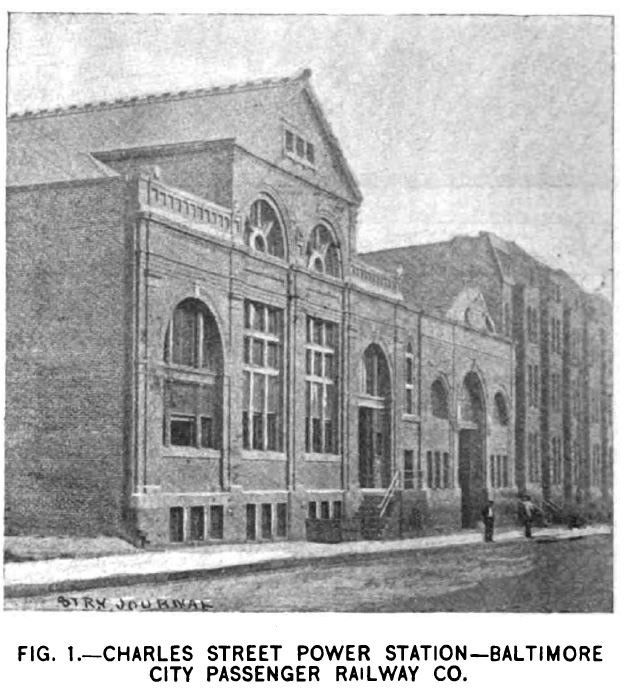
|
The extensive cable plant in Baltimore, upon which the City Passenger Railway Company of that city has been at work for a little over a year, has been finally completed, and on May 23, the Blue or Charles Street line was started on July 23, the Red or Gay Street line, and on August 20, the White or Madison Avenue line. These lines are operated from three stations, located on Charles Street near Landvale, on the corner of Baltimore and East Streets. and on Eutaw Street near Cider Alley.

|
The Blue line is a comparatively short, independent division running from Huntingdon Avenue to St. Paul Street, down St. Paul Street to North Avenue, then to Charles Street, to Read Street, to Calvert Street, thence to the corner of Calvert and Baltimore Streets, a distance of about two and a quarter miles. Free transfers are given at this corner to all the other lines of the system.
The Eutaw Street and Baltimore Street houses operate cables for both Red and White lines. The portion from Gay Street to Eutaw in Baltimore Street is common to both lines.
The Blue line is composed of 21,406 ft. of tangent and 1,128 ft. of curve. Power tests by indicator diagrams show that power required to drive the machinery and cable alone was 173 H. P. The variations of load, with eleven trains of ten cars each, were from 275 to 450 H. P. The average load from cards yet taken is about 274 H. P. The larger stations have not been indicated yet. The Red line has 50,014 ft. of tangent and 859 ft. of curve. The White line has 45,116 ft. of tangent and 1,670 ft. of curve. No loops are used at termini, two crossover switches in each case being used.
The cable driving machinery was supplied by Robert Poole & Son Company, and Walker differential drums are used. The driving drums measure 8 ft. 6 ins. in diameter, and the driven drums 24 ft., the two being connected by twenty two-inch cotton ropes. The cable drums are thirteen feet in diameter. One cable, one and a quarter inches in diameter, Lang's lay, and 23,400 ft. in length, is driven at a speed of nine and a half miles per hour. Upton tension carriages are used in all stations.
The foundations for the driving machinery are of brick, twelve feet in depth, and rest on one foot of concrete. The boiler room measures 37 ft. 6 ins. X 62 ft., and contains three Campbell 8! Zell boilers of 150 11. P., each equipped with Roney mechanical stokers. The feed water heater is of the Reynolds type, and Worthington feed pumps, 6 X 4 X 6 ins., are used. Fairbanks gate valves are used throughout all the stations. Water is taken from the city mains. The stack is 110 ft. in height, with four foot flue. Adjoining the boiler room is a commodious coal storage room 30 X 33 ft. 6 ins.
The station is lighted by an isolated electric plant consisting of a General Electric eight and a half kilowatt generator driven by a Payne engine which also supplies current for lighting the car barn adjoining. The latter, which is 180 X 56 ft., contains four plain tracks and two open for the inspection of grips, transfer table, etc.
From this station is operated at present twelve trains of two cars each. The grip cars were bullt by the J. G. Brill Company, of Philadelphia, and are similar to those in use in Chicago, Cleveland and Washington. They are equipped with a double, side jaw grip, manufactured from designs furnished by the engineers of the railway company. The Baltimore Car Wheel Company's running gear is used. The trail cars are sixteen feet in length. The bodies come from the Brill works, while the gears were designed by j. M. Blondell, master mechanic of the road. Whitney wheels are employed. The rails used on this line were supplied by the Pennsylvania Steel Company, and weigh seventy-five pounds to the yard. Joint connections are made by twenty-four inch splice bars, with six one inch bolts. The slot rail is of a type designed by the company, and was rolled by the Cambria Steel Company. The curve sheaves are of chille diron, and are thirty-six inches in diameter. The carrier sheaves are fourteen inches on the fast ropes and ten inches on the slow ropes. They were supplied by Davies & Thomas, of Catasauqua, Pa. There are five cable crossings, and these were supplied by the Pennsylvania Steel Company and the Indianapolis Frog & Switch Company, from designs furnished by the engineers of the railway company. A large amount of special track was furnished by the Weir Frog Company. The smallest radius used on curves is forty feet, and the largest 250 ft.

|
The engine room measures 92 X 81 ft., and contains two Allis tandem compound, non-condensing engines with cylinders 22 and 36 X 60 ins. Walker driving machinery is used. The driving drums measure 8 ft. 6 ins. in diageter, and the driven drums 24 ft. each. Two ropes are driven from this station. That on Gay Street is driven by drums 13 ft. in diameter and that on East Baltimore Street 14 ft. The two cables measure, respectively, 27,500 and 14,000 ft. in length, and travel at nine and eleven miles per hour.
All cables were furnished by John A. Roebling's Sons Company, one and a quarter inches in diameter, and Lang's lay.
The boiler room of the Baltimore Street power station measures 48 ft. 6 ins. X 41 ft. 6 ins. The boilers are of 210 H. P. capacity each, and Were supplied by Campbell & Zell, of Baltimore. Worthington duplex pumps, 7 1/2 X 4 1/2 X 6 are used, and the Berryman feed water heater is employed. The boilers in all stations use the Roney mechanical stoker. The coal storage room in this station is 41 ft. 6 ins. X 31 ft., and the station has an isolated lighting plant of the same character as the Charles Street power station.

|
The contractors on the White and Red lines were E. D. Smith & Son, of Philadelphia, and on the Blue line E. Saxton, of Kansas City. The architect for the power houses was Jackson C. Gott of Baltimore. The chief engineer of the Baltimore City Passenger Railway is A. N. Connett, to whose kindness we are indebted for the facts in the accompanying article.
Go to top of page.