|
Where Should I Go from Here?
Visit the Map
If you came to this page from an outside link, you may want to see the Picture of the Month and visit my main page. |
- Melbourne - Melbourne Tramways & Omnibus Company
- Sydney - New South Wales Government Tramways
- Dunedin - Cable Tramways in Dunedin
- Wellington - Kelburn Cable Car
- Penang Hills Funicular Railway (It's not in Australia, but it's in the same hemisphere)
Melbourne - Melbourne Tramways & Omnibus Company
|
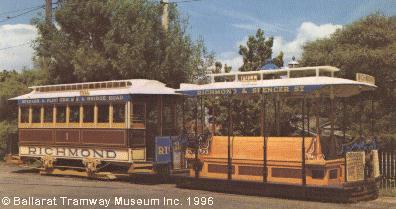
The first Melbourne cable train is preserved at Scienceworks. Photograph used with kind permission of Andrew Cox at the Ballarat Vintage Tramway. Jul, 1998 Picture of the Month. |
I've started this section with a minimum amount of information about Melbourne's cable trams. I would happily accept any information from people who know more than I do. Thanks to Peter Vawser for supplying several useful items. There must be many people living in Melbourne who still remember the cable trams.
Melbourne had an extensive network of cable trams, which was remarkably long-lived. Its longetivity was remarkable because most lines did not have heavy grades.
line: Spencer Street-Richmond
opened: 11-Nov-1885. Spencer from Bourke to Flinders, Flinders to Wellington Parade, Bridge Road to Hawthorne Bridge
powerhouse: Bridge Road, NE at Hoddle Street. Demolished for a left turn lane.
grip: Single-jaw side grip.
gauge: 4'8 1/2"
cars: dummy & trailer trains. double-ended.
turntables: crossovers
crossings:
line: North Fitzroy
opened: 02-Oct-1886.
powerhouse: Victoria Parade, NE at Brunswick Street
line: Victoria Bridge
opened: 22-Nov-1886.
powerhouse: Victoria Parade, NE at Brunswick Street
line: Clifton Hill
opened: 10-Aug-1887.
powerhouse: Nicholson Street, SE at Gertrude Street
line: Nicholson Street
opened: 30-Aug-1887.
powerhouse: Nicholson Street, SE at Gertrude Street
line: Brunswick
opened: 01-Oct-1887.
powerhouse: Brunswick Road, NW at Black Street
line: Johnston Street Bridge (Carlton)
opened: 21-Dec-1887.
powerhouse: Johnston Street, N side near Brunswick Street
line: Brighton Road
opened: 11-Oct-1888.
powerhouse: Saint Kilda Road, SE at Bromby Street
line: Prahran
opened: 26-Oct-1888.
powerhouse: Toorak Road, NW at Chapel Street
line: North Carlton
opened: 09-Feb-1889.
powerhouse: Rathdown Street, SW at Park Street
line: Toorak
opened: 15-Feb-1889.
powerhouse: Toorak Road, NW at Chapel Street
line: North Melbourne
opened: 03-Mar-1890.
powerhouse: Queensberry Street, SW at Abbotsford Street
line: West Melbourne
opened: 18-Apr-1890.
powerhouse: Queensberry Street, SW at Abbotsford Street
line: South Melbourne
opened: 17-Jun-1890.
powerhouse: City Road, S side near Cecil Street
line: Port Melbourne
opened: 20-Jun-1890.
powerhouse: City Road, S side near Cecil Street
line: Windsor-Saint Kilda Esplanade
opened: 17-Oct-1891.
powerhouse: Wellington Street, N side near Marlton Crescent
Independent line
line: Northcote
opened: 18-Feb-1890.
powerhouse: High Street, NE at Martin Street. Now occupied by Brown's Motors, an automobile service and repair business.
notes:
The entire system was operated by one company, the Melbourne Tramways & Omnibus Company. The first line opened on 11-Nov-1885. The company was founded by Francis Boardman Clapp, an American emigrant who had purchased the Victorian rights to Andrew S Hallidie's cable patents.
The local councils of Melbourne formed the Melbourne Tramways Trust to build tracks and powerhouses for new lines, which were then leased to the Melbourne Tramways & Omnibus Company. The company also operated connecting horse tram lines. Later, other companies built electric lines.
Engineer George S Duncan, who had built the Roslyn Tramway in Dunedin, New Zealand, the first cable tramway outside of San Francisco, was also responsible for the Melbourne Tramways & Omnibus Company's lines. His brother Alfred Duncan, who had been the engineer for the North Sydney cable car line in Sydney, Australia, later came to work on the Melbourne lines.
The first order of grip cars and trailers was built by the John Stepenson Company of New York, NY.
The major cable lines survived until the 1920's, after the city formed the Melbourne & Metropolitan Tramways Board (1919) to consolidate public transit. The first major line to close was the Windsor-Saint Kilda Esplanade line on 25-Aug-1925. The Richmond line closed on 29-Jun-1927. Other lines closed until the Great Depression stalled conversions. The last Melbourne cable tram operated on 26-Oct-1940.
Northcote was built as an independent line but was eventually taken over by the Melbourne & Metropolitan Tramways Board.
Portland Cable Trams Inc is restoring a Melbourne cable tram, which it will operate with Diesel power. The grip car is a reproduction, but the trailer, Number 95, is original. They hope to start service in December, 2000. The track will be 3.7 kilometers.
The Melbourne Public Transport Corporation Photographic Archive has many wonderful pictures of cable trams.
Visit David Hoadley's Trams of Australia for information about all kinds of Australian trams.
Clive Mottram's Tramway and Trolleybus Images, has a nice collection of transit-related photos in Australia. Thanks to Clive for providing some useful information for this article.
There is an interesting site about an existing Australian funicular, the
Katoomba Scenic Railway (which is not in Melbourne).

|
Gertrude Street Cable Winding House, photographed in 2001 by Bob Murphy. He believes the building is still used as Central Control. Thanks to Bob for the picture. |

|
A view of the North Melbourne Winding House, photographed in 2001 by Bob Murphy. He points out that it emphasizes that trams still run on the old cable routes. This is an A class tram. Thanks to Bob for the picture. |

|
Another view of the North Melbourne Winding House, Queensberry Street, SW at Abbotsford Street, photographed in 2001 by Bob Murphy. Thanks to Bob for the picture. |

|
Another view of the North Melbourne Winding House, also photographed in 2001 by Bob Murphy. Note the stump of the chimney in the rear. Thanks to Bob for the picture. |

|
Collins Street with two cable trams. Photographed by William Henry Jackson in 1895. (Source: World's Transportation Commission Photograph Collection (Library of Congress) Call Number: LOT 11948, no. 660). |
Go to top of page.
Sydney - New South Wales Government Tramways
Sydney claims to be the only Australian city to have used horse, steam, cable, and electric traction.
line: North Sydney

|
North Sydney cable tram. Smaller version. Photo courtesy of Ric Francis. Visit his Western Australian Trams site. December, 2001 Picture of the Month. |

opened: 22-May-1886. Alfred Street from Milsons Point Wharf to Junction, to Blue, Miller to Ridge Street
extended: 17-Jul-1893. Miller to Falcon Street to Lane Cove Road (later Pacific Highway) at Crows Nest
powerhouse: Miller and Ridge.
grip: single-jaw side
gauge: 4'8 1/2"
cars: dummy & trailer trains. double-ended. Some trains carried two trailers.
turntables: crossovers. Turntable at Miller and Ridge removed when line was extended.
crossings: N/A

|
North Sydney ferry terminus at Milsons Point. Cable tram in foreground. Photo courtesy of Ric Francis. Visit his Western Australian Trams site. |

|
North Sydney cable train. Photo courtesy of Ric Francis. Visit his Western Australian Trams site. |
line: King Street

|
King Street cable trams. Photo courtesy of Ric Francis. Visit his Western Australian Trams site. |
opened: 19-Sep-1894. King Street from Darling Harbour, Saint James Road, College, Boomerang and William Streets, Bayswater Road (outbound) and New South Head Road to Ocean Street, Edgecliff. Upper William Street South (inbound).
powerhouse: Rushcutter's Bay, adjacent to Rushcutters Bay Park.
grip: single-jaw side
gauge: 4'8 1/2"
cars: dummy & trailer trains. double-ended. Grip cars and trailers carried air brakes starting in 1895. The compressor was driven off of the axle of the grip car.
turntables: crossovers
crossings: N/A
notes: Melbourne had a comprehensive system of cable tramways, but Sydney had two isolated lines in places where no other form of traction was practical.
The North Sydney line connected the township with the main ferry wharf for the North Shore, climbing a steep rise from the waterfront. The severity of the grade led to the choice of cable traction rather than steam or electricity.
George S Duncan's brother Alfred, also an engineer, worked on the North Sydney system.
The cable line operated successfully, but the Depot to Crows Nest extension was converted to electricity in 1898, and the rest of the line to Milsons Point on 10-Feb-1900. 13 North Sydney grip cars and 6 trailers were transferred to the King Street line. Five of the grip cars were converted to use the King Street grip and the rest were converted to be open trailers. Seven more trailers were transferred in 1903.
In 1890, when a new tram line was proposed along King Street to replace a horse omnibus, there was some controversy about what form of traction it should use. It was argued that electric lines were cheaper to build, but others argued that electric traction was still in an experimental stage, and that poles supporting the trolley wires would block the street. On the other hand, cable traction had proved its worth in Melbourne and North Sydney.
King Street grip cars and trailers were fitted with air brakes soon after the line opened in 1895. Reservoirs were recharged by compressors driven by the wheels.
In 1898, the speed of the King Street City (inner) cable increased from 8 to 9 miles per hour. Speed changes were not a common occurence in the industry, as it required modifications to the driving equipment.
An electric line to Rose Bay connected with the King Street cable line. The cable cars hauled the electric cars to Darling Harbour. King Street was electrified by March, 1903, but the last cable tram did not run until 14-Jan-1905 because of extensive tests to make sure that electric operation was safe on the gradients, and delays in the delivery of new electric equipment.
The Ballarat Vintage Tramway preserves car 12. Car 12 started life as North Sydney cable trailer 18. The Electric Supply Company of Victoria purchased 12 trailers in 1905 and had them rebuilt as electric single-truck California cars. Car 12 retired by 1935 and became part of a home. She was rescued in 1990 and is under restoration.
Thanks to Ric Francis and Bill Bolton for providing photos and information for this article.
Go to top of page.
Dunedin - Cable Tramways in Dunedin

|
An 1895 view of Maryhill Tramway car 9 with unusual roof and windows. Photograph by William Henry Jackson. Thanks to Len Foley for pointing out that this was the Maryhill and not the Roslyn line. (Source: World's Transportation Commission Photograph Collection - Library of Congress. CALL NUMBER - LOT 11948, no. 688 ) |
I'm still collecting information about Dunedin cable trams, so I thought I would throw in a couple of pictures to tide me over. Dunedin is important because it had both the first and the last Hallidie-type cable trams outside of San Francisco.

|
Another 1895 view of Maryhill Tramway car 9 with the members of the World Transportation Commission. (Source: World's Transportation Commission Photograph Collection - Library of Congress. CALL NUMBER - LOT 11948, no. 686) |
Go to top of page.
Dunedin and Roslyn Tramway Company
line: Rattray Street
opened: 11-Nov-1885. Rattray Street from MacLaggan Street to Highgate
extended: ??-???-1900. Rattray Street from MacLaggan Street to Princess Street.
extended: ??-Aug-1906. Highgate to Frasers Road
powerhouse: At Highgate. Replaced by powerhouse in the Kaikorai Valley. Replaced by new powerhouse at Highgate
grip: Single-jaw side grip, wheel operated. Later lever operated.
gauge: 3'6"
cars: open dummies with one glassed-in end, double-ended. Also a coal car and a water car to supply powerhouse.
turntables: crossovers
crossings:

|
A Roslyn cable tram near the pull curve next to Saint Joseph's Cathedral. January, 2006 Picture of the Month. |
notes:
The Roslyn Tramway was the first Hallidie-type cable tramway built outside of San Francisco. Its engineer, George S Duncan, created two important devices: the pull curve and the slot brake. The pull curve allowed cars to climb the curve by Saint Joseph's Cathedral. The slot brake allowed cars to descend the steep hills more safely. (See How Do Cable Cars Work? for more information)
The line was built as a single track with passing loops. The down-bound cars dropped rope and coasted through the passing loops. The line was double-tracked in 1884. The cable ran at 7.95 miles per hour.
The line was replaced by buses on 26-October-1951.

|
Roslyn cable tram 95. Photo by Peter Erlich. All rights reserved. September, 2005 Picture of the Month. |
In May, 2005 Peter Erlich, recently retired Muni motorman, visited Australia and New Zealand. At the Ferrymead Heritage Museum, he found Roslyn cable tram number 95, from Dunedin.

|
Another view of Roslyn cable tram 95. Photo by Peter Erlich. All rights reserved. |
Go to top of page.
Wellington - Kelburn Cable Car

|
The Kelburn Cable Car, a funicular in Wellington, NZ. |
The Kelburn Cable Car, a funicular, has operated since 22-Feb-1902. I'll write more about it another day. In the meantime, visit the Wellington Cable Car Museum site to learn more. In late 2005, they received grip car 3, which had been restored to its 1905 appearance. Grip Car 1, which was alread on display at the museum, and Grip Car 2, which is housed at the Wellington Tramway Museum at Mackays Crossing, Paekakariki, both look the way they did in the 1970's.
Go to top of page.
Penang Hills Funicular Railway

|
Penang Hills car on the lower section. |

|
A 1950's view of cars at the passing loop in the upper line. |

|
A 1999 view of cars at the upper passing loop. |
Ric Francis has written a book about the Penang Hills Funicular Railway. Visit his Western Australian Trams site. Thanks to Ric for providing the illustrations and the information about the line.
The Malaysian island of Penang was administered by the British Empire as part of the Straits Settlements (Penang, Malacca, and Singapore). The lowlands around the port of Penang are hot and humid. British administrators and colonists wanted to get away to the higher, cooler Penang Hill, and decided that a funicular railway was the way to get there. A line was completed in 1906, but it didn't work and the company that built it went under.

|
Postcard view of the cars of the original, unsuccessful Penang Hills Railway. |
The Straits government organized a new project after the First World War. The Penang Hills Funicular Railway was designed by Arnold R Johnson, who had studied funiculars in Switzerland. The funicular opened to the public on 21-Oct-1923, and was immediately popular, both because it provided access to the cooler upper air and because of the beautiful views.
The Penang Hills Funicular Railway has two independent sections. The upper and lower sections each have two counterbalanced 40-passenger cars. Each car has automatic brakes which apply if the cable breaks or otherwise loses tension. Each section has a passing loop in the middle and intermediate stops. A winding house at the top of each section is electrically driven.
The funicular carries both passengers and freight in special wagons (cars in American).
The line is currently owned by the Penang Government and operated by the George Town City Electricity Supply Department.
After an eight-month shutdown in 2003, caused by an equipment failure, the line received a RM2.5mil rebuilding. After delays caused by difficulty in locating materials, the line reopened in August, 2004.
On Sunday, 24-Apr-2005, a load of tourists was trapped on the hill for three hours when a brake malfunctioned. Later that week, the State Tourism Development and Environment Committee requested RM40mil for a thorough overhaul of the system, citing its importance to tourism.
Learn more about Penang at Penang Insights.

|
Looking down the Penang Hills incline. |

|
Penang Hills car with baggage wagon at bottom station. |

|
A modern car, pushing a freight wagon, approaches the tunnel on the upper section. |
Go to top of page.