|
Where Should I Go from Here?
Visit the Map
If you came to this page from an outside link, you may want to see the Picture of the Month and visit my main page. |
- Sioux City, Iowa - Sioux City Cable Railway
- Grand Rapids, Michigan - Valley City Street and Cable Railway
- Saint Paul, Minnesota - Saint Paul City Railway
- Omaha, Nebraska - Cable Tramway Company of Omaha
- Providence, Rhode Island - Providence Cable Tramway
- Lisbon - Nova Companhia dos Ascensores Mecânicos de Lisboa
- Paris - Tramway Funiculaire de Belleville
- Brazil - São Paulo Railway
Sioux City, Iowa - Sioux City Cable Railway

|
Lefton model of a Sioux City Cable Railway grip car. |
line: Jackson Street
opened: 01-June-1889. 29th Street at Jackson Street on Jackson Street to between 3rd and 4th Streets.
extended: ??-???-1890. Jackson Street from 29th Street to 39th Street
extended: ??-May-1892. 3rd Street from Jackson to Water Street

|
Power-House of Sioux City Cable Railway.
(Source: Sioux City Journal / 01-January-1891.)
August, 2026 Picture of the Month. |
powerhouse: 29th Street and Hawthorne Street (now Jones Street)
grip: Phenix double-jaw side grip
gauge: 4'8 1/2"
cars: grip and trailer trains, double-ended. Built by Laclede and James A Trimble
Terminals: crossovers or loop
crossings: N/A
notes: The Sioux City Cable Railway considered using the Rasmussen non-grip system for its line, but after studying the Valley City Street and Cable Railway in Grand Rapids, Michigan, the company contracted with William Phenix to make a similar single-track installation in Sioux City. The original line had four passing loops. There was one more on the extension to 39th Street. The line on 3rd Street was double tracked. It ended in cross-overs. The grip cars pulled the trailers with ropes to switch them.
The line on Jackson Street connected the low-lying business district with a proposed high-lying residential area. The company planned to build an extensive set of cable lines, so it built a very large powerhouse.
The extension to 39th Street ended in a balloon loop at a company-operated recreational pavilion. This helped to generate traffic because the area had few houses.
|
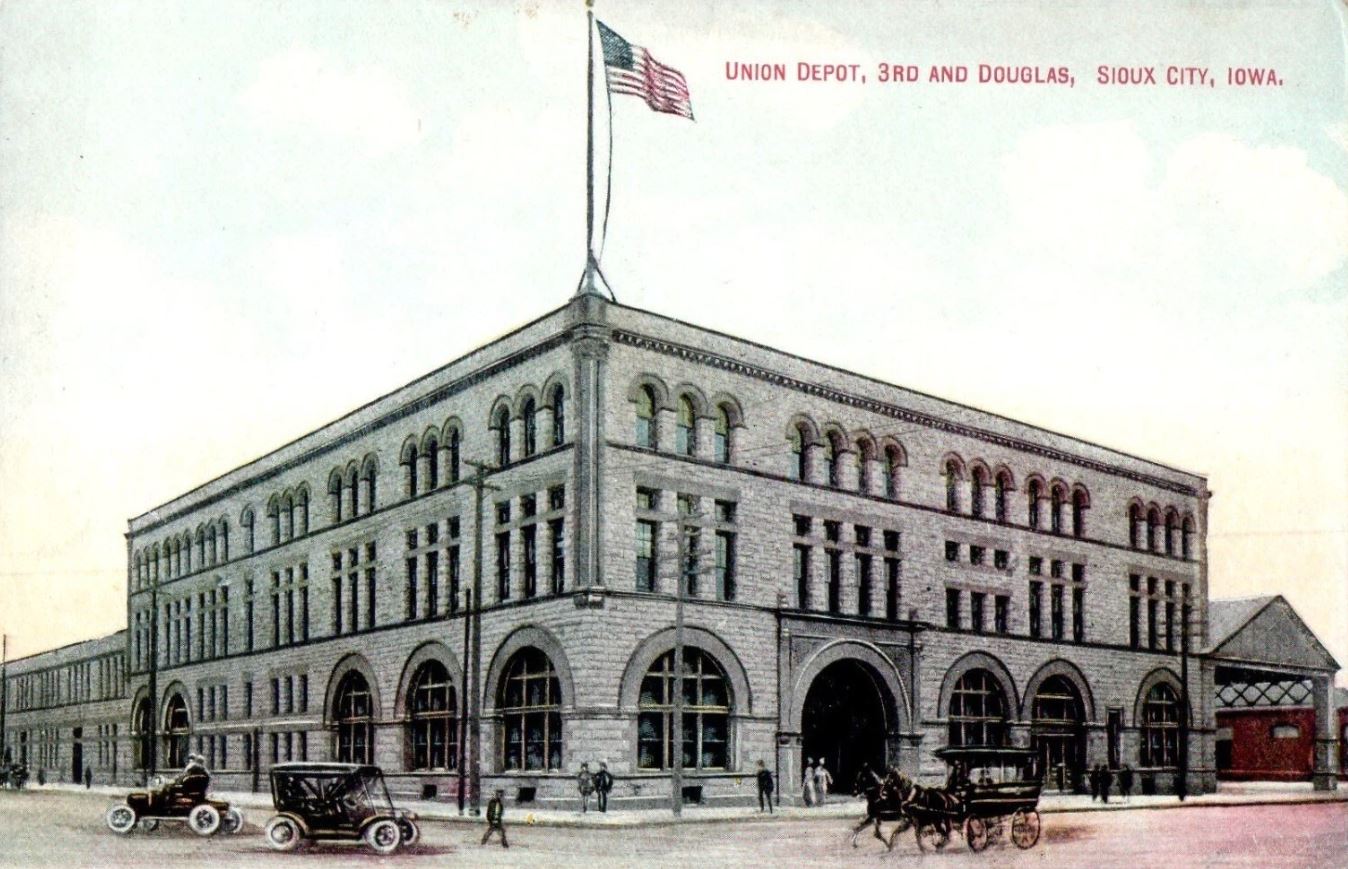
Sioux City Union Passenger Depot in the 1910's. |
The Third Street extension to Water Street connected with the Union Passenger Depot at Third and Douglas, which opened in 1893.
After the competing Sioux City Street Railway converted from horse to electric traction, the cable company's fortunes began to decline. Like many lines built to promote new real estate deveopment, the company went bankrupt during the Panic of 1893. Today we would call it a depression.
The line converted to electric traction on 16-May-1894.
The site of the powerhouse is now occupied by Sunken Garden Park. Reports indicate that there are still piles of cinders from the boilers scattered around the site.
from "BEST IN AMERICA/Sioux City's Rapid Transit System Challenges the County to Show Its Equal," Sioux City Journal / 01-January-1890.From the 1st of June until the 1st of November, the fist five months of operating the cable railway, the expenses were $7,500 and the receipts $14,384.55. In other words, the expenses have been $50 per day and the receipts $95.90 per day, showing a net revenue of $45.90 per day. It is a most remarkable showing for a new street railway and a wonderful result when taken into consideration with the fact that the line penetrates a new and as yet sparsely settled addition. (My emphasis - JT). The figures of its business show it to be as complete a success financially as it has proven to be in mechanical construction. The constructive work of the cable line on Jackson Street began on the 20th of August, 1888 and the machinery and track were tested on the 28th of May, 1889. Cars have been running from eighteen to twenty hours per day ever since the 30th of May, and it speaks volumes for the perfection of the system when the statement is made that the repairs of the entire plant up to this time have not amounted to $5. So far as any history of the operation of a new cable railway goes, it is said by its pattentee and buider, William Phoenix (Phenix -- JT), tobe the only one that has operated so long without a strand of the 22,271 feet of cable breaking or becoming out of repair. There are 752 carriage wheels (carrying sheaves -- JT) on the line of the road, and it is an unprecedented circumstance that no breakage has occurred or readjustment been found necessary. There ten automatic switches in use and not one of them has failed to work. The roadbed construction is so firm that neither chisel nor wedge has been used to move the slot. It has held its place as firmly as a rock. It is a remarkable circumstance where the climatic changes are so sudden. The coaches roll along with almost noiseless motion, and the two miles of cable and and three trains have been moved with twenty-five pounds of steam pressure, which again gives evidence of the perfection of machinery and roadbed. Other single track lines have proven failures. One was built at Los Angeles, Cal. and one at New Zealand (The single track Roslyn Tramway in Dunedin operated from 1881 to 1951. I would call that successful -- JT), but they were pronounced failures and were removed. Mr. Phoenix built his first single track cable road at Grand Rapids, Mich. two years ago and it is in operation still and giving complete satisfaction. The power-house, situated on Twenty-Ninth street, contains sufficient machinery to operate twenty-five mies of railway. There are two 250-horse power automatic Williams' cut-off engines, set quartering on the main shaft, so as to give them a reversible motion in case it is needed. They can back up and go ahead like a railroad locomotive. There are two Hazleton tripod boilers, one of which had 400 horse power capacity and the other 500. The Rooney mechanical stoker is now being added to the power-house appliances, and will, when in working order, burn all the smoke which now arises from the huge brick smokestack. Eight tons of the poorest quality of slack coal is used per day to move the machinery. Pulleys are now being added to the main line shaft to drive the new electric light plant. The cable company intends to light Jackson street from Fourteenth to Fortieth and all intersecting streets in Pierce's and Hedge's addition with arc lights and to furnish incandescent lights for residences and the power-house. By the 20th of this month one and a half miles more of track, stretching from Twenty-ninth to Fortieth street, where the Jackson street line terminates in Central park (Cook Park since 1936, but is not what appears to be at Jackson and 40th -- JT), is expected to be in operation. Everything is in readiness on this extension excepting the surface foundation at the park. A heavy fill of earth was necessary at that point, and a wait has been made to give the earth time to settle before the conduit and trac are laid. The additional cable is ready to line, and the additional rolling stock is in the carhouse. The plant up to date has cost the company $332,000, and the building of the system has but fairly begun. Its franchise extends over many miles of street, and this year it will branch out toward the easter part of the city. Its officers are: John Peirce, president; D. T. Hedges, secretary; W. V, Hedges, treasurer; William Phoenix, general superintendent; directors, John Peirce, D. T. Hedges, Maris Peirce, L. C. Watkins, C. L. Wright, William Phoenix, and W. V, Hedges. |
from "RAPID TRANSIT FACILITIES/Sioux City Finely Equipped in This Important Respect," Sioux City Journal / 01-January-1892.The Sioux City cable railway was the first built in Iowa, and is still the only cable line in the state. It is a single track line with switches, and was the first successful road ever built on this plan. The line as now built on this plan. The line as now built extends from Third and Jones ato Forty-First and Jackson streets, and is about three and a half miles long. An extension of about a third of a mile on Third street, from Jackson to Water, is now in process of construction. It will be double tracked, and it in the intention to make the entire line double tracked as soon as the business will warrant... At the power house are also well-equipped carpenter and machine shops where all work necessary for the maintenance and repaif of the road is done. The grips used on the line are made in the shop here... |
from "Editorial Correspondence," The Street Railway Journal April, 1892.
This is the first single track cable railway that we have visited, and is the only cable line in the State of Iowa. It was started in May, 1889, and since that time the cars have been running regularly. The line was designed and built by Wm. Phenix, of Chicago, and does credit to his engineering ability. There are six side tracks with automatic switches for the passage of trains, and the line terminates in a loop at Central Park. At the city terminus crossover switches are provided. In making the switch the grip car drops the trailer and crosses over and takes the return rope after passing the trailer, a long rope is attached to the grip and made fast to the trailer, when the grip is started and the trailer is hauled over on another crossover, and overtakes the grip by momentum. The ordinary grip cars are employed, but the gripman is protected by a diamond shaped cab which surrounds the space between the seats, and having glass sides gives him a clear view in front or rear. The cars were mostly built by the Laclede Car Company, but there are five double decked summer cars built by Jas. A. Trimble of New York, shown in Fig. 2. These cars seat twenty inside and thirty on top. Seven trains are run usually on a six minutes' headway. The power station (Fig. 1) is on 29th Street, well out of town, and is a very handsome brick structure. Two Hazelton tripod boilers of 400 and 500 H. p., with stokers, provide the steam, and the power is generated in two Williams automatic cut-off engines of 250 H. P. each, built in Beloit, Wis. The power is transmitted by belt from the flywheel to a large drum on the auxiliary shaft which is set outside the winding drum, and is coupled by gear to the first drum. The second drum is not driven. Two ropes are employed, and are run at a speed of eight and eleven miles per hour. Roebling ropes are employed, and the average life of the rope is eighteen months. One rope ran for twenty-two months. There are two interesting features in connection with the operation of this line. The first is the utilization of the exhaust steam for house heating purposes. Ordinary radiators are used. This system of heating by exhaust steam is at present extended to five buildings over a third of a mile distant from the station, as well as being employed in the power house itself, while the back pressure on the engines is said to be less than was formerly experienced when the power house alone was heated. The exhaust is first connected to a large expansion tank, properly proportioned to relieve the engines of their back pressure by forming a cushion, and arranged for eliminating the oil, etc., from the steam. This tank is important, serving to take up the throbbing and pulsations of the engines and assuring a constant volume of steam for the mains. From this tank starts the main pipe which is proportioned to serve 200 houses under a total pressure of two pounds. The main from the tank reservoir passes through the cable wheel pit into the street, and runs for 600 ft. before being connected to any houses, a uniform pitch being carefully provided to insure the entrained water traveling in front of the steam. No short turns are allowed anywhere on the piping, and special sweep elbows are provided for the reduction of friction. The expansion of the pipes is cared for by carefully arranged offsets every 150 ft, and the" creeping" of the main is avoided by carefully anchoring it at the proper points, throwing the expansion in the direction that the steam travels. After passing 600 ft., as described above, the main pipe branches into two smaller mains, having a combined run of 1,700 ft., the dividing line being so arranged that it can be continued in the future. These branch mains are preferably run in alleys, the company avoiding in this way any conflict with the city authorities on the paving question, and securing as well general convenience in entering the houses. Four inches is the minimum size of any house connection. The company insists upon having the piping plans of each building submitted to its engineers for approval so as to avoid any unscrupulous steam fitting which might involve a failure in the heating. They do not regard a building as being properly piped unless a perfect circulation is produced without any indicated back pressure and unless the building can be thoroughly heated with a maximum pressure of two pounds. All buildings are piped on the one pipe system with a continuous main around the basement from which the risers are taken. After the steam has made the circuit of the house it passes through a specially designed heater, connected with the city water system and from this heater passes through a gravity trap into the sanitary sewer. The advantages of the heater are manifold, for in addition to providing the residence with a constant supply of hot water, the residual steam is condensed, tending to form a vacuum and aid the circulation. The insulation of the mains is effected by a box filled with specially prepared mineral wool, the mains being so laid as to move easily without affecting the covering. The value of this insulation, the company believes, is incomparably superior to either asbestos or split logging. In fact, at the point where the pipe in its box passes through the cable pit the box is exposed to the weather and is often covered with snow and ice, with no perceptible melting. This station, it should be stated, is particularly well situated for supplying heat in this way because it has the exhaust steam all day from the cable engines, and during the night when employed in operating the lighting dynamos, so that they are not obliged to use live steam at any time. The design of the system was worked out by C. Moller, general manager and superintendent of the railway company, assisted by Frank G. Perkins, mechanical engineer of the John Davis Company, of Chicago, Ill., which latter company supplied the material for the entire system. In the electric lighting plant referred to Brush generators are used, and are driven by rope transmission from the cable plant. The streets for a long distance on this line of the road are lighted by arc lamps at the company's expense, and a number of houses in the neighborhood are provided with arc lamps, for which a charge is made.
|


|
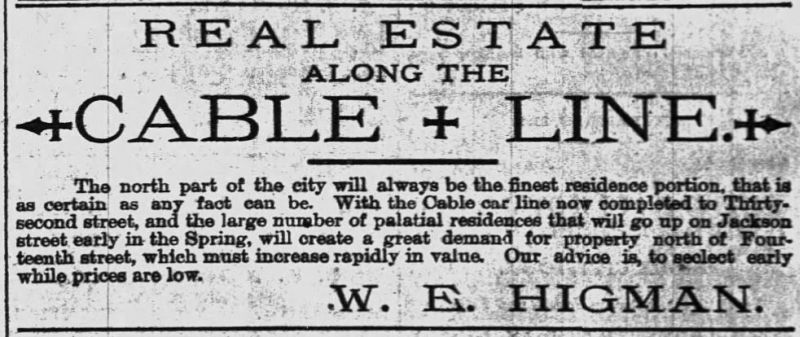
"With the Cable car line now completed to Thirty-second street..." |
Go to top of page.
Grand Rapids, Michigan - Valley City Street and Cable Railway

|
A Valley City Street and Cable Railway cable train on Lyon Street. (© Grand Rapids Public Library. All Rights Reserved.) September, 2016 Picture of the Month. |
line: Lyon Street
opened: 18-April-1888. Canal Street (now Monroe Street) at Lyon Street on Lyon Street to between Union Avenue and Grand Avenue.
extended: 07-March-1889. Canal Street at Lyon Street on Canal Street to Bridge Street (now Michigan Street). Bridge Street to Ottowa Street. Ottowa Street to Coldbrook Street. Coldbrook Street to Ionia Avenue. Ionia Avenue to Leonard Street.
extended: 06-April-1890. Two-way loop. Bridge Street (now Michigan Street) on Bridge Street to Grand Avenue. Grand Avenue to Lyon Street. Lyon Street to Union Avenue. Union Avenue to Fulton Street. Fulton Street to Eastern Avenue (?) near the Fulton Street Cemetery.
extended: 23-August-1890. Ionia Avenue and Leonard Street on Leonard Street to Taylor Street. Taylor Avenue to Sweet Street (great name). Also new tracks south from Lyon Street and Ottowa Street (blind conduit across gap on Ottowa Street from Bridge Street to Lyon Street) on Ottowa Street to Louis Street. Louis Street to Spring Street (now Commerce Avenue). Spring Street to Post Street (now Wealthy Street -- great name). Post Street to Sheldon Avenue. Sheldon Avenue to Western Avenue (now Logan Street). Western Avenue to Lafayette Avenue. Lafayette Avenue to Hall Street.
cut back: 15-April-1891. South line abandoned.
Upper powerhouse: Lyon Street between Union Avenue and Grand Avenue
Lower powerhouse: Lyon Street and Campau Street. Inaugurated for 23-August-1890 extensions
grip: Phenix double-jaw side grip
gauge: 4'8 1/2"
cars: grip and trailer trains, double-ended.
Terminals: crossovers
crossings: N/A
notes: One reason that the Valley City Street and Cable Railway in Grand Rapids, Michigan is the second-to-last Hallidie-type cable car operating company that I have written about is that it went through a convoluted series of route changes that have been very hard to describe. I did the best I could and hope to improve them in the future.
Grand Rapids had a long, steady climb from the central business district to residential districts. In 1884, the Common Council asked horse car operator Street Railway Company of Grand Rapids to build a cable car line. The company declined.
Local businessmen founded the Valley City Street and Cable Railway in 1887, hiring William Phenix to design and build the line.
|
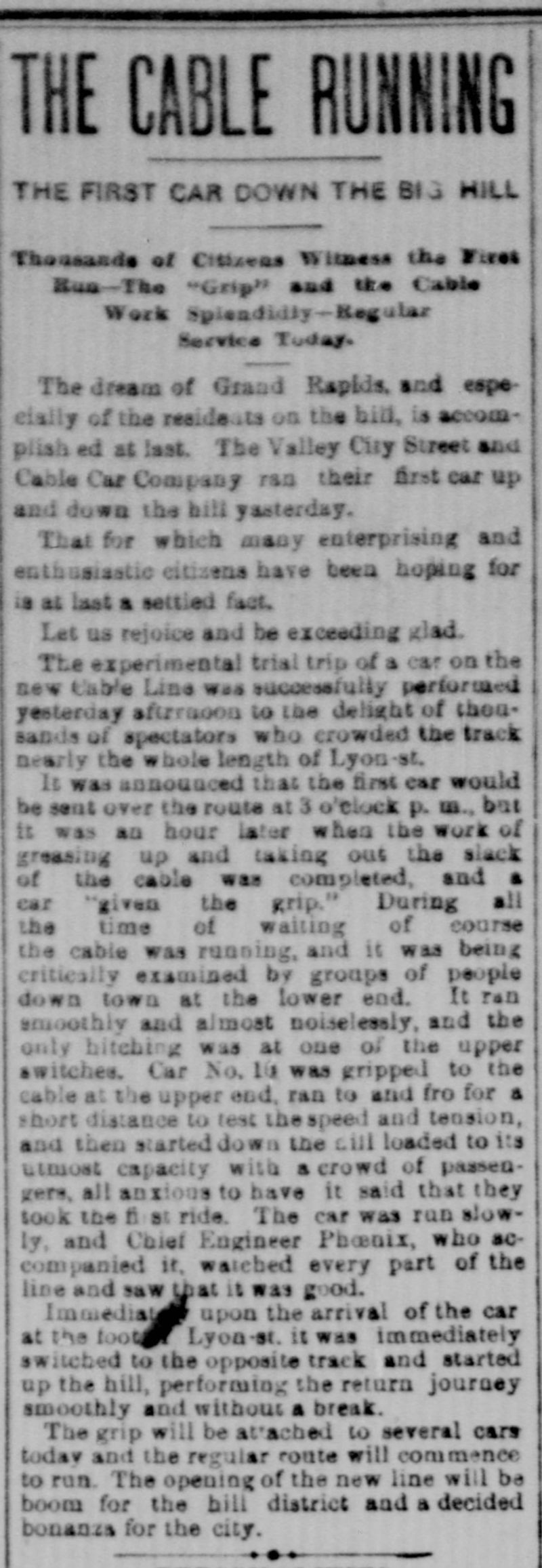
"The experimental trial trip of a car on the Cable Line was successfully performed yesterday afternoon to the delight of thousands of spectators who crowded the track nearly the whole length of Lyon st." (Source: Grand Rapids Herald, 15-April-1888). |
First he built a straight line on Lyon Street, from the powerhouse at the top to Canal Street at the bottom of the slope. The company soon extended the single line into a loop, where cars ran both ways.
|
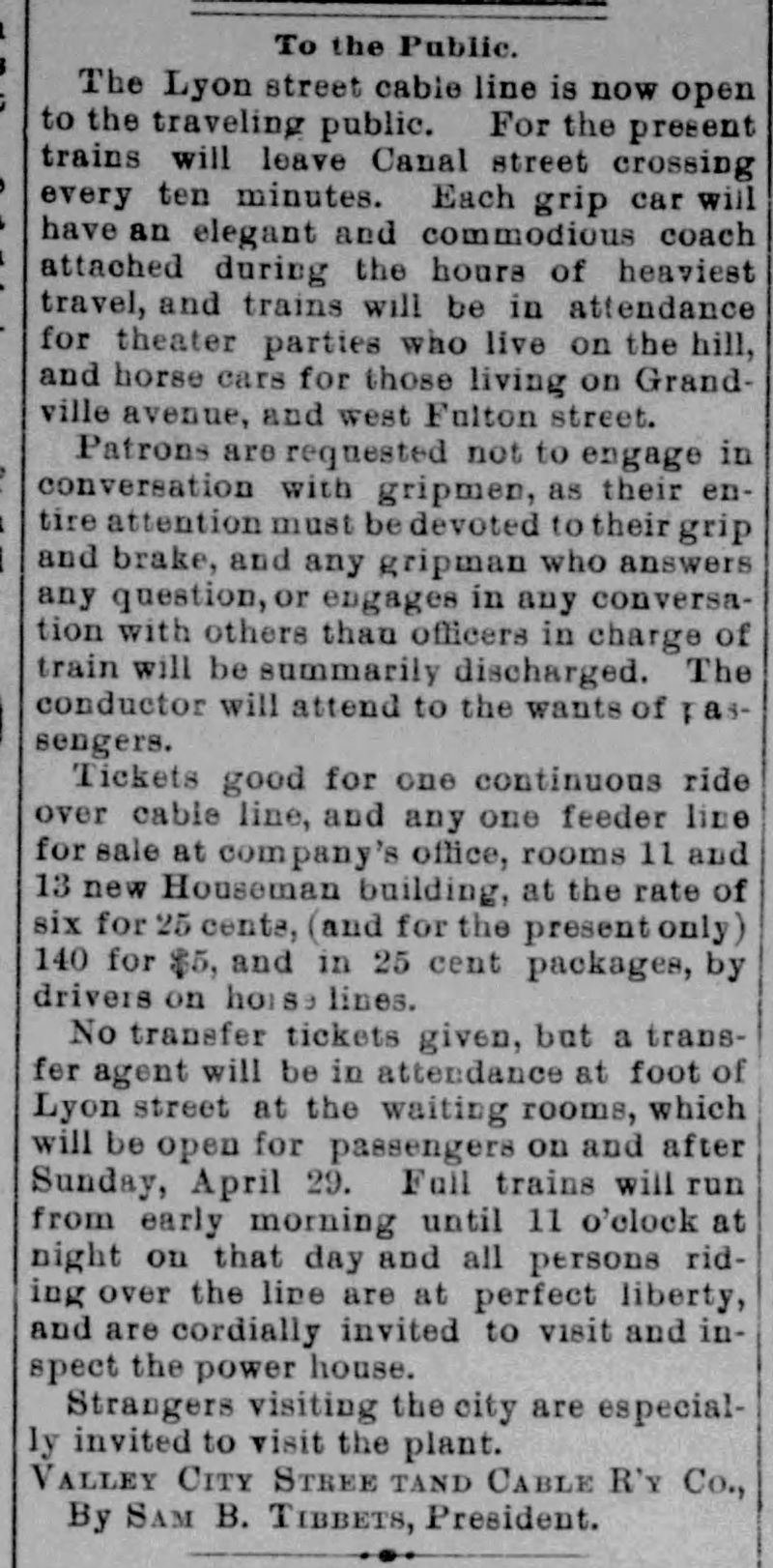
"Patrons are requested not to engage in conversation with gripmen, as their entire attention must be devoted to their grip and brake, and any gripman who answers any question, or engages in any conversation with others than officers in charge of the train will be summarily discharged." (Source: Grand Rapids Eagle, 25-April-1888). |
The Lyon Street cable was extended out Ottowa Street in 1890. The cable proved to be too long and to have too much curvature. The company built a new powerhouse at the bottom of the slope and created a long, twisting line to the south. Cables from the lower powerhouse ran the north and south lines.
The south line carried little traffic and was abandoned after a flood in 1891.
The Valley City Street and Cable Railway and the Street Railway Company of Grand Rapids merged to form the Consolidated Street Railway Company in July, 1891. On 09-October-1891, electric cars began to run on the loop.
from History of the City of Grand Rapids, Michigan by Albert Baxter, 1891.from "The Civil Chronicle -- Events of Forty Years." 1885. February 16, the Valley City Street and Cable Railway ordinance was passed. 1887. July 11, an ordinance was passed granting franchises in certain streets to the Valley City Street and Cable Railway Company. 1888. The Valley City Street and Cable Railway Company, on January 23, was granted a franchise in Grand Avenue north from Crescent Avenue. 1889. The putting in place of the steel wire cable of the Valley City Street and Cable Railway Company, April 13, was an event of public interest. The grip cars ran over the Lyon street track April 16, and began regular trips a few days later. VALLEY CITY STREET AND CABLE RAILWAY. November 10, 1884, a report made in the Common Council recommended that permission be given for the construction of a cable railway in Lyon, Union and East Bridge streets, and an ordinance was passed February 16, 1885, granting a franchise with conditions. Some efforts toward starting the work were made in the following year, without much progress. The Valley City Street and Cable Railway was incorporated June 6, 1887 - President, Wm. P. Innes; Secretary and Treasurer, Robert W. Innes; Engineer, Wm. Phenix. Their first cable line was in Lyon street, from the foot to Grand avenue; and horse-car lines in connection were constructed from the foot of Lyon to Waterloo and down Grandville avenue to the south city line, also across Fulton street bridge and to the west city line, and one north from Lyon on Barclay street. The company began work in August, and the horse-car branches were running in October. The cable in Lyon street was drawn to place April 13, 1888, grip cars ran on the 16th, and soon began their regular trips. The power house is by the Lyon street and Grand avenue corner, where very powerful steam machinery is placed to operate the line. The lines in the early part of 1890 are: Lyon and Bridge street (cable), from the corner of East Fulton and East streets over Fulton, Union, Lyon, Canal, and East Bridge streets and Grand avenue. Ottawa street (cable), from the City Hall by the way of Canal and East Bridge streets to Ottawa, and over North Ionia and Taylor streets to the north city line at Sweet street. West Third ward line (cable), from Pearl street and business center to city limits by Louis, Spring, Wealthy avenue, Sheldon, Wenham avenue and Lafayette streets. Grandville avenue line (horse), from Canal street and business center to city limits south on Grandville avenue. West Fulton street line (horse), Fulton, Straight, Jackson, Pine and Bridge and business center. Barclay street line (horse), Coit, Trowbridge and Clancy to D., G. H. & M. track. Ionia street line, south on Ionia to and beyond the city limits. Some seven miles of roadway are completed, or nearly so. A central power house plant is in the course of development and construction, at the foot of Lyon street, between Campau street and the river. Twenty-five passenger and twenty-three grip (cable) cars are in use, also fifteen passenger cars drawn by horses. The capital invested is near half a million dollars. There has been some change of officers and management. Directors chosen July 3, 1889: A. J. Bowne, James Blair, John W. Blodgett and A. D. Rathbone, of Grand Rapids; W. S. Crosby and John M. Hagar, of Chicago; H. P. Breed, of Minneapolis - President, A. J. Bowne; Vice President, J. W. Blodgett; Secretary, W. S. Crosby; Assistant Secretary, Accountant and Purchasing Agent, H. P. Baker; Treasurer, James Blair. |
from The Street Railway Review, Volume 1, 1891.The Lewis and Fowler Girder Rail Co. have just secured an order from the Sixth Avenue Street Railway Co. of New York City; for rail to relay their track from Bleeker to Fourteenth Sts. This is in a part of the city where the traffic from truck teams is very heavy, and speaks well for the rapid advancement this rail is making. They have also recently received orders from the Valley City Street and Cable Railway Co. at Grant Rapids, Mich... |
from The City of Grand Rapids, Manufacturing Advantages Commercial Importance: Sketches of the Principal Industries and Business Houses by B.F. Conrad and Company, 1889.The Valley City Street And Cable Railway Co. -- Office at foot of Lyon street. A project of comparatively recent realization, but one whose success has been notable, whose influence has been felt by all business interests, and whose existence distinctly marks the progressiveness of the Valley City, the enterprise here under review is well deserving of passing mention in this portion of our work. The enterprise originated with one of our most popular and influential citizens, Gen. Wm. P. Innes, the "Valley City Cable Company" being, through his energetic efforts, organized and incorporated March 2, 1885. Two subsequent re-organizations took place, at the last, on June 6, 1887, the present title being adopted, and the company incorporated with a capital stock of $100,000. Active operations were at once inaugurated, and after considerable delay since the original inception of the enterprise, the system finally became practically assured, a contract for construction being awarded to Samuel B. Tibbets and others, June 10, 1887. On the 11th of April, 1888, the first car was run over the Lyon street line, from the power house at the eastern end of Lyon street to Canal street, and regular service commenced one week later. The system has been extended on Canal street to Bridge street, on Bridge street to Ottawa, and on Ottawa and Ionia to Leonard street. The cable is about six miles in length, and the actual distance covered being about three miles. The system as operating upon streets where horse car lines are impracticable and (in the case of Lyon street, where the ascent is very rapid,) literally unavailable, and as affording effective service, is of great value and importance among the distinctive improvements and enterprises of the city. The plant, which is most thoroughly equipped and most effective, includes boilers of 450-horse power and engines of equal power are soon to be in operation, the present capacity in the line being of 200-horse power. The company use fourteen cars on their cable line and eight on the horse-car lines operated, and about sixty men are employed. Some fifty horses are used on the horse-car lines. Eight grip cars and trains are run on the cables between the hours of 6 A. M. and 11 P. M. each day, the round trip being made in 42 minutes, a train passing a given point in either direction once in every seven minutes. Extensive improvements are projects of the near future and will still further increase the important value of the system. The officers of the company are A. J. Bowne, president; John De Graaf, acting superintendent; W. S. Crosby, secretary and James Blair, treasurer; A. J. Bowne is president of the Fourth National Bank and the other officials and the interested stock-holders are to be noted as among the most prominent capitalists and business men of the city, concerned in her prosperity and progress. The excellent street railway facilities of the Valley City connect its remotest limits with the business center, but the recent growth of the city to the southward has made rapid transit beyond the limits a necessity, to meet which the South Grand Rapids Street Railway Company was organized,. Joseph C. McKee being president, Loyal E. Knappen, vice-president and Percy T. Cook, secretary and treasurer. The company owns a franchise for three and one half miles of street railway connecting South Grand Rapids by a belt line with the Grand Rapids Street Railway Company's lines at the corner of Hall and Division streets and The Cable Company's line on Grandville avenue. One mile and a half of this road is now under construction, and will be in operation within 30 days. A suburban street railway line to Oakdale. Park was constructed during the present year, and is in operation, connecting with the street railway company's lines. Another motor line to Reed's Lake, and one to the Soldiers' Home, are among the projected enterprises. |

|
"Take the Cable Cars and Visit the Circus." Not actually a circus (Source: Grand Rapids Herald, 14-April-1888). September, 2026 Picture of the Month. |
|
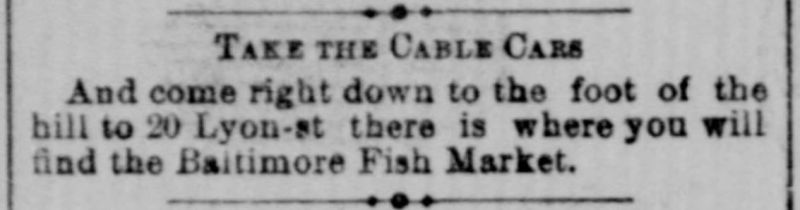
"Take the Cable Cars/And come right down to the foot of the hlll to 20 Lyon-st (Should be a period or semicolon here) there is where you. will find the Baltimore Fish Market." (Source: Grand Rapids Herald, 15-April-1888). |
|
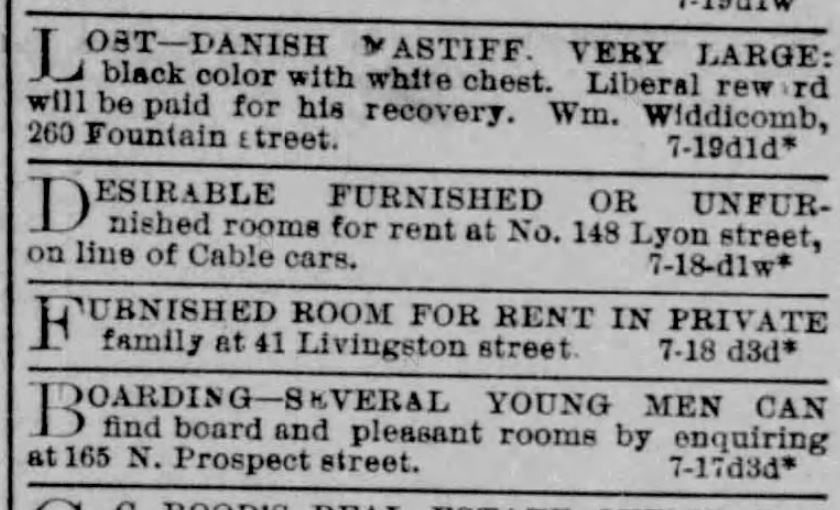
I hope they found the "VERY LARGE" dog. Also rooms for rent "on line of Cable cars." (Source: Grand Rapids Eagle, 19-July-1888). |
|
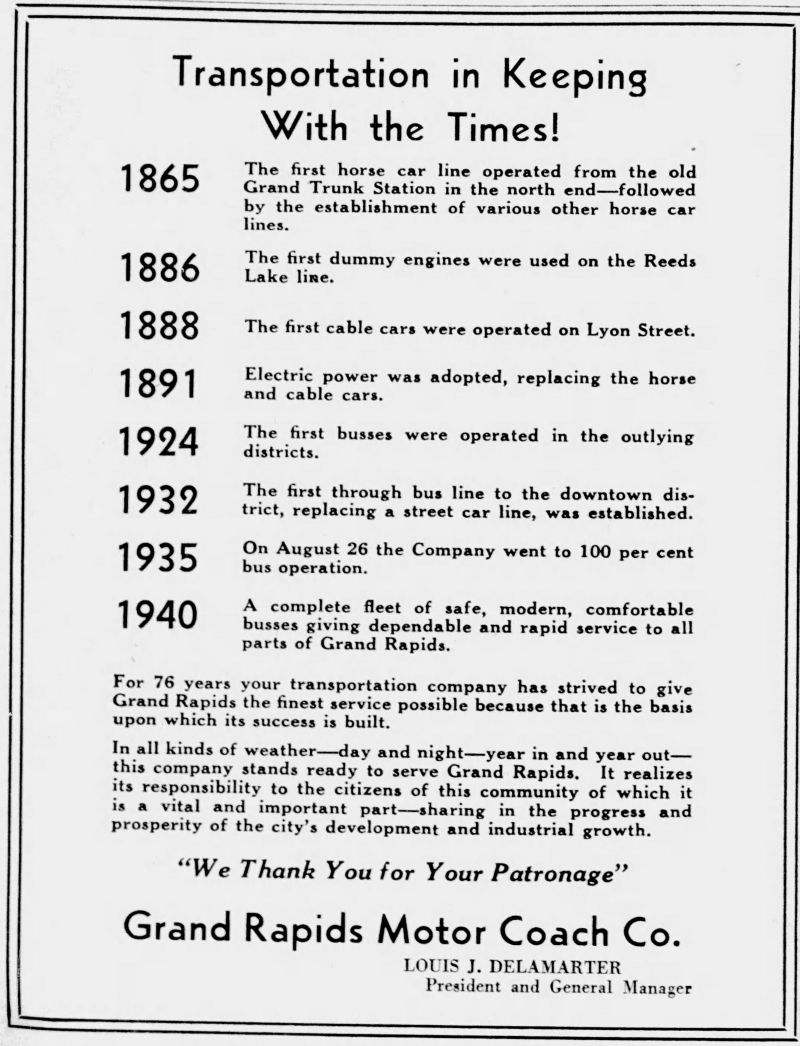
The Grand Rapids Motor Coach Company, a successor to the Valley City Street and Cable Railway wrote about the transit history of Grand Rapids. (Source: Grand Rapids Eagle, 01-January-1941). |
Go to top of page.
Saint Paul, Minnesota - Saint Paul City Railway

|
"A Horse on Minneapolis." Saint Paul had cable cars and its twin city, Minneapolis, did not. The expression comes from dice games. (Source: Saint Paul Globe / 07-July-1889.) October, 2016 Picture of the Month. |
line:Selby Avenue
opened: 21-January-1888. Broadway Street at Fourth Street on Fourth Street to Third Street (now Kellogg Boulevard). Third Street to Selby Avenue. Selby Avenue to Chatsworth Street.
Powerhouse: Selby Avenue and Dale Street
grip: Hovey double-jaw side grip
gauge: 4'8 1/2"
cars: grip and trailer trains, double-ended.
Terminals: crossovers
crossings: N/A
line: Seventh Street
opened: 14-June-1889. Seventh Street at Wabasha Street on Seventh Street and viaduct to Duluth Avenue.
Powerhouse: Seventh Street and Duluth Avenue
grip: Hovey double-jaw side grip
gauge: 4'8 1/2"
cars: grip and trailer trains, double-ended.
Terminals: crossovers
crossings: N/A
notes: The central business district of Saint Paul, Minnesota is on flat land by the Mississippi River. It is surrounded on three sides by hills. The winter weather in Saint Paul is the harshest faced by any Hallidie-type cable railway. The company used a wide slot, but the slot still got squeezed shut at times when the ground froze. Keeping the conduit free of snow required much effort.
The Selby Avenue line had heavy curvature going from Fourth Street to Selby Avenue. This section also had a 16% grade on the transition from Third Street to Selby Avenue. Soon after the line opened, on 27-January-1888, a train ran away going down the 16% grade. The gripman had lost the cable and the brakes could not stop the train. The grip car was destroyed in a derailment which killed one passenger and injured many others.
The Seventh Street ran on a viaduct over several railroad yards. It climbed a steady grade, but not a steep one. The line ran with cable traction only until 01-September-1893, when it was converted to electric.
The 16% grade section of the Selby Avenue line was too steep for electric operation. On 03-June-1898, the line was converted to electric traction, but the steep part became a counterbalance, similar to the revised counterbalance that replaced the Providence Cable Tramway. Weights ran on rails in the conduit. The former grip cars, motorized and enclosed, latched onto the weights.
The counterbalance ran until 10-October-1906, when a tunnel opened to bypass the streep section. The motorized grip cars were used as shop switchers by Twin City Rapid Transit until the end of rail transit.
Writer F Scott Fitzgerald grew up in the neighborhood traversed by the Selby Avenue line.

|
Clift Wise was chief engineer of the Saint Paul City Railway. From the May, 1895 Street Railway Journal |

|
HM Kebby designed the powerhouses of the Saint Paul City Railway. From the May, 1895 Street Railway Journal |
from "Notes and Items," The Street Railway Journal June, 1887.St. Paul, Minn. It will probably be July before the company begins the laying of its tracks beyond the Robert street bridge. The Dayton's Bluff extensions and the Fourth street cable line will certainly be built this year, and early next spring operations will begin on the East Seventh street cable line. President Lowry says he intends as soon as the Selby avenue cable is completed, to extend the St. Anthony Hill line, which now runs up Rice street, out Rice to Rondo, thence out Rondo to Mackubin, and farther as occasion requires. |
from "Editorial Correspondence," The Street Railway Journal February, 1892.Two cable lines are operated in St. Paul, one from the Silby Avenue (Selby Avenue - JT) station and the other from a station on Seventh Street. Both stations are alike in their equipment, the driving machinery having been manufactured by the Robert Poole & Sons Company, of Baltimore. At the Silby Avenue station the power is supplied by two Allis high pressure engines of 500 H. P. each, and the steam is generated by four tubular, double deck boilers of 250 H. P., manufactured by the Schuylkill Foundry & Machine Company, under which oil fuel is burned. Two ropes are driven by solid drums geared together, one at a speed of eight miles an hour and the other at twelvejmiles, and the life of the ropes, which are of Roebling make, is about fifteen months. Ten regular trains, consisting of open grip and trailer, are run. The cars were all manufactured by the Laclede Car Company. The trains are equipped with a Johnson continuous brake, and the trail car is provided with a special wedge brake or shoe having a rubber surface which comes in contact with the rail when in use. This brake is designed for emergency use on a 500 ft., 6 per cent, grade which occurs in the line. On ascending or descending this grade each train is boarded by a special brakeman stationed at this point, who uncouples the continuous brake chain and takes his position on the front platform with his hand on the lever of the emergency brake. These precautions were instituted after a runaway on this grade in which several people were injured. The company proposes changing from cable to electric power on the Seventh Street line, for the reason that with the present traffic the cost for operating per car mile is greater than it is on the electric lines. |

|
San Francisco Municipal Railway car 1080, originally Twin City Rapid Transit 328, later Newark Public Service 9, waits to turn from Steuart Street into Don Chee way on 02-March-2012. It had to wait because a tourist couple had driven their car into the private right-of-way. A kind Muni employee helped them back out. |
Go to top of page.
Omaha, Nebraska - Cable Tramway Company of Omaha
|
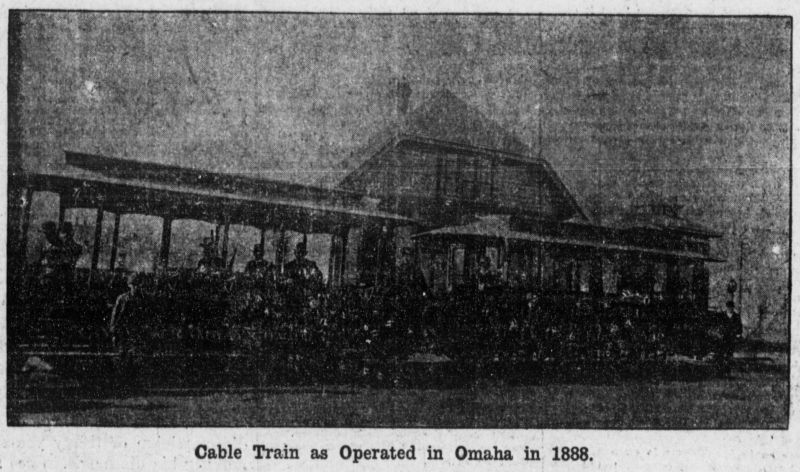
A cable train in Omaha, Nebraska. (Source: "Cable Railways in Omaha," Omaha Daily Bee / Sunday, February 21, 1909.) October, 2014 Picture of the Month. |
line: Harney Street
opened: 29-December-1887. 10th Street and Harney Street on Harney to 20th Street. 20th Street to Dodge Sreet. Dodge to 25th Street.
powerhouse: 20th Street and Harney Street SW
grip: Hovey single-jaw side or Gillham single-jaw side
gauge: 4'8 1/2"
cars: open grip and trailer trains, double-ended
Terminals: crossovers
crossings: N/A
line: Dodge Street
opened: 29-December-1887. 10th Street at Jones Street on 10th Street to Dodge Sreet. Dodge to 20th Street. 20th to Cass Street.
extended: 28-June-1888. 20th Street from Cass Street to Lake Street.
extended: ??-???-1888. 10th Street from Jones Street to Union Station.
powerhouse: 20th Street and Harney Street SW
grip: Hovey single-jaw side or Gillham single-jaw side
gauge: 4'8 1/2"
cars: open grip and trailer trains, double-ended
Terminals: crossovers
crossings: N/A
|
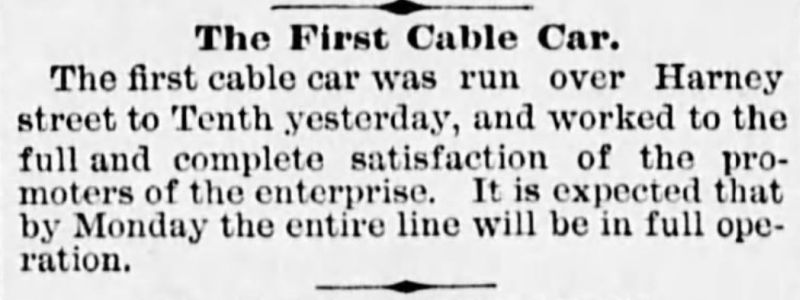
A grip car operated on Harney street and it "worked to the full and complete satisfaction of the promoters of the enterprise." (source: Omaha Daily Bee, 25-December-1887) |
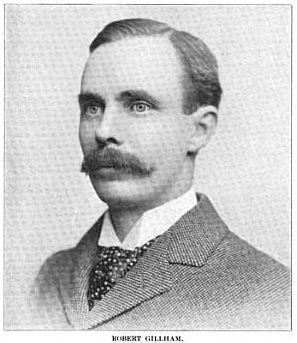
notes: Engineer Robert Gillham faced some problems in designing and building the Cable Tramway Company of Omaha. Because of interference from the Omaha Horse Railway, the company had to build parallel routes on Harney and Dodge Streets, which ran around the cental business district. Both streets had steep grades, especially Dodge. The line shared sections of 10th and 20th Streets with the Horse Railway and paid damages every year to the Horse Railway for the privilege. The system had a lot of curvature, which led to cables lasting an average of 90 days.
|
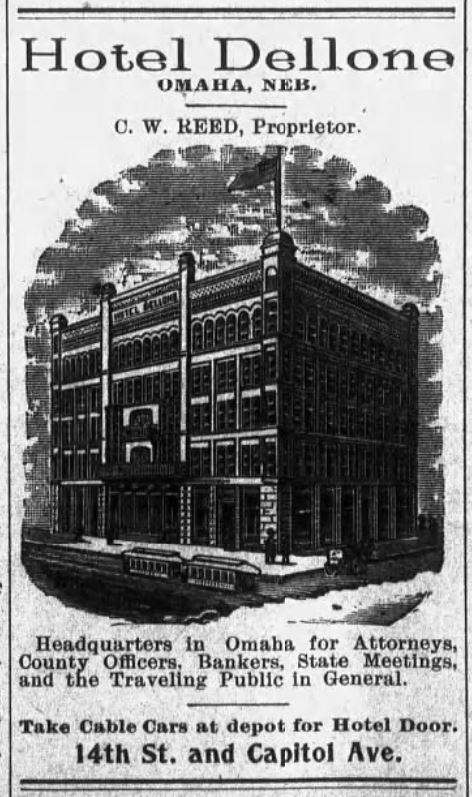
This ad for the Hotel Dellone instructs visitors to "Take Cable Cars at depot for Hotel Door." (source: Omaha Mercury, 11-January-1894) |
|
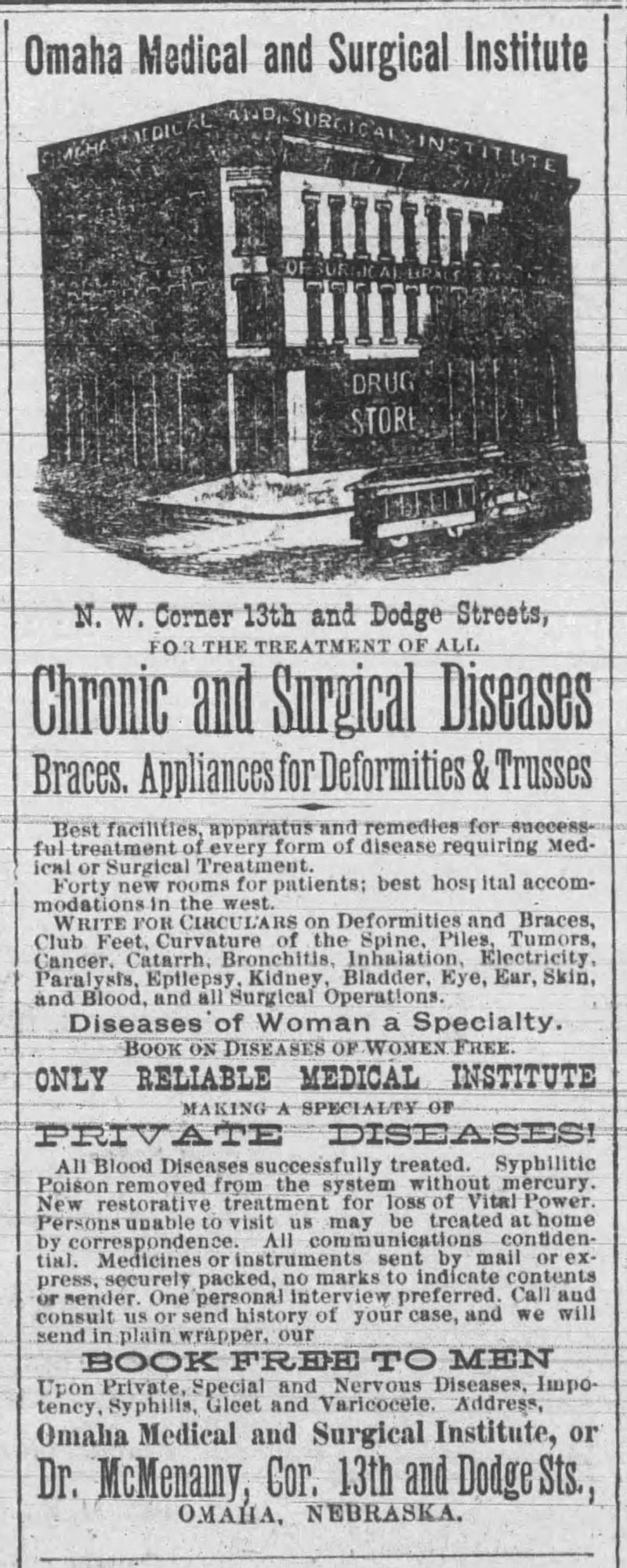
The image in this ad for the Omaha Medical and Surgical Institute may include a Dodge Street cable car. The Institute offers an interesting variety of services to women and men. (source: Omaha Mercury, 11-January-1894) |
The 10th and Harney terminal of the Harney Street line was next to the Jobbers Canyon District, where lines of huge wholesalers' warehouses reminded people of canyon walls. The Dodge and 25th Street outer terminal was near the campus of Creighton University, a Jesuit school. The 10th Street at Jones Street inner terminal of the Dodge Street line was in the present-day Old Market neighborhood. Some of the buildings still standing were there when the cable cars operated. After a few extensions, the outer terminal was near the Union Pacific Depot.

|
Fred Drexel (source: Illustrated History of Nebraska by Julius Sterling Morton, Albert Watkins, George L. Miller J. North, 1913) |
from History of the City of Omaha, Nebraska by By James Woodruff Savage, John Thomas Bell, Consul Willshire Butterfield, 1894.The Cable Tramway Company of Omaha was incorporated in June, 1884, by the following named: Samuel R. Johnson, Charles B. Rustin, Isaac S. Hascall, Casper E. Yost and Fred. Drexel. There was a re-organization effected December 4, 1888, under the style of the Omaha Cable Tramway Company, a new franchise having been secured in May of that year, granting broader privileges, and giving the company the right to run its cars on all the streets of the city, and allowing it to use cable, electricity, or such other motive power as might be deemed advisable. The capital stock of the company was fixed at two million dollars. The operation of the line was commenced December, 1887, and soon thereafter four and a half miles of double track were in use. A splendid power-house, 132 by 140 feet in size was built in 1887, at the intersection of Harney and Twentieth Streets. The incorporators of the company, when re-organized, were S. R. Johnson, L. B. Williams, C. B. Rustin, W. V. Morse, B. F. Smith and S. D. Mercer. The following named were the officers of both of these companies: S. R. Johnson, president and treasurer; L. B. Williams, vice-president; C. B. Rustin, secretary. |
The Tramway went bankrupt in 1888 and was reorganized as the Omaha Cable Tramway.
The cable lines did not long survive past the merger of the Cable Tramway, the Horse Railway and the Omaha Motor Railway into the Omaha Street Railway. The Street Railway converted the Harney line to electric operation on 07-July-1890. The Dodge line, cut back to 10th and Harney, continued until early January 1894.
|
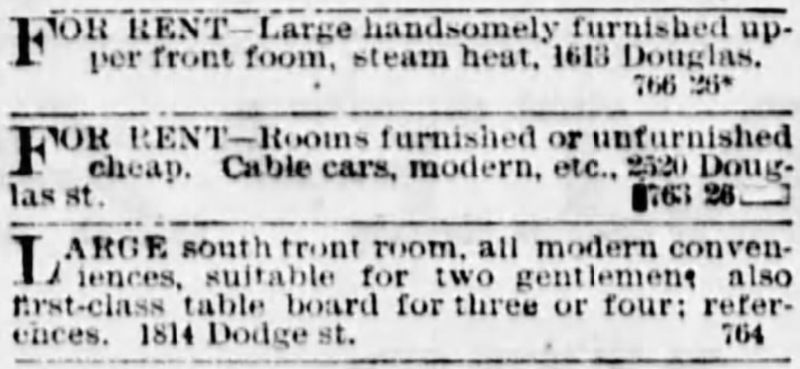
This want ad for "Rooms furnished or unfurnished cheap" mentions proximity to cable cars, which would soon start to operate. (source: Omaha Daily Bee, 25-December-1887) |
from "Street Railway News," The Street Railway Journal April, 1888.New York, N. Y. The John Stephenson Co., Lim., have just made shipments of cars to Japan via Canadian Pacific and steamer from Vancouver, and are preparing shipments for Allegheny City, Pa.; Norfolk, Va.; Salt Lake City, U. T.; Chicago, Ill.; the City of Mexico; Bay City, Mich.; Lowell, Mass.; and Elmira, N. T. Their latest improved grip car, now in use at Omaha, Neb., has met with the most unqualified favor, and is without doubt the best of its kind yet produced. Illustrations of this car will appear in a subsequent issue. Omaha, Neb. Cable Tramway Co. of Omaha is about opening its Dodge and Twentieth street line. The North Twentieth street line is also completed. They will build a new single track to the base ball park. from "Street Railway News," The Street Railway Journal May, 1888.Omaha, Neb. A Decision has been rendered in the suit of the Omaha Horse Railway Company against the Cable Tramway Company to determine the title of the Horse Railway Company to the exclusive right to operate street cars in the city. The plaintiff is declared to have the right to operate horse cars in Omaha to the exclusion of all other parties but when motive power other than horse power is used the right is not exclusive. The Cable Tramway Company is ordered to compensate the Horse Railway Company for damage done by the construction of a parallel cable line. from "Equipment Notes," The Street Railway Journal May, 1888.John Stephenson Company, Limited, is now filling orders for Chicago, Salt Lake City, Norfolk, Va.; Allegheny City, Pa.; Los Angeles, Cal.; New Haven, Conn.; Brunswick, Ga.; Omaha, Neb.; Dunedin, New Zealand; Conoepcion, Chili; City of Mexico; St. Paul, Brazil; Wellington, New Zealand. The new Stephenson grip car with improved track brake is making an excellent impression, being tasty, durable and efficient. The Broderick & Bascom Rope Co. has received the following from the Cable Tramway Company of Omaha, Neb: "In answer to your inquiry regarding the servioe of cables furnished by you, I take pleasure in stating that the cables were put in and operating since the latter part of December '87. During this time we have encountered all kinds of weather and on several occasions our conduit has been filled with snow and water. This is our first cable and we have had green men. Thus far the cable shows very little wear and is in first class condition, and considering the many difficulties of a new road, I think it is giving remarkably good service, and judging from past experience, I shall be very much disappointed if it does not prove equal, if not superior to cables made by other companies." |

|
This portion of an ad for the Kelley Steiger and Company clothing store at Dodge and Fourteenth Steets, says that "Parties from out of town will find it convenient to take the Dodge Street line of cable cars, wich run directly by our store, stopping at the post office." (source: Omaha Daily Bee, 08-January-1888) October 2024 Picture of the Month. |

|
In 1909, the Omaha and Council Bluffs Street Railway published a weekly series of stories on the history of transit in Omaha in the Omaha Daily Bee. |
from "Editorial Correspondence," The Street Railway Journal February, 1892.The lines of the Omaha Street Railway Company, which controls nearly all the traffic in the city, embrace eighty-five miles of track, of which sixty miles are operated electrically, seven by cable, .and the balance by horses. About 100 horses are still in service. One line of about four miles, which was formerly operated by cable, has for some time been operated by electric power. The cable conduit still remains in place. This line was very crooked, so that it required a great deal of power to operate, and the traffic being light, comparatively, it is found to be more economical to operate by electricity; in fact it is claimed by the management that the cost for operating per car mile is less on the electric lines than on the cable line. Two car trains are run on the cable line on ten minutes headway. This is almost the first instance where we have found electric cars operated for less per car mile than cable cars. These lines also enjoy the distinction of operating electric cars at a less cost per car mile than any other lints with which we are acquainted, with one exception. Quite steep grades are encountered on some lines, and these are operated with motor cars only. On most of the lines, however, trail cars are hauled. A very high rate of speed is attained in the suburban sections. The cable tracks are constructed with a sixty pound girder rail, and after four years of service are standing up quite well, the joints having been but once overhauled. The electric lines are constructed for the most part with a forty-five pound girder rail resting on chairs with ties two and a half feet centers. During the past season the Johnson standard joint construction has been substituted for fishplate joints. The special work on these lines was made by the Weir Frog & Switch Company. The rails are bonded, but there is no return wire. These stations also supply power for operating two cars on the line of the East Omaha Land Company.
|
|
Engineer Robert Gillham designed and built the Cable Tramway Company of Omaha. From the 30-July-1897 Railway Age and Northwestern Railroader. |
Go to top of page.
Providence, Rhode Island - Providence Cable Tramway

|
"SCREW SPINDLE GRIP -- PROVIDENCE R. I., CABLE LINE." From Street Railways: Their Construction, Operation and Maintenance by CB Fairchild, 1892. July, 2008 Picture of the Month. |
line: College Hill
opened: 11-December-1889. From Market Square on College Street to Prospect Street. Outbound on Prospect from College to Angell Street. Angell to River Drive (?). River (?) to Waterman Street at Red Bridge. Waterman Street inbound to Prospect. Prospect to College.
powerhouse: Angell Street and River Drive (?)
grip: double-jaw side, wheel operated
gauge: 4'8 1/2"
cars: open grip and trailer trains
turntables: crossovers at Market Square
crossings: N/A
notes: The Providence Cable Tramway was the only Hallidie-type cable car line in New England. The Union Railroad provided horse-car service to most parts of Providence (According to the 1887 Poor's Directory of Railway Officials, it operated "58.855 miles of road, owned 1,850 horses and 272 cars."), but not to Brown University and the wealthy neighborhood on the east side of College Hill. The direct route over the hill would be too steep for horse traction.
Walter Richmond, a resident of the East Side, organized the Providence Cable Tramway and secured a franchise against the opposition of the Union Railroad. The Union Railroad was unhappy about losing its monopoly in general and was particularly unhappy about having to shares its tracks on Westminster Street to Olneyville and back via Weybosset Street. The line's trailers would be pulled by horses along this section (Proceedings of the Rhode Island Historical Society, 1909, page 58).
Richmond engaged engineer Henry M Lane, who had designed Cincinnati's Mount Adams and Eden Park and Vine Street cable railways.
The cable line was difficult to operate because the streets it covered were not straight, and included both steep and undulating sections. Because of a difficult pull curve at College and Prospect, by the entrance to Brown University, the company used left-hand operation. The cable broke 17 times in the first six months ("Cables connect College Hill", Karen Davis, Providence Journal, 25-January-1999).
Despite the difficulties, the company made money and in due time was taken over by the Union Railroad. Union failed to buy two shares of the Tramway and so leased it for 50 years, beginning in April, 1895, and kept the corporate structure intact. The Union Railroad had already electrified its lines and was anxious to convert the Tramway's operation.
The stretch up the hill from Market Square to Brown University was too steep for electric operation. In April 1894, the grip cars had started pulling electric cars up the hills. The cars may have been the former trailers, with one axle motorized. The company converted the line to a counterbalance, similar to the one on Queen Anne Hill in Seattle. Weights ran on rails in the conduit and cars would latch on at the bottom and top of the hill and help each other up and down.
The original counterbalance was too inflexible, so engineer-in-chief Milton H Brondson designed a system using the grip cars, motorized and enclosed, to latch onto the weights. The motorized cars could handle two electric cars each, switch themselves at Market Square, and ascend or descend alone, giving more flexibility.
A tunnel replaced the counterbalance in 1914.

|
A former Providence cable car equipped for the counterbalance. |

|
Thanks to Bob Vennerbeck for sharing this photo of a conduit once used by the Providence Cable Tramway and/or the counterbalance that replaced the line on College Hill. All rights reserved. |
In July, 2018, Bob Vennerbeck let me know that he was walking around the College Hill district of Providence, Rhode Island when he was hailed by a crew
"Yesterday, I was hailed by a crew working on replacement water mains under College Street at Benefit Street - 'You're the historian - you know anything about these brick foundations under the street?'
"It seems they had unearthed a parallel pair of low brick walls about 2' high, with a smooth concrete slab about 3' wide between them, forming a U-shaped channel under the length of the street. The tops of the walls were about 2' below modern grade, and after the backfill was removed, a series of metal 'chairs' were found embedded either side of the slab, with bits of heavily greased mounting bolts scattered nearby."
I agreed with Bob that this was the channel that the counterbalance's counterweight ran through or the cable conduit of the Providence Cable Tramway.
Thank you to Bob for letting me present this find.
"Mr. M. H. (Milton Howard - JT) Bronsdon learned the business of his father (constructing engineer). His first work of importance was done at the age of 21 years, while foreman of construction of two cable railways at Los Angeles, Cal. (The Second Street Cable Railway and the Temple Street Cable Railway - JT), and afterward as master mechanic of one of them. He remained in Los Angeles from April, 1885, until May, 1889, when he went to Denver, Col., as manager of the Denver Tramway for seven months. He resigned his position in order to accept the office of superintendent of Providence Cable Tramway of Providence, R. I. In March, 1895, the road changed to electric motive power, and Mr. Bronsdon was appointed engineer-in-chief for the Union R.R. Co. of Providence, R.I., which position he now holds. In 1895 he designed and built the Inclined Counterweight System (his own patented invention) on the steep incline of College Street, Providence. In 1896, he built a similar railway at Morgan Park, 1ll. In 1898, he built the Inclined Railway Systems on St. Anthony's Hill, at St. Paul, Minn." (Bronsdon and Box Families: Part I. by Colonel Lucius B Marsh and Mrs Harriet F Parker, 1902)
from Annual Report of the Railroad Commissioner, January Session, 1891.Incorporated 1884. Road built in 1889. Began running January 1, 1890. OFFICERS.
DIRECTORS.
Returns for Six Months Ending June 30, 1890.
* Mr. W. D. Watson was fatally injured Jan. 26, 1890, (and died within a week) from attempting to cross in front of a grip car on Hope street, corner of Waterman. from ACCIDENTS DURING 1890. page 43 Jan. 26. WALTER D. WATSON, of Providence, while attempting to drive in a carriage across Waterman street, in front of grip car No. 18, of the Providence Cable Tramway Co., was struck by the car and so severely injured that lie died on the following Wednesday. page 46 May 15. JOHN COYNE, a laborer in the employ of the highway department, city of Providence, was struck by a car of the Providence Cable Tramway Co. on Angcll Street, and received severe injuries about the hips. He saw the car and stepped aside, but not far enough. page 47 July 19. ROY EVERETT BRYANT, 7 years old, was playing with other boys on South Angell street, Providence, and while running backward was struck by a grip-car of the Providence Cable Tramway Co. and run over. He was taken to the Rhode Island Hospital, and his right leg amputated below the knee. He was discharged from the Hospital cured, on the 7th of August. from CHANGES IN OWNERSHIP. page 89 The Providence Cable Tramway, having accomplished its object and secured direct transportation to the residents of the "East side," has been absorbed by the Union Railroad Company, and is now operated by that company. This I regard as a move in the right direction, as whenever two or more rival companies use the same tracks, there will necessarily be more or less friction between employees. |
from Annual Report of the Railroad Commissioner, For the Year Ending December 31, 1893.Incorporated July 24, 1884. OFFICERS.
DIRECTORS.
Returns for Six Months Ending June 30, 1893.
from ACCIDENTS DURING THE YEAR 1893. page 47 Feb. 26. Antonio De Angelis stepped from car No. 14, Providence Cable Tramway Co., while it was in motion, but fell and broke his leg. He was taken to the R. I. Hospital. May 29. As car No. 40, Providence Cable Tramway Co., drawn by horses, was passing up Dyer avenue, Johnston, a boy by the name of Willie Williams fell from the car and one wheel passed over his leg. He was taken to the R. I. Hospital. |
from Annual Report of the Railroad Commissioner, For the Year Ending December 31, 1894.Incorporated July 24, 1884. OFFICERS.
DIRECTORS.
Returns for the year ending June 30, 1894.
CABLE TRAMWAY. page 39 When the Union horse system was changed to an electric that portion of the Providence Cable Tramway line which had been operated by horse power was also transformed. Within the past year authority has been given the company to substitute electric power for the propulsion of cars upon the cable portion. The operation of cars upon the excessive grade on College Hill is to be assisted by a system of counterweights similar to those in successful use in the cities of Seattle and Portland. Without some such device it would be unsafe to make the ascent and descent of so heavy a grade, and this provision is being made by the company so as to preclude to the greatest extent any possible liability to accident. from ACCIDENTS. page 41 February 6. Herbert Dyer of Providence, while coasting down Grand Avenue, was struck by cable car No. 30, Providence Cable Co., and somewhat injured. |
|
The Cable Car Cinema and Cafe showed independent and foreign films at 204 South Main Street from 1976 to 2018. It fell victim to the forces that have destroyed so many cinemas across the country. |

|
A November, 1978 schedule for the Cable Car Cinema. I remember when many of these movies would play in San Francisco at theaters like the Golden Gate, the Parkside and the Strand. |
Go to top of page.
Lisbon - Nova Companhia dos Ascensores Mecânicos de Lisboa

|
Car 4 of the Camões-Estrela line was built by the German Maschinenfabrik Esslingen. I wonder if it is on a transfer table. Photo courtesy of Maschinenfabrik Esslingen. All rights reserved. August, 2015 Picture of the Month. |
line: Camões-Estrela
opened: ??-???-1890. From the Praça de Camões via São Bento to Largo da Estrela
powerhouse: Largo da Estrela
grip: wheel-operated bottom
gauge: 90CM
cars: four wheeled cars
terminals: loops
crossings: N/A
line: Graça
opened: 27-Feb-1893. From the Rua da Palmo to Largo da Graça
powerhouse: ???
grip: lever-operated bottom
gauge: 90CM
cars: grip and trailer trains
terminals: loops
crossings: N/A

|
A train of the Camões-Estrela line. It looks as if it should belong to the the Graça line, but this is what the caption said in the magazine (Source: "Por Encostas e Ladeiras", Illustração Portugueza, 08-February-1909. |
notes: The Nova Companhia dos Ascensores Mecânicos de Lisboa (NCAML) hired Maschinenfabrik Esslingen to build two lines of Hallidie-type cable tramway. The lines were designed by engineer Raoul Mesnier de Ponsard.
The Camões-Estrela line terminated in a loop. The cars coasting around the loop by gravity sometimes hit things, earning the line name of "Dog Killer" ("Mata-cães").
The Graça line had many curves, so it used grip and trailer trains.
The company was taken over by the Companhia Carris de Ferro de Lisboa (CCFL) in 1913. The Graça cable stopped running in 1909. The Camões-Estrela cable stopped running on 03-July-1913. Because of franchise restrictions, the cars were lettered for the NCAML and charged separate fares until 1928. The cars had magnetic track brakes to help them deal with the steep grades.
A new Funicular da Graça opened on 12-March-2024.

|
Grip car and trailer 6 of the Graça line was also built by the German Maschinenfabrik Esslingen. I wonder if it was photographed on elevated tracks as a builder's photo. Photo courtesy of Maschinenfabrik Esslingen. All rights reserved. August, 2025 Picture of the Month. |
Thank you to John Perkin for sharing an article from one of the LRTA booklets on Portugal's Tramways written by J H Price.
Go to top of page.
Lisbon - Street-Running Funiculars

|
Thank you to João Firmino for permission to use this 2005 shot of Elevador do Lavra tram 1 at the upper terminal. Note the two pantographs on the roof of the car and the two wires above each track. Copyright 2005 by João Firmino. All rights reserved. |
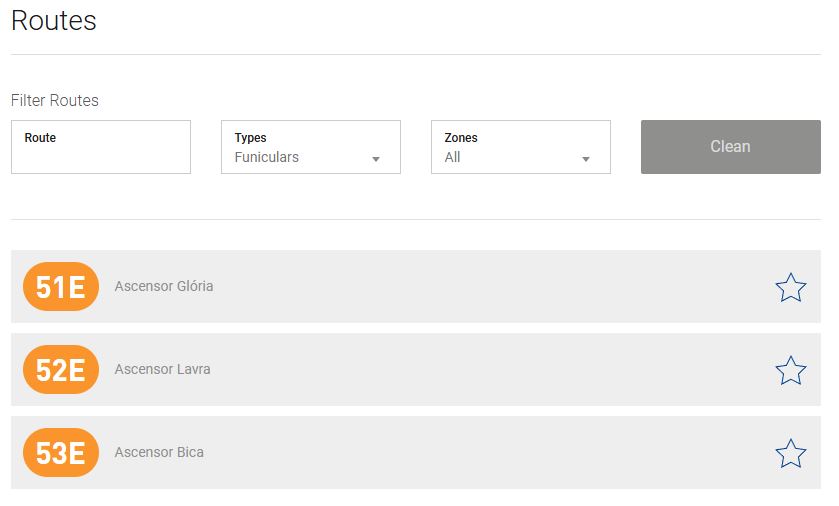
Lisbon has three unique street-running funiculars, the Elevador da Bica, the Elevador da Glória and the Elevador do Lavra. They are currently operated by Carris (Companhia Carris de Ferro de Lisboa).
|
The Carris website identifies three funiculars |
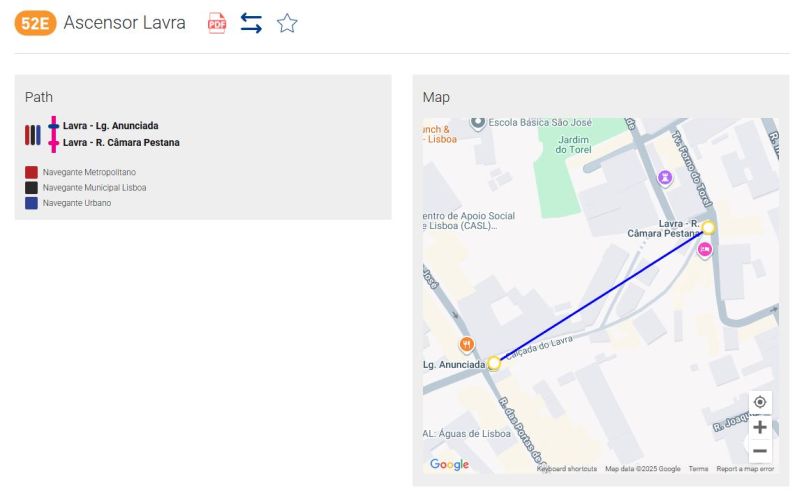
The Elevador do Lavra (Route 52e) opened on 19-April-1884. Two counterbalanced cars operate, attached to a cable that runs in a conduit under the street. At first, a steam engine drove the cable. A rack rail in the conduit allowed for emergency braking. The cars ran on gauntlet tracks, with a passing loop in the middle. In 1914, the line was converted have the cable driven by an electric motor. In 1930, the line was converted to be a counterbalance. The cars had their own electric motors. The two cars were wired in parallel, which required two overhead wire for each car. The cable runs over an idler sheave at the top. Inclined frames keep the tram body horizonal.
|
The route of the Elevador do Lavra (Route 52e) from the Carris website. |

|
A double decker car of the Lavra line. (Source: "Por Encostas e Ladeiras", Illustração Portugueza, 08-February-1909. |

|
An early view of the Lavra line. (Source: "Por Encostas e Ladeiras", Illustração Portugueza, 24-February-1916. |

|
Thank you to João Firmino for permission to use this 2005 shot of the motorman's control position on an Elevador do Lavra tram. Copyright 2005 by João Firmino. All rights reserved. |

|
Thank you to João Firmino for permission to use this 2005 shot of a graffiti-covered Elevador do Lavra tram 1. Note the gauntlet tracks and the width of the street. Copyright 2005 by João Firmino. All rights reserved. |

|
Thank you to João Firmino for permission to use this 2005 shot of the grip under an Elevador do Lavra tram. Copyright 2005 by João Firmino. All rights reserved. |

|
Thank you to João Firmino for permission to use this 2005 shot of an Elevador do Lavra tram at the upper terminal. It looks down the curving street. Here is another good view of the two pantographs on the roof of the car. Copyright 2005 by João Firmino. All rights reserved. |
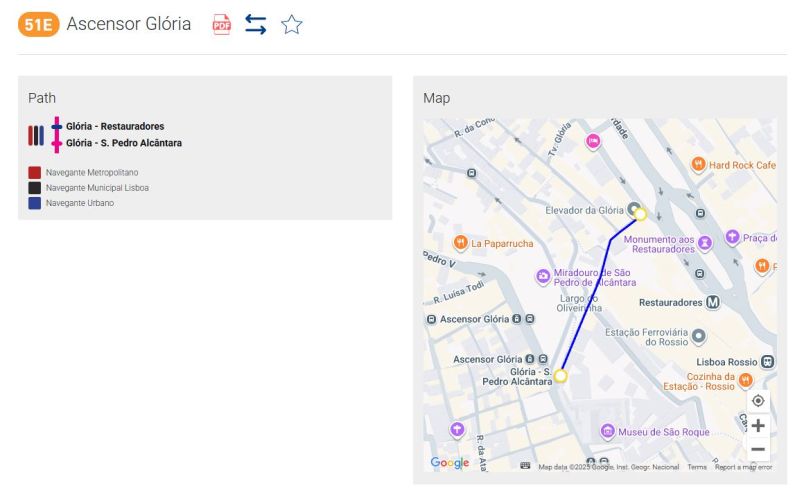
The history of the Elevador da Glória (Route 51e) is very similar to that of the Elevador do Lavra. It opened on 24-October-1885. First it used water power. A tank under the upper car would be filled with water, making it heavy enough to pull up the lower car. Then the tank would be emptied and the tank on the car now at the upper station would be filled. Later it was converted to steam power, perhaps to save water. It was converted from steam to electric drive in 1914, then to electric motors on the cars in 1930. As on Lavra, inclined frames keep the tram body horizonal.
|
UPDATE: 04-September-2025
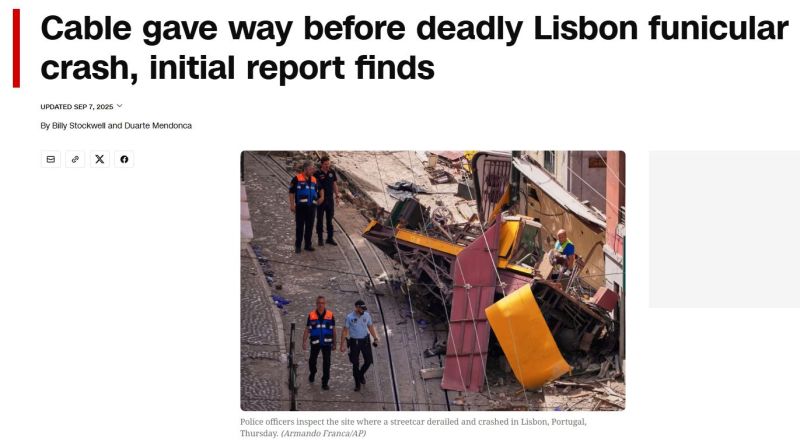
On 04-September-2025, the Elevador da Glória (Route 51e) suffered a fatal crash when the upper car ran away and hit a building. At least 16 are dead. |

|
| (Source: cnn.com, 07-September-2025 October 2025 Picture of the Month. |
|
|
A car of the Glória line. (Source: "Por Encostas e Ladeiras", Illustração Portugueza, 08-February-1909. |
|
The route of the Elevador da Glória (Route 51e) from the Carris website. |
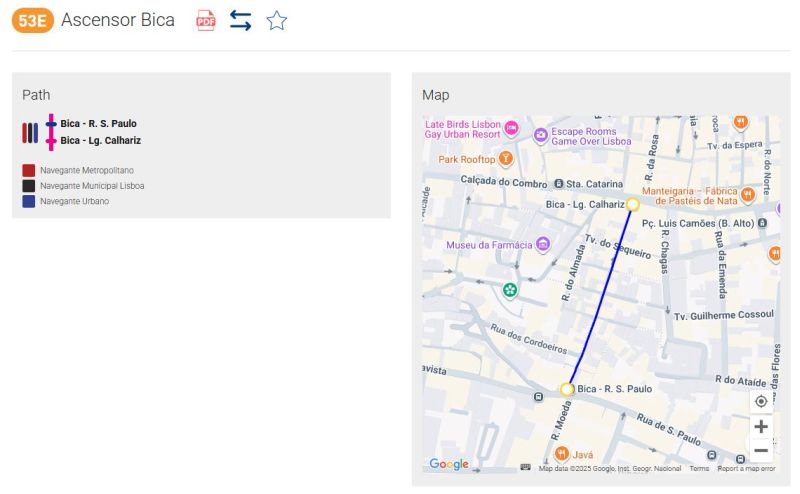
The Elevador da Bica (Route 53e) works differently. It opened on 28-June-1892. It was powered by a steam engine. Like the others, it was converted to electric drive in 1914, but it has stayed that way. Pantographs on the car roofs connect with wires which are used to carry signals to the powerhouse. The car bodiess are stepped, as on most traditional funiculars.

|
A car of the Bica line. (Source: "Por Encostas e Ladeiras", Illustração Portugueza, 08-February-1909. |
|
The route of the Elevador do Lavra (Route 53e) from the Carris website. |
All the lines run on 90CM tracks, which are standard in Lisbon.
Go to top of page.
Paris - Tramway Funiculaire de Belleville

|
"Élévation d'une voiture funiculaire" (View of a funicular car) from the article "Tramway Funiculaire De Belleville" by G De Burgraff, from Le Magasin Pittoresque, 1890. November, 2003 Picture of the Month. |
line: Belleville
opened: 25-Aug-1891. From La Place de la République on Rues du Faubourg-du-Temple and Belleville to the Church of Belleville
powerhouse: Top of la rue de Belleville
grip: single-jaw side
gauge: 1M
cars: closed grip and trailer trains
turntables: ?
crossings: N/A
notes: The Tramway Funiculaire de Belleville was designed and built by Fulgence Bienvenüe, who later built the Paris Metro. It was a popular line, carrying up to 5 million passengers a year.
There was one serious accident on the line. In 1906, a car ran away down the hill to the Place de la République, running at speeds up to 120 kmh. Over 20 people were injured.
The cable line ran until 18-Jul-1924, when it was replaced by a bus.
Read the article "Tramway Funiculaire De Belleville" by G De Burgraff, from Le Magasin Pittoresque, 1890.
Go to top of page.
Brazil - São Paulo Railway

|
A Churchman's Cigarettes card shows a cable-hauled train leaving a tunnel on Brazil's São Paulo Railway. November, 2015 Picture of the Month. |
British investors built the São Paulo Railway to connect the port of Santos with São Paulo City. The line used cable traction to haul freight and passengers up and down the Serra do Mar. Showing typical British skill with local languages, they incorporated it as the San Paulo Railway. The Railway opened on 16-February-1867.
The line uses a gauge of 5'3". There are several different gauges used in Brazilian railroads and metro systems. 5'3" is used on several.
The first section of the line runs for about 20 kilometres from near sea level at Santos to Piassaguera. Construction of this section began in 1860. The second section climbs the Serra do Mar from Piassaguera to Paranapiacaba. It is about eight kilometres. Construction of this section began in 1861. Methods of climbing and descending have changed over the years. The third section of the line, about 110 kilometres, crossed he plateau from Paranapiacaba via São Paulo to Jundiaí.
The second section has used three different systems to climb and descend the Serra do Mar. The original section, later called the Serra Velha, used four separate inclines with cable traction. On each incline, trains were attached to a brake van, called a serrabreque. The serrabreque was attached to the cable. A steam engine in a powerhouse at the top of each incline would wind up and unwind a steel rope. The trains were not counterbalanced. Declining traffic led to this section stopping work in 1970.
The second section was a bottleneck which slowed handling of big coffee crops. The company built a parallel section starting in 1891. Grades were lighter on this section, which used five separate inclines. The ropes were endless and loads moving up and down were counterbalanced. Trains were attached to the ropes by a Locobreque, a small steam locomotive which could grip the rope to run on the inclines and pull the train to the next incline. This section was used until 1982.
Now the second section is operated using Abt system rack traction with electric locomotives on the grade of the Serra Velha. This section opened in 1974.
On 13-September-1946, the government of Brazil nationalized the line and renamed it Estrada de Ferro Santos-Jundiaí. On 27-September-1948, it merged into the national system, Rede Ferroviária Federal SA (RFFSA).

|
A Wills's Cigarettes card shows a Beyer-Garratt 4-6-2+2-6-4 articulated locomotive on Brazil's São Paulo Railway. November, 2015 Picture of the Month. |
Go to top of page.