If you came to this page from an outside link, you may want to see the Picture of the Month and visit my main page.
| Where Should I Go from Here? Visit the Map |
There were, at one time, several funiculars in the Los Angeles area.
- Mount Lowe
- Angels Flight
- Court Flight
- Santa Catalina Island Incline Railway
- Playa Del Rey Incline Railway
- Griffith Park Incline Railway
- Los Angeles and Mount Washington Railway
- Victoria Station Restaurant at Universal City
- Industry Hills Incline
- Getty Museum Shuttle
- Private Funiculars
Mount Lowe

|
| A Pacific Electric Mount Lowe advertisement from the back of a Santa Monica Airline timetable. |

|
The Mount Lowe incline with a connecting Pacific Electric interurban car (Source: [group 3:27], William C. Barry Collection of Los Angeles Area Photographs, BANC PIC 1964.056--PIC, The Bancroft Library, University of California, Berkeley). |
The great incline at Mount Lowe, a funicular rather than a cable car line, ran for a distance of 3,000 feet on a grade varying from 48 to 62 per cent from Rubio Canyon to the summit of Echo Mountain.
Professor Thaddeus Sobieski Constantine Lowe, who was born in Jefferson Mills, New Hampshire on 20-Aug-1832, led a remarkable life. He apprenticed as a shoe maker, became a "Professor" in a travelling chemistry show, and then, in 1857, became a balloonist. The Civil War interrupted his plan to fly across the Atlantic, so Lowe went to Washington, DC, where Joseph Henry, head of the Smithsonian Institution, persuaded President Abraham Lincoln to allow Lowe to form a Balloon Corps for the Union Army. For two years, Lowe and his fellow pilots provided valuable intelligence for the army at battles including Fair Oaks, Chancellorsville, Mechanicsville, and Chickahominy. Lack of funding and ill health forced Lowe to resign.
In private life, Lowe developed a mechanical refrigeration system and made many improvements in the use of gas for heating and lighting. He moved to Southern California in 1888 and settled in Pasadena in 1890.
In Pasadena, Lowe was approached by an engineer named David J Macpherson. Macpherson had a plan for building a scenic railway to the summit of Mount Wilson. Lowe approved of the plan and agreed to finance it. Macpherson made surveys and began construction on Mount Wilson. He found that the land owners were not cooperative and that the rock wasn't suitable. Lowe and Macpherson decided to go ahead with a different route.
They built the Pasadena and Mount Wilson Railway, a 3' 6" gauge trolley line from the Altadena station of the Los Angeles Terminal Railway to Rubio Canyon in 1891 and 1892. During the winter of 1891, crews began building the great incline to the summit of Echo Mountain. The incline opened on 04-Jul-1893. In 1894 Lowe opened the twelve room Echo Mountain House at the top of the incline. A larger forty room Echo Mountain House opened later and the original was renamed as the Chalet. Lowe also built a hotel and pavilion in Rubio Canyon, at the foot of the incline.
The incline used an electrically powered endless cable to move two counterbalanced cars. The two original cars were named Echo and Rubio. A backup car named Alpine was built in 1920. The incline had three rails with an automatic passing track in the middle.
The line then moved on toward Oak Mountain, which would be renamed as Mount Lowe, building a 3.6 mile narrow gauge electric railway. This scenic line was an exciting ride, on narrow ledges and trestles with many sharp curves. The longest stretch of straight track was only 225 feet. The line climbed 1500 feet. It included the famous Circular Bridge, which climbed a 4.5% grade and formed a full circle with a radius of 75 feet.

|
A narrow gauge electric car passes through Granite Gate above the Mount Lowe funicular in 1895. |
Lowe operated both the lower and upper electric lines with single truck open cars. At Mount Lowe, he built the Alpine Tavern at an elevation of 5000 feet in 1896.
A 1905 newspaper article, "Car Crashes Into Woodmen Party", describes operations at the top of the incline.
Lowe ran out of money before he could extend the line to the summit of Mount Lowe, and the properties were taken over by the Pasadena & Los Angeles Electric Railway, which itself was taken over by the Pacific Electric in 1902. Pacific Electric standard gauged the line from Pasadena to Rubio Canyon and ran through cars from Los Angeles. Pacific Electric replaced the single truck cars on the upper line with heavier open double truck cars with extra deep flanges. Pacific Electric operated the Mount Lowe incline and upper narrow gauge line as its Alpine Division. For most of its period of ownership, Pacific Electric ran five electric trains a day to Mount Lowe. The 24 mile trip from downtown Los Angeles to the Alpine Tavern took just under two hours.

|
"Coming Down From Echo Mountain In One of the White Chariots." A photograph from "A Mountain Paradise" by Ronald L Pearse, in Cassel's Magazine, June, 1901, showing one of the cars on the Mount Lowe incline. August, 2009 Picture of the Month. |

|
"Echo Mountain House is Destroyed by Fire" from the 06-February-1900 San Francisco Call, is a typical example of the forces of nature working against the Mount Lowe Railway. |
The Alpine Division suffered from many problems common to the California mountains. Trestles and short sections of track were regularly hit by landslides and flash floods. The Echo Mountain Chalet and cable winding house burned in 1905, reducing the incline to limited operation for some time. A 1906 newspaper article, "Mt. Lowe Line is Rebuilt", describes the remarkably quick return to service.
The hotel in Rubio canyon was wiped out by a landslide in 1909. In 1936, the Alpine Tavern burned. Most of the upper line was wiped out by floods in 1938. This caused Pacific Electric to abandon the Alpine Division.
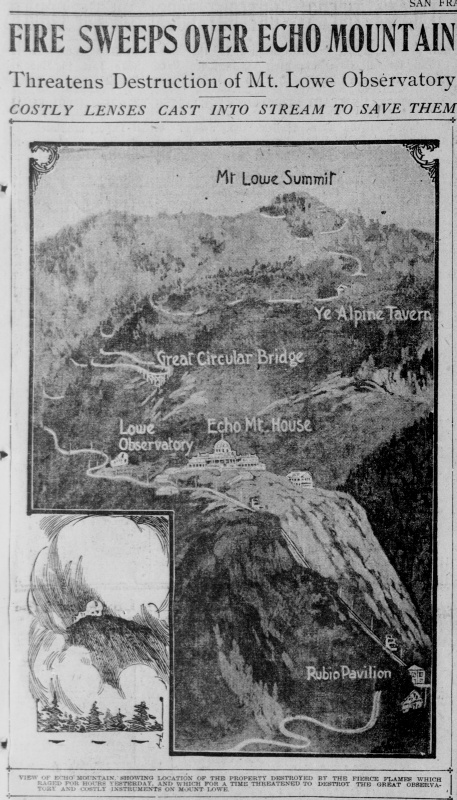
|
"Fire Sweeps Over Echo Mountain" from the 10-December-1905 San Francisco Call, is another example of the forces of nature working against the Mount Lowe Railway. |
Professor Lowe died on 16-Jan-1913. He had never been able to restore his finances. There are a few traces left of his work, but they are hard to find.

|
A Mount Lowe funicular car, during Pacific Electric operation. Note the tiers, which kept the seats level. August, 1999 Picture of the Month. |
|
From Los Angeles: a Guide Book By Alice Mary Phillips, 1907. Page 130. Mt. Lowe. -- Garvanza, Arroyo Seco, Pasadena, Altadena, Rubio Canyon, Incline Railway, Echo Mountain and Observatory, Alpine Tavern. Pacific Electric cars leave station at 8, 9, and 10 a. m., and 1 and 3:30 p. m. Round trip fare, $2.50. |
Thanks to Michael Patris, founder of the Mount Lowe Preservation Society, Inc , for reviewing this article and suggesting some corrections.
Also visit The Great Incline by Jake Brouwer.
Echo Mountain Echoes has some nice material.
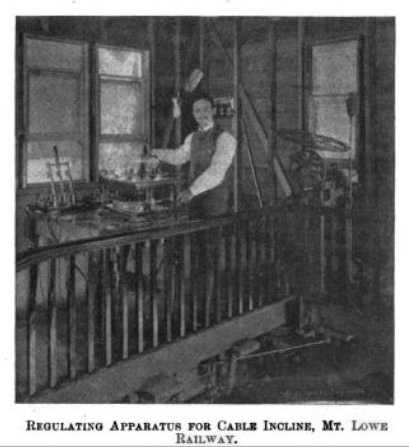
|
"Regulating Apparatus for Cable Incline, Mt. Lowe Railway." A photograph from "From Strawberries to Snow by the Mount Lowe Electric Road" in The Electrical Engineer, 07-February-1894. |
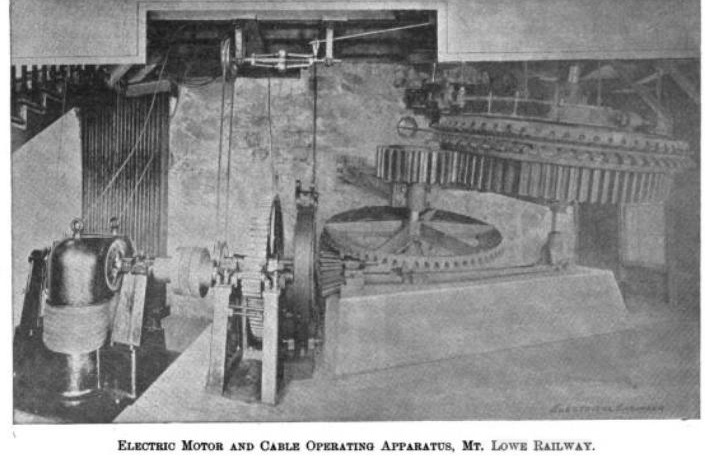
|
"Electric Motor and Cable Operating Apparatus, Mt. Lowe Railway" by Ronald L Pearse, in The Electrical Engineer, 07-February-1894. |
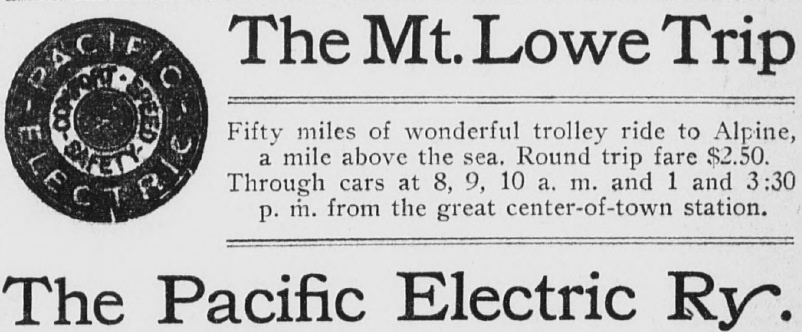
|
| A Pacific Electric ad for Mount Lowe. "Round trip fare $2.50." From the 29-March-1906 Los Angeles Herald. |
|
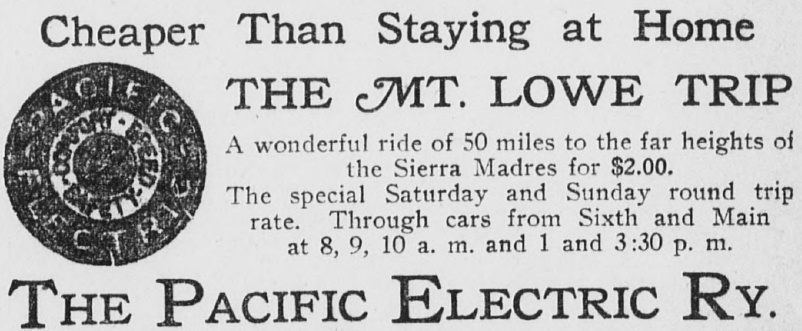
| A Pacific Electric ad for Mount Lowe. "Cheaper Than Staying at Home." From the 31-March-1906 Los Angeles Herald. |
|
|
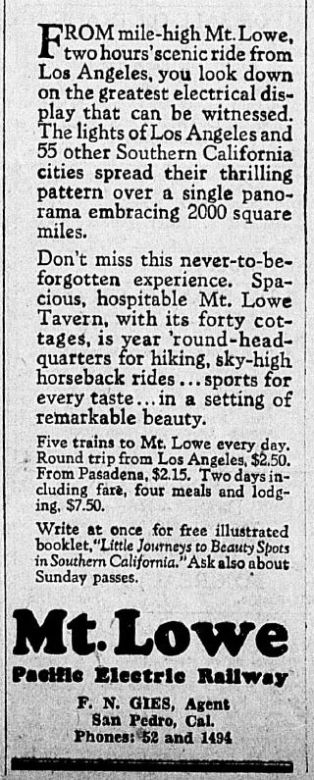
| A Pacific Electric Mount Lowe advertisement from the 22-May-1929 San Pedro News-Pilot. |
|
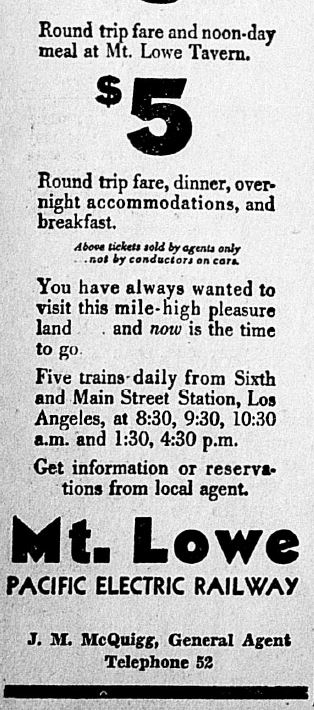
|
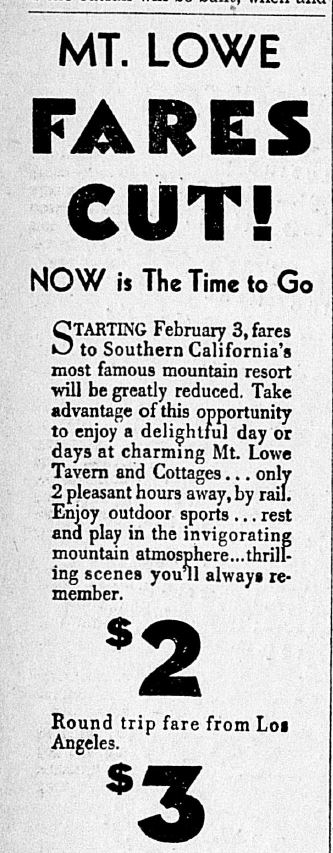
| A Pacific Electric Mount Lowe advertisement from the 26-February-1930 San Pedro News-Pilot. |
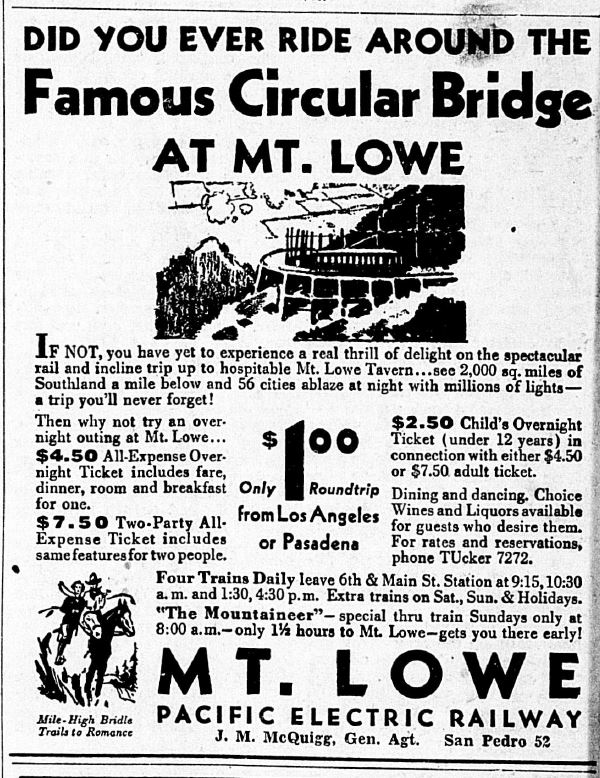
|
| A Pacific Electric Mount Lowe advertisement from the 21-February-1934 San Pedro News-Pilot. |
Go to top of page.
Angels Flight
|
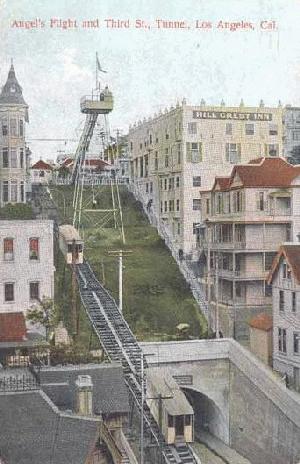
A high level view of Angels Flight, clearly showing the passing track. September, 1999 Picture of the Month. |
|
From California: A Guide to the Golden State By the Federal Writers' Project, 1939, page 218. 15. ANGEL'S FLIGHT (open 6 a.m.-12 p.m. daily; round trip fare 5 cents), 3rd and Hill Sts., built in 1901 by Col. J. W. Eddy, is a commercially operated miniature cable railway transporting passengers up and down the steep slope of Bunker Hill, between Hill and Olive Streets. The line climbs 315 feet up the 33 1/3 percent gradient from its starting point just south of the entrance to the Third Street Tunnel. An observation tower rises 100 feet above the tunnel mouth, and commands a view of the distant San Gabriel Mountains. |
Angels Flight (no apostrophe), "The Shortest Railway in the World", ran for a distance of 320 feet on a 33 per cent grade from Third and Hill Streets up to Olive Street on Bunker Hill, the same obstacle conquered by Los Angeles' first two cable car lines.
Colonel J W Eddy promoted the line, which opened in 1901. Colonel Eddy had been a friend of Abraham Lincoln before the Civil War. When the war broke out, Eddy, who was in Washington DC, volunteered to defend the Union. After the war and some time in the Illinois legislature, Eddy headed west.
Angels Flight was built to allow residents of the wealthy Bunker Hill neighborhood to get to and from the business district near the Plaza. Eddy also set up a telescope and later a 100 foot tower to attract tourists. "Truly one of Los Angeles' greatest attractions is the Angels' Flight, with its rest pavilion, park, electric fountain, observation tower, camera obscura and searchlight." - Los Angeles Herald / Saturday, September 9, 1905. Page 4.
Eddy sold the company in 1912. He passed on in 1916.
Two thirty-inch gauge counterbalanced cars, seating thirty-eight passengers each, operated on the line. The track had three rails with a passing siding in the middle.
Only up-bound passengers had to pay. The city required the company to maintain a parallel stairway for people who didn't want to pay.
The initials "B.P.O.E." on the lower entrance stood for the Benevolent and Protective Order of Elks, which built a large lodge building at the top of the line in 1906.
|
From Urban Renewal Notes May-June 1962, Pages 5-6.
ANGEL's FLIGHT IS SAVED San Francisco has its cable cars -- Los Angeles its Angel's Flight. Angel's Flight was born on Decernber 31, 1901, when it was christened -- not with champagne, but with fruit punch, served by the Mayor of Los Angeles to the many notables attending the opening of this diminutive railway. Said to be the world's shortest incorporated railway, the 2 counterbalanced cars, controlled by cables, travel a 33% grade for 315 feet. It is estimated that Angel's Flight has carried more passengers per mile than any other railway in the world -- 100 million in its first 50 years. Angel's Flight traverses one side of Bunker Hill, one of the oldest residential areas of downtown Los Angeles, now badly deteriorated and slated for redevelopment. The railway provides the only transportation up the steep hill; the only other way of getting to the top is climbing a stairway of 123 steps. With the historic landrnark threatened by the Bunker Hill urban renewal project, the city's citizens sought some means of saving its life. The Los Angeles City Council approved the purchase of Angel's Flight from its present owners for $35,000 and it will be operated by the Redevelopment Agency as part of its property management function. It will be operated until it is no longer needed to serve the area; it will then be preserved as a historic landmark. |

The Bunker Hill neighborhood gradually declined over the years until the 1960's when the city decided to "renew" it. The city promised to save the line's equipment and to rebuild it. The last day of service was 18-May-1969.
In early 1995, construction began at a new location, 4th and Hill Streets, using the original railcars, station house, and the two end station arches. The original driving mechanism was put back, but is no longer used. The trestle and track structure are new.
The line reopened on 24-Feb-1996.
Angels Flight is now operated by the Angels Flight Railway Foundation. The fare is 25 cents a ride. Ticket books are available in books of five for $1 and forty for $7.50. It operates seven days a week from 6:30 am to 10:00 pm. It is closed on the first and third Tuesdays of each month from 6:30 am to 8:00 am for maintenance.
There was a serious accident on the restored line on 01-Feb-2001. Sinai, the upper car, ran away and struck Olivet, the lower car. One person died, two were seriously injured, and at least five injured less seriously. The accident may have been caused by a problem with the winding mechanism. This was only the second fatality in the entire history of the line.
On 24-Jan-2007, a Los Angeles Times article reported that Angels Flight, should reopen in the summer. The cars and trackway had been renovated, and work would start soon on replacing the driving machinery and adding some safety devices that had not been included when the line was restored in 1996. The article stressed how the neighborhood has changed since the accident. On 15-March-2010, Angels Flight returned to operation.
On 09-June-2011, the California Public Utilities Commission ordered that Angels Flight shut down immediately because of excessive wear on the wheel flanges of its two cars. The foundation which operates the line said it was planning to replace the wheels. The line returned to service on 07-July-2011.
Later in July, 2011, we were finally able to visit Angels Flight.
|
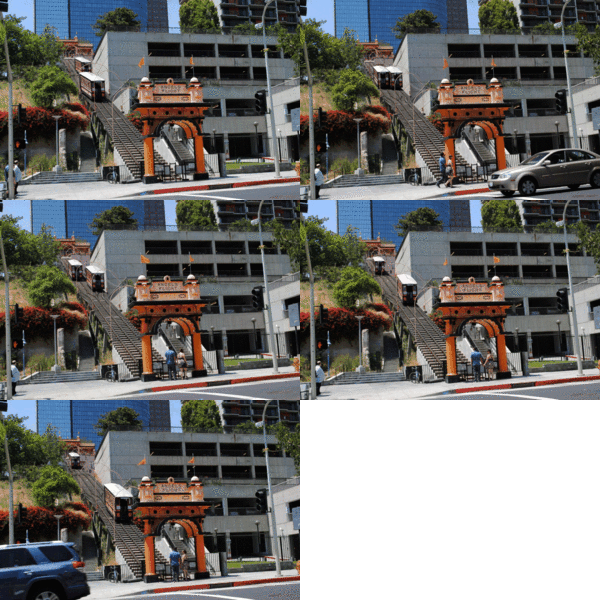
Photos I took during our visit to Angels Flight, as an animated gif, courtesy of gifka.com. |
One of the cars derailed on 05-September-2013. No one was injured. The operator of Angels Flight blamed the derailment on an electrical interruption that caused the emergency brake to engage. Apparently the brake lifted the car off the rails.
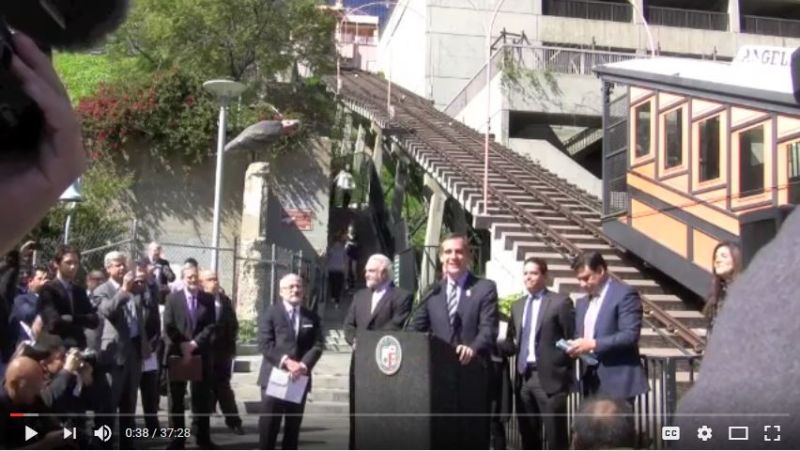
|
Los Angeles Mayor Eric Garcetti announces the rebirth of Angels Flight. (source: Angels Flight Railway Revival Press Conference, from Esotouric). |
On 01-March-2017, Los Angeles Mayor Eric Garcetti announced that Angels Flight, which had been shut down since 05-September-2013 would resume service by Labor Day. A petition organized by the Angels Flights Friends & Neighbors Society (FANS) Preservation Campaign deserves much of the credit. Thank you to everyone who signed. Petitions can work.
ACS Infrastructure Development and a team of other transportation and engineering firms have made a deal with the nonprofit Angels Flight Railway Foundation, which owns the railway, to refurbish it, improve the mechanism, and operate it for thirty years.
Angels Flight returned to service on 31-August-2017.
Six Flags Magic Mountain amusement park has had a copy of Angels Flight since 1971. It may have been renamed the Orient Express in 1988.
Some newspaper articles about Angels Flight:
- Angels Flight Sued (Los Angeles Herald, Saturday, January 28, 1905): "..asserts that the city of Los Angeles, aided and abetted by the railway company, demanded the possession of the premises at the summit of what is known as Angel's Flight.."
- Angels Flight Real Estate Effect (Los Angeles Herald, Sunday, January 29, 1905): "...which occupies a lot at the top of the Third street hill, directly north of the Angeles flight observation tower..."
- Angels Flight Burgled (Los Angeles Herald, Wednesday, June 7, 1905): "...burglars had entered his power house by means of a skeleton key and stolen $12 in cash and $25 worth of tickets. As the tickets are valued at just one cent apiece a detective will be detailed to watch for a man who rides on the flight with 2500 tickets in his pockets..."
- Angels Flight Burglars (Los Angeles Herald, Thursday, June 8, 1905): "Hopelessly lost must be those burglars who did not even respect Col. Eddy's Angels' flight, but entered the power house thereof and "swiped" cash and flight tickets..."
- "carried more people per mile of track than any railway in the United States" (Los Angeles Herald, Saturday, September 9, 1905): "Truly one of Los Angeles' greatest attractions is the Angels' Flight, with its rest pavilion, park, electric fountain, observation tower, camera obscura and searchlight."
- Angels Flight: Unfair Competition (Los Angeles Herald, Sunday, October 15, 1905): "The proposition is not to interfere with the Angels' Flight, but to run an elevator in the public library building that would carry the patrons to the second floor and surely the right of a building to its own elevator..."
- Elks Building (Los Angeles Herald, Thursday, July 19, 1906): "I will have to improve the facilities of my incline railway by placing double deck cars..."
- "the shortest railway in the world" (Los Angeles Herald, Sunday, July 29, 1906): "The credit for this unique resort is due to Col. J. W. Eddy..."
- Violence on the Flight (Los Angeles Herald, Saturday, September 15, 1906): "Adolph Russell ... punched the head of Valentine Hall, who is the night operator of the Angels' Flight car..."
- Crime Near the Flight (Los Angeles Herald, Wednesday, November 14, 1906): ""
- UP ANGEL'S FLIGHT (Los Angeles Herald, Monday, March 4, 1907): "Mrs. Ross stated to the police that she left the car on the Angels' Flight on Olive street and started for home..."
- Making Money From the Flight (Los Angeles Herald, Thursday, June 20, 1907): "Los Angeles will in a few years get a growing income from franchises through the provision which, after five years, forces all franchise recipients to pay 2 per cent of gross earning to the city..."
- Injured By the Flight (Los Angeles Herald, Thursday, July 18, 1907): "Alleging that through the premature starting of one of the Angel Flight cars his right foot had been crushed..."
- Colonel Eddy Gets Burned (Los Angeles Herald, Wednesday, August 7, 1907): "He has been greatly missed by the patrons of Angels' Flight, and his many friends will be glad to hear of his improvement."
|
From Los Angeles: a Guide Book By Alice Mary Phillips, 1907. Page 61. Besides having one of the best electric railway systems, urban and interurban, in the country, Los Angeles can boast of the most unique, interesting and picturesque inclined railroad in the world. Right in the heart of the city, ascending Third street from Hill, is a 304-foot incline on which are operated two quaint little cars, which carry passengers every minute of the day up Third street hill, 100 feet from the level of Hill street. At the top of Angel's Flight is a rest pavilion overlooking the city and above that 100 feet is a tower called "Angel's View," from which can be obtained a sight of the city from the sea to the mountains. This little railroad is so well patronized that in its six years of existence the records show that it has carried more passengers per mile than any other railroad now in operation, and this absolutely without accident -- a truly creditable history. Page 133. Angel's Flight. -- Located at the corner of Third and Hill streets. A most unique trip. On the summit a pleasure pavilion and an observation tower are to be found. |
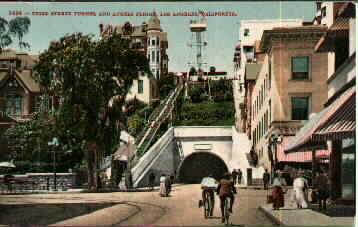
|
An early postcard of Angels Flight. The Third Street vehicular tunnel is in the background. |

|
The Hill Crest Inn is an example of real estate development inspired by Angels Flight. Detective Mike Hammer visits the Hillcrest Inn in the 1955 movie Kiss Me Deadly. |

|
A later view of Angels Flight. Note the trestle which supported the track. Also note how the adjoining buildings have changed since the earlier view. |
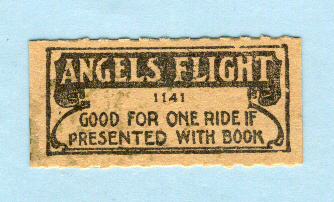
|
A 1930s Angels Flight ticket. |

|
A 1990s Angels Flight ticket. |

|
The front of an early advertising flier for Angels Flight. September, 2009 Picture of the Month. |
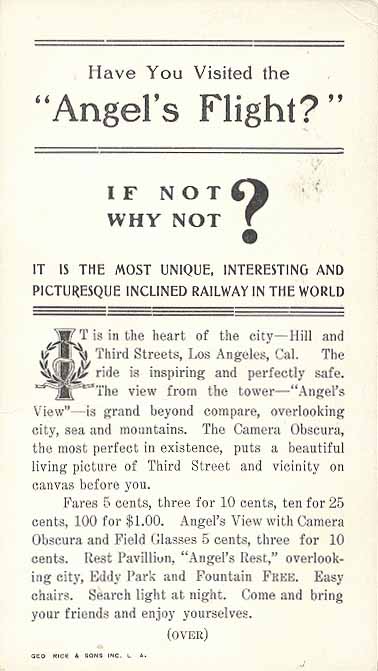
|
The back of an early advertising flier for Angels Flight. |

|
A view of the planned Angels Flight in Los Angeles (Source: Los Angeles Herald, March 29, 1901). September, 2019 Picture of the Month. |
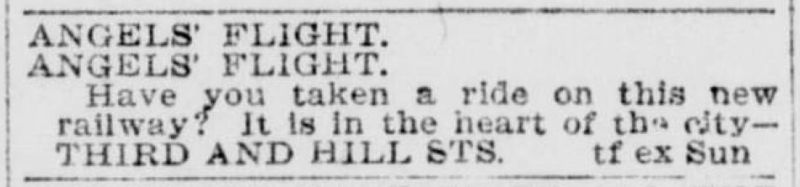
|
| An early ad for Angels Flight (Source: Los Angeles Herald, February 19, 1902). |

|
Joe Lacey provided this 1960s photo of Angels Flight, taken by Jack Cane the late San Francisco Municipal Railway Central Control Dispatcher. |
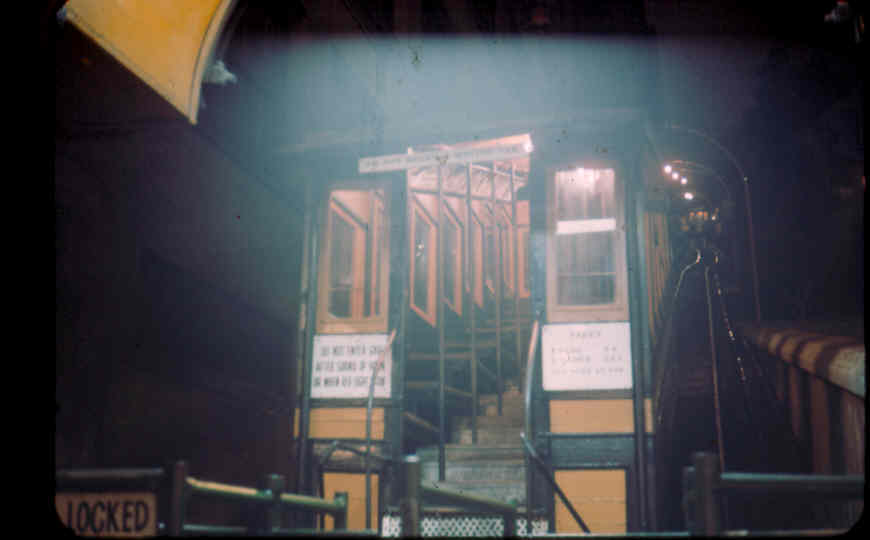
|
Joe Lacey provided this 1960s photo of Angels Flight, taken by Jack Cane the late San Francisco Municipal Railway Central Control Dispatcher. |

|
Joe Lacey also provided this 1960s photo of Angels Flight, but he is not sure who took it. It shows the Flight after redevelopment started destroying the surrounding buildings. |
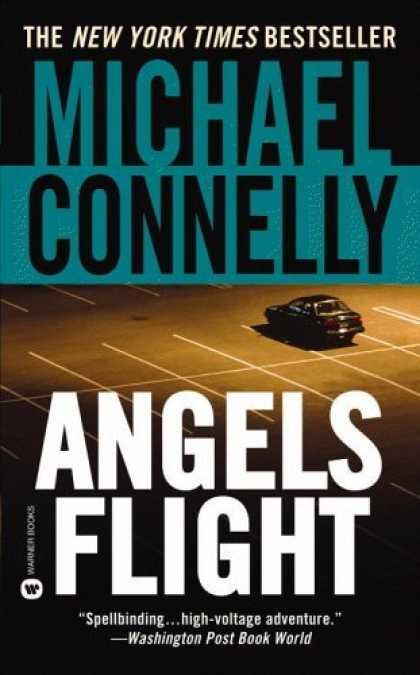
|
Angel's Flight is a 1999 detective novel by Michael Connelly. His recurring character Harry Bosch investigates the murder on Angels Flight of a lawyer who is not popular with the Los Angeles Police Department. Cover image from the wonderful site CoverBrowser. |
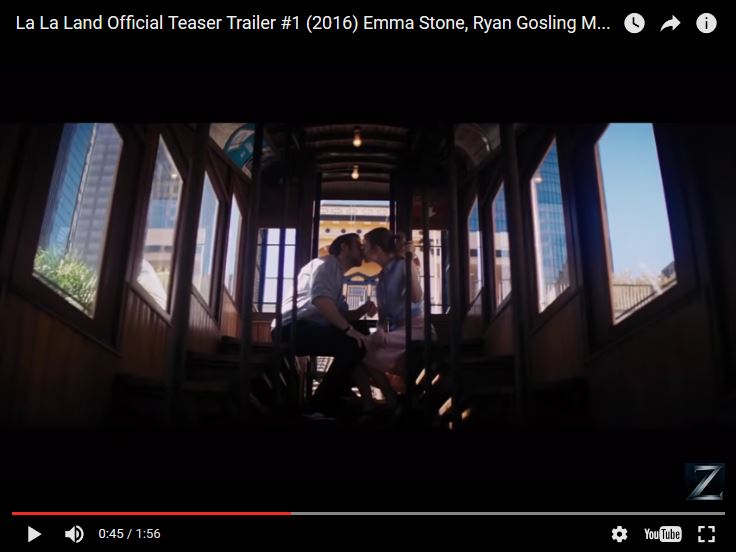
Angels Flight has appeared in many movies, including The Glenn Miller Story, Act of Violence, Kiss Me Deadly, and La La Land.
|
Ryan Gosling and Emma Stone on Angels Flight. (source: La La Land Official Teaser Trailer #1 (2016)) |
Back in 2016, while the line was still closed, an article in Los Angeles Magazine, If Ryan Gosling and Emma Stone Can Make Out on Angels Flight, We Should Be Able to, Too said that the trailer for Ryan Gosling and Emma Stone's new movie, La La Land includes a shot the two stars necking on Angels Flight. I enjoyed the movie.
|
The COVID-19 pandemic in 2020 caused many transit lines, long and short, to shut down "until further notice." Angels Flight reopened on 10-April-2021.
Go to top of page.
Court Flight

|
A 1918 view of the Court Flight in Los Angeles (Source: Security Pacific National Bank Photo Collection). October, 2019 Picture of the Month. |
|
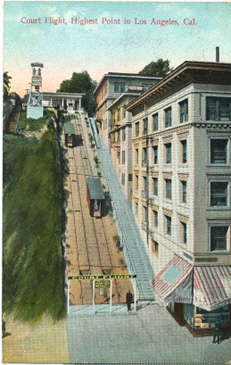
An early postcard view of Court Flight. The double tracks were an unusual feature. |
|
From California: A Guide to the Golden State By the Federal Writers' Project, 1939, page 216. 15. COURT FLIGHT (round trip fare 5 cents), 151 S. Broadway, built in 1903, is the smaller of the city's two cable railways. The lumbering wooden cars pass each other along rows of palm trees, travelling with occasional short jerks from top to bottom, but have never had a serious accident. |
The Court Flight was built by Attorney R. E. Blackburn of the McCarthy real estate firm and Samuel G Vandegrift, to serve the wealthy Bunker Hill neighborhood. Completion of the line was delayed by heavy winter rains. It opened on 24-September-1905.
The Court Flight Incline Railway ran for a distance of 180 feet up a 42 per cent grade between Broadway and Court Streets, in the middle of the block between Temple and First Streets.
The line was double tracked throughout and used a pair of thirty-inch gauge counterbalanced cars.
The incline was intended to server an observation tower and hotel, to be built by the promoters, but an injunction filed by neighbors prevented the building of the tower. The owners claimed that the line failed to turn a profit.
In later years, the line was heavily used by motorists who took advantage of cheap parking at the top of the hill. They rode the incline to and from the nearby Civic Center. World War II restrictions on civilian driving hurt the company's revenue. On 20-October-1943, a fire damaged the line and it went out of business.
When I created this page I wrote: "Rumors persist that the cars are owned by a private collector in Woodland Hills."
Thanks to Harry Marnell and Ray Long, we know what happened to them: Lindley F Bothwell, a famous collector of diverse stuff, had them at his ranch in Woodland Hills. Ray Long saw them there and says "...they were in sad shape. Very basic plywood construction and that old stuff would delaminate for little or no cause. They were stored outside..."
An article in the 05-February-1949 Los Angeles Times, "Fire Destroys Antique Autos," reported that a fire the day before had "destroyed 32 antique automobiles, streetcars, fire engines and a covered wagon ... Only one horse-drawn streetcar was saved ... Also lost were a San Francisco cable car, several horse-drawn streetcars and a horse-drawn fire wagon." I wonder what cable car he had.
Some newspaper articles about Court Flight:
- Court Flight Delayed by Rain (Los Angeles Herald, Sunday, January 1, 1905): "...celebrated the last day of '04 by viewing the damage done to their pet enterprise by the driving rain of Friday night. Real estate kept sliding down hill Into Broadway..."
- Court Flight Real Estate Ad (Los Angeles Herald, Sunday, January 8, 1905): "LARGE CORNER ON COURT, CLOSE TO NEW INCLINE RAILWAY, WHICH WILL SOON BE IN OPERATION..."
- Court Flight Fights A Competitor (Los Angeles Herald, Saturday, January 14, 1905): "The long-drawn battle between Court street hill residents to whether they would ride on an incline railway or an elevator came to an end yesterday"
- Court Flight Approved (Los Angeles Herald, Sunday, August 13, 1905): "The members of the Observatory Improvement company that planned the tower enterprise and incline railway at Court street, off Broadway, several months ago, has at last secured a favorable decision in the superior court and the injunction has been dissolved..."
- Court Flight In Progress (Los Angeles Herald, Sunday, August 27, 1905): "...it is expected that cars will be going up and coming down at an early date..."
- Court Flight to Open Monday (Los Angeles Herald, Sunday, September 24, 1905): "The twin cars on this new angels' flight will be in operation for the use of the public tomorrow."
- Court Flight a Success (Los Angeles Herald, Sunday, October 15, 1905): "The enterprise of the Observation Tower company in operating the Court Street incline railway at a cent a ride to the top of the hill from Broadway, has proven an instant success."
- Court Flight Tax Plea (Los Angeles Herald, Tuesday, June 26, 1906): "R. E. Blackburn, president of the Observation Tower company, yesterday addressed a sarcastic letter to the city council, asking that his cars be taxed according to the length of the railway and not the width."
- Court Flight Inspires Hotel (Los Angeles Herald, Sunday, October 21, 1906): "The site affords entrancing views to every point of the compass, including the heart of the city and the magnificent mountains away to the north and east."
- Court Flight Losing Money (Los Angeles Herald, Friday, February 8, 1907): "...because of a permanent injunction the company could not avail itself of the tower, the proposed profit earner of the company..."
|
From Los Angeles: a Guide Book By Alice Mary Phillips, 1907. Page 134. Observation Incline Railroad. -- From the top of this incline railway an unequalled view of Los Angeles can be obtained. The inclined road is located opposite the County Court House on North Broadway. |

|
A circa 1920 view of the Court Flight in Los Angeles (Source: Security Pacific National Bank Photo Collection). |

|
A circa-1930 view of Court Flight, showing the sandwich shop which provided additional revenue to the line. Digitally reproduced by the USC Digital Archive (c) 2004, Title Insurance and Trust / C.C. Pierce Photography Collection, 1860-1960, CHS-M8486. All rights reserved. October, 2009 Picture of the Month. |

|
| An advertisement for the Observation Incline Railroad (Court Flight) from the 29-March-1906 Los Angeles Herald. |

|
| An advertisement for El Palacio. "Take Court Flight, North Broadway. Romantic and attractive surroundings. High above the city's noise, yet only one minute from Broadway." From the 14-August-1912 Los Angeles Herald. |
|
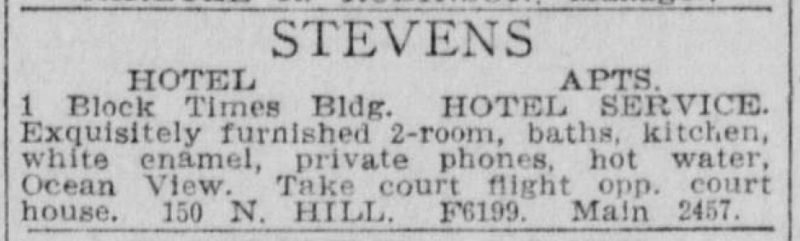
| An advertisement for the Hotel Stevens. "Take court flight opp. court house." From the 07-October-1915 Los Angeles Herald. |

|
An advertisement touts Court Flight as the way to reach some of the studios. From the program of the Picture Player Camera Men's Ball, under the auspices of the Static Club of America, Inc, held at Rutherford's, January 16, 1914. |
Many early movie producers rented space in the Bradbury Mansion near Court Flight.
|
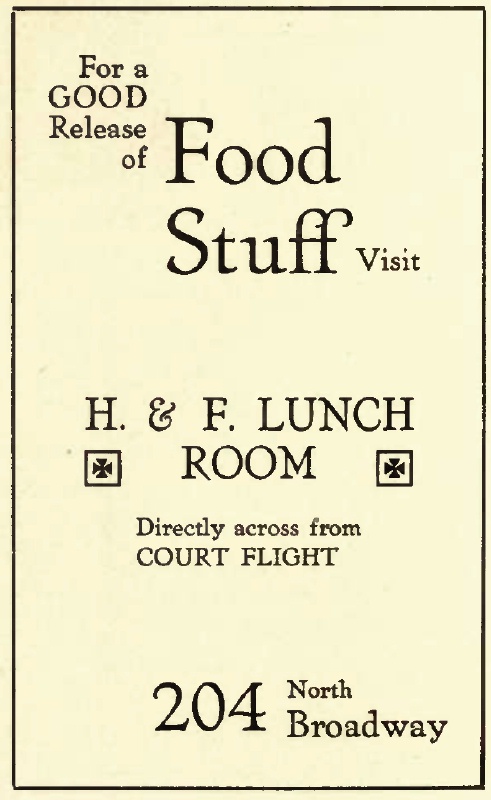
An advertisement for a lunch room across from Court Flight. |
Go to top of page.
Santa Catalina Island Incline Railway
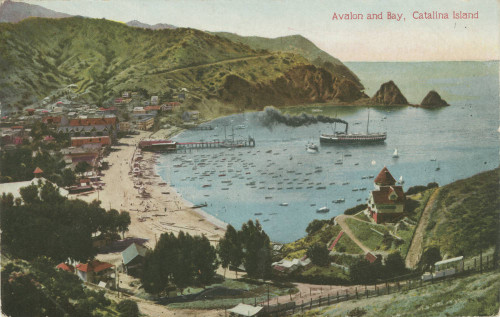
|
The town of Avalon on Santa Catalina Island. The incline is just visible in the lower left corner. (Loyola Marymount University, Department of Archives and Special Collections, William H. Hannon Library) |
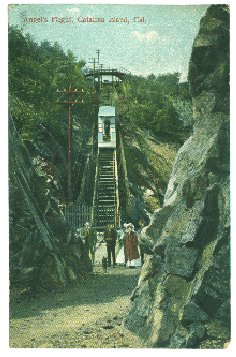
|
The incline on Santa Catalina Island. |
|
From California Teachers Association Journal, Volume 3 By the California Teachers Association, 1907. Catalina IslandCatalina Island, which has been for so long a "place of peace" for tired teachers and other professional people, as well as a humming resort for pleasure seekers, has been undergoing a change during the past year or two. A stage road has been under construction, connecting Pebbly Beach and Moonstone Beach; the hill behind Lookout Cottage has been terraced and an incline railroad is built from Avalon over the hill to Lovers' Cove. At the Avalon end is a pretty little park, to which the music "shell" has been moved from its old station near the pavilion. A new Sugar Loaf has been made to take the place of the old one, which is wearing away under stress of wind and wave. The picturesque line of boatstands has disappeared from the beach, and the sea-wall has been extended south of the pier. But the charm of the place remains; and the old habitués of the island are lamenting the possibility that other transportation companies may wrest from the Bannings their exclusive control which has been, in the main, so wisely exercised. |
The Santa Catalina Island Incline Railway had two funiculars. One line carried passengers from the Amphitheater on the lee side of the island to the top of the mountain and the other carried passengers down the ocean side to Pebble Beach in Lovers' Cove.
The railway was built in 1905 by the Banning family, which owned the island.
- "...building materials for the construction of an incline railway between this point and Pebbly beach arrived today..." (Los Angeles Herald, Saturday, July 22, 1905)
- "The incline rail way between this point and Pebbly beach is beginning to take definite form" (Los Angeles Herald, Saturday, July 29, 1905)
A great fire in 1915 burned most of the town of Avalon and hurt the finances of the Bannings and their Santa Catalina Land Company. They offered the island for sale and suspended operation of the railway in 1918. They sold the island to William Wrigley in 1919. The railway was reopened in 1921 for a Knights of Pythias convention. The lines were scrapped in 1923.
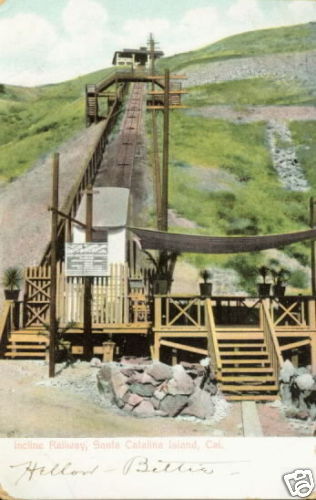
|
Another postcard view of the incline on Santa Catalina Island. |
Go to top of page.
Playa Del Rey Incline Railway
In 1904 and 1905, developers began to lay out an ambitious project at Playa del Rey. Playa del Rey was connected to Los Angeles by a line of the Los Angeles and Pacific, which later became part of the Pacific Electric. They built an inclined railroad to connect the station to homes on top of the bluff.
- "The present week also marks the beginning of work upon the inclined railway..." (Los Angeles Herald, Monday, July 17, 1905)
- "Rails and lumber are already on the ground for the inclined railway..." (Los Angeles Herald, Saturday, July 22, 1905)
- "Work began today upon the new inclined railway..." (Los Angeles Herald, Saturday, July 29, 1905)
I don't have much information about this incline, and some people have expressed doubt that it operated, but I have seen one photograph of it. It would be impossible to trace its path today because of cliff erosion.
|
From A History of California and an Extended History of Los Angeles and Environs, Volume One By JM Guinn, A.M., 1915. PLAYA DEL REYPlaya del Rey (Beach of the King) was known to the old-timers as Will Tell's. It was a popular seaside resort thirty years ago, where sportsmen went for duck shooting on the lagoon. The southeasters of the great flood year of 1884 destroyed its hunting grounds, and for two decades it was deserted. With the great boom of ocean frontage that began in 1902 the capabilities of the place for a seaside resort were brought to the front and extensive improvements begun. In 1904 fully a quarter of a million dollars were expended. A new pavilion was built at an outlay of $100,000 and was dedicated on Thanksgiving day, 1904. On the lagoon side, and extending from the level of the pavilion to the water's edge, an amphitheater with a seating capacity of 3,000 was erected. From this a fine view of the boat races and aquatic sports can be obtained. A handsome three-story hotel was erected at a cost of $20,000 and a number of fine residences were erected. During the year 1905 extensive improvements were made at the King's Beach. The lagoon's banks were bulkheaded for miles on either side. Two suspension bridges of concrete were constructed to connect the strand with the mainland, and an incline railway was built from the beach to Mount Ballona, as the eminence is called that rises above the beach. A two-story bank building was constructed, and the Los Angeles-Pacific Electric Railway expended $5,000 in building a passenger depot in the so-called mission design. Gold has been found in the black sands of the beach. It is one of the possibilities of the future that gold mining may be made to pay. |
I like the variety of designs used by these real estate advertisements.
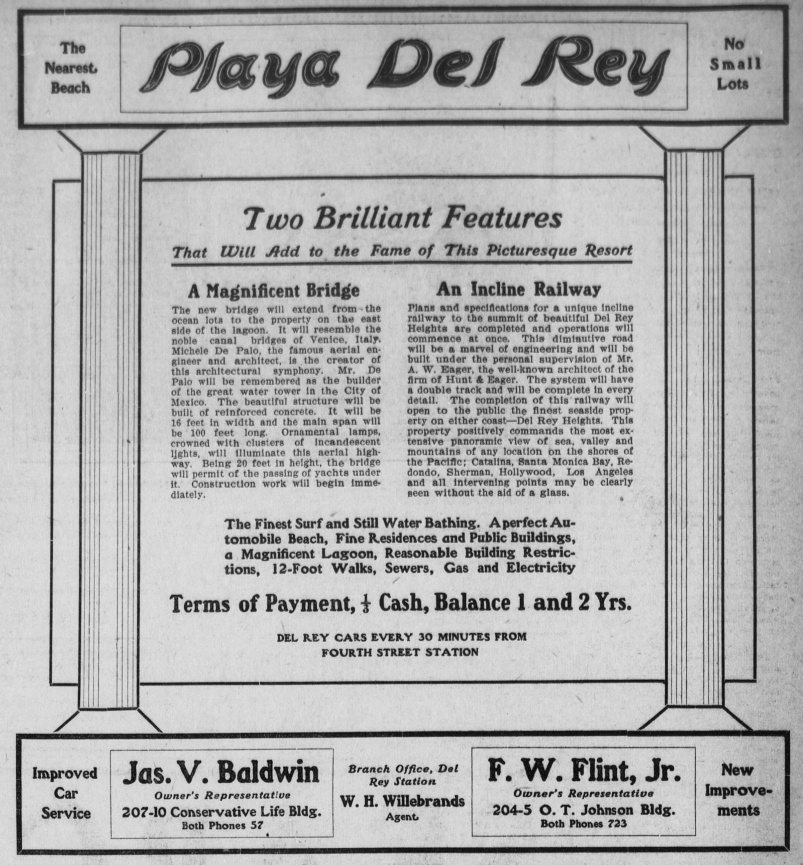
|
An advertisement for the Playa Del Rey development. "An Incline Railway -- Plans and specifications for a unique incline railway to the summit of beautiful Del Rey Height are completed and operations will commence at once. This diminutive road will be a marvel of engineering and will be built under the personal supervision of Mr. A. W. Eager, the well-known architect of the firm of Hunt A Eager. The system will have a double track and will be complete in every detail. The completion of this railway will open to the public the finest seaside property on either coast -- Del Rey Heights. This property positively commands the most extensive panoramic view of sea, valley and mountains of any location on the shores of the Pacific: Catalina, Santa Monica Bay, Redondo, Sherman, Hollywood, Los Angeles and all intervening points may be clearly seen without the aid of a glass." From the Los Angeles Herald, 16-July-1905. |
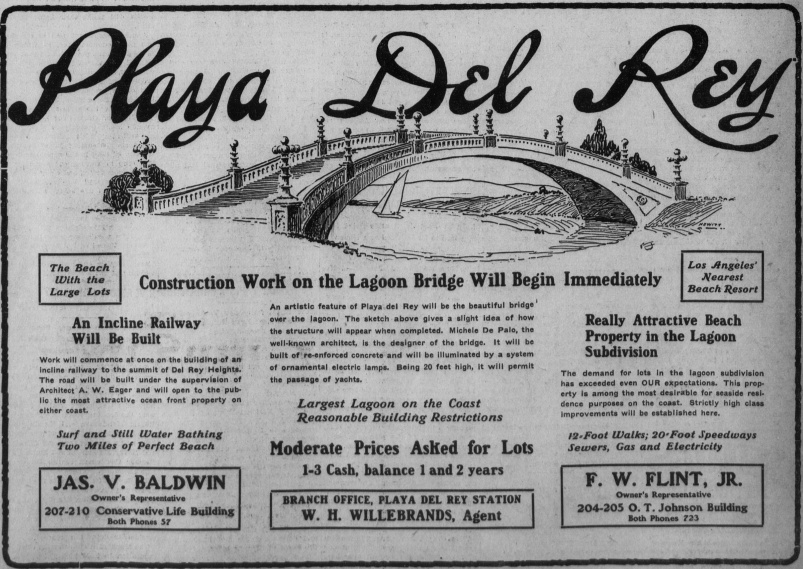
|
An advertisement for the Playa Del Rey development. "An Incline Railway Will Be Built -- Work will commence at once on the building of an incline railway to the summit of Del Rey Heights. The road will be built under the supervision of architect A. W. Eager and will open to the public the most attractive ocean front property on either street." From the Los Angeles Herald, 21-July-1905. |

|
An advertisement for the Playa Del Rey development which mentions the "unique incline railway which will extend to the summit of Del Rey Heights will be completed in a comparatively short time. Surveyors and graders are now at work preparing the roadbed. The system will have a double track, with pavilions at the summit and foot. An attractive 'midway station' will also be built. This diminutive road will be a marvel of modern engineering, and will open to the public the most picturesque seaside residence property on the Pacific Cost." From the Los Angeles Herald, 23-July-1905. November, 2009 Picture of the Month. |
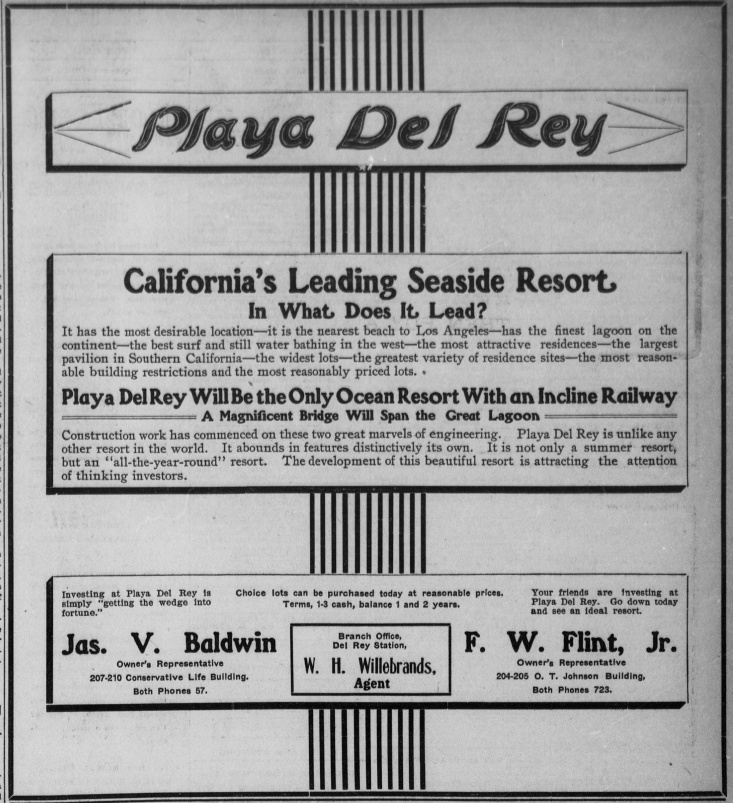
|
An advertisement for the Playa Del Rey development: "Playa Del Rey Will Be the Only Ocean Resort With an Incline Railway." From the Los Angeles Herald, 30-July-1905. |
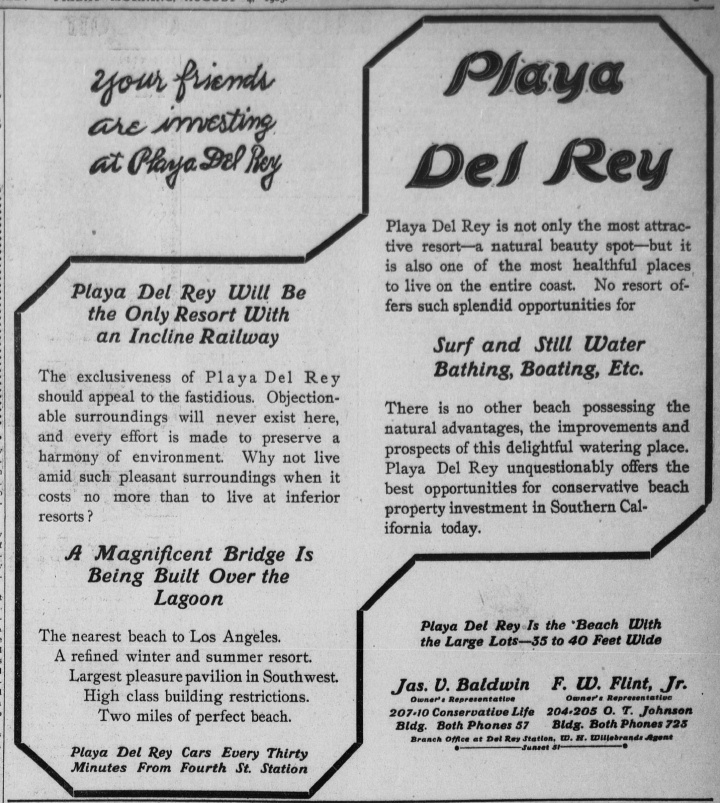
|
An advertisement for the Playa Del Rey development: "Playa Del Rey Will Be the Only Ocean Resort With an Incline Railway." From the Los Angeles Herald, 04-August-1905. |
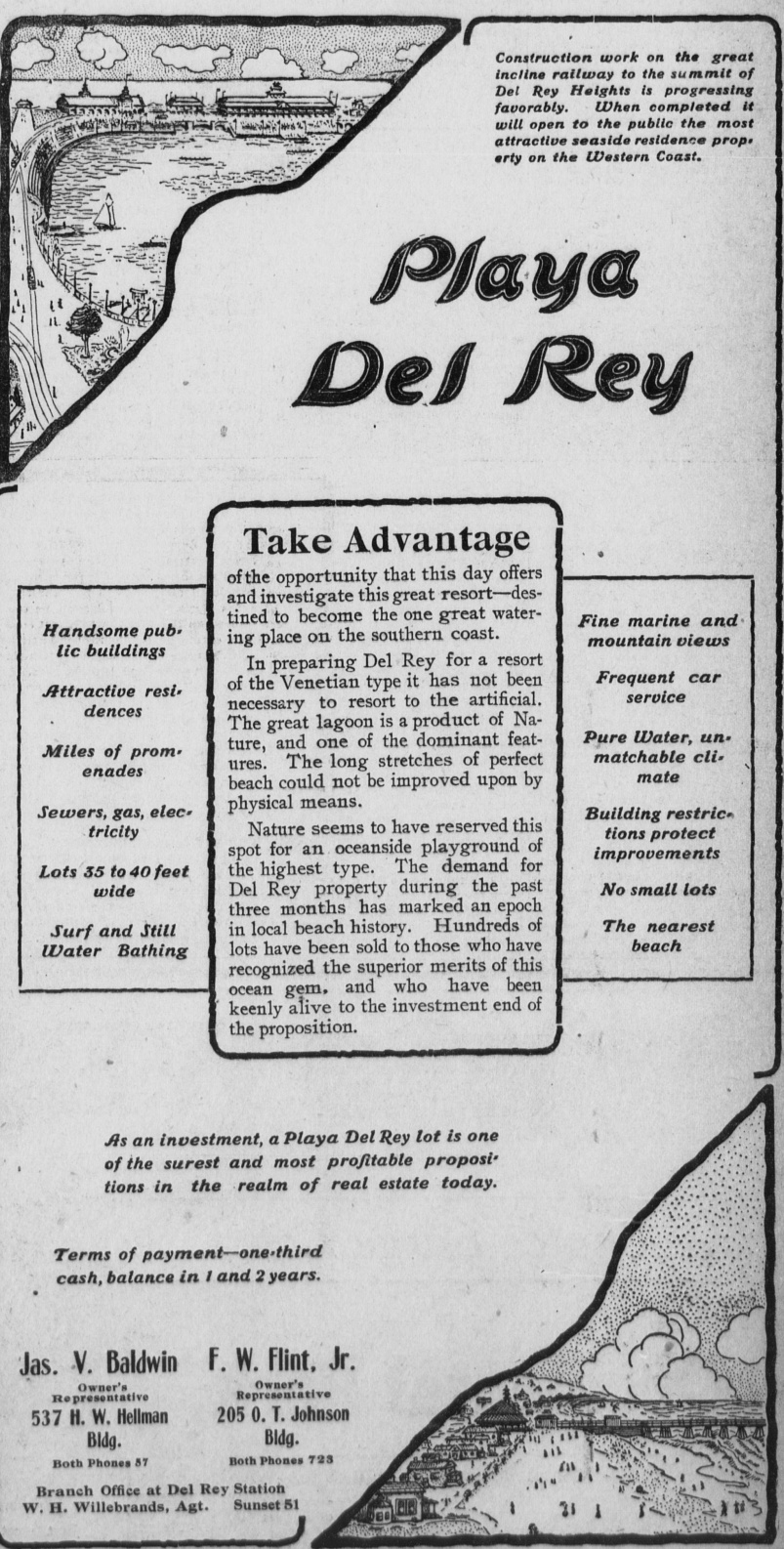
|
An advertisement for the Playa Del Rey development: "Construction work on the great incline railway to the summit of Del Rey Heights is progressing favorably. When completed it will open to the public the most attractive seaside residence property on the Western Coast." From the Los Angeles Herald, 20-August-1905. |

|
The only known photo of the Playa Del Rey Incline. Thank you to John Heller for permission to use this photo from the Electric Railway Historical Association of Southern California website. Courtesy Malcolm Atwill collection. |
Go to top of page.
Griffith Park Incline Railway
|
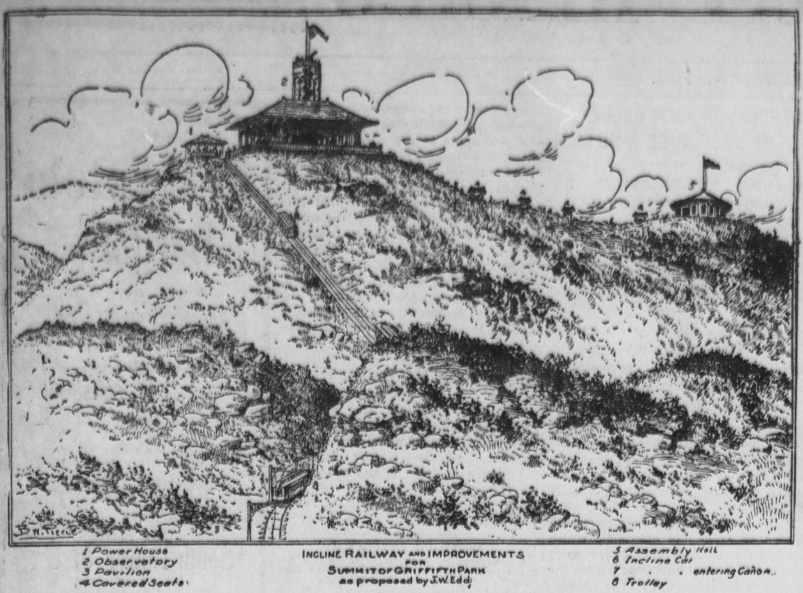
The proposed incline and improvements in Griffith Park. From the Los Angeles Herald, 27-August-1905. December, 2009 Picture of the Month. |
Colonel J. W. Eddy, who built and operated Angels Flight, proposed building another incline to reach the top of the mountain in Griffith Park. According to the article "Incline Railway/To Griffith Park," from the Los Angeles Herald / Sunday, August 27, 1905, Colonel Eddy had sold his franchise for the line to the Mount Hollywood Scenic Railway Company. This deal must have fallen through because a later article, "Col. Eddy Gets More Time/ for Griffith Park Project" (Los Angeles Herald, Thursday, November 28, 1907) says that Colonel Eddy "has been granted an extension of time until January 31 for his incline elevator enterprise at Griffith park."
In any event, it didn't happen.
Go to top of page.
Los Angeles and Mount Washington Railway

|
At the foot of the Mount Washington funicular. The ticket office and waiting room on the left still stands. November, 1999 Picture of the Month. |

|
The former ticket office and waiting room of the Los Angeles and Mount Washington Railway. Google Maps Streetview Image updated March 2019. Copyright 2019 Google. November, 2019 Picture of the Month. |
The Los Angeles and Mount Washington Railway ran for a distance of 3000 feet on a grade as high as 42 percent.
Mount Washington is a 900 foot hill near the Highland Park district of Los Angeles. In 1909, real estate developer Robert Marsh built a hotel and laid out a subdivision on the summit of Mount Washington, and an incline railway to allow guests and prospective buyers to reach the top. The developer sold many lots and Mount Washington became a desirable residential area.
Construction of the railway began during October, 1908. It was tested on 30-Mar-1909, but city inspectors demanded that the open cable trench be planked over to form a conduit. The line opened for business on 24-May-1909.
The line used two counterbalanced cars running in the street along what would become Avenue 43 from Marmion Way. The line used an endless cable. Each car was equipped with a telephone so the conductor could communicate with the engineer in the powerhouse. The trip to the top took five minutes. The cars were named Florence and Virginia. The seats on each car were arranged in three tiers so that passengers could sit on the level and enjoy the view.
The tracks were 3' 6" gauge. The line used three rails with an automatic passing turnout in the middle. The conductor crossed from the ascending car to the descending car at the passing turnout.
The powerhouse used a 40 horsepower electric motor, controlled by a standard trolley car controller.
The fare was five cents each way. The line ran from 6:00 AM to midnight.
After the line opened, the operators saw the need for a shelter at the base. They built a two-story mission style station. The ground floor held the waiting room and ticket window, and the upper floor was the residence of the ticket seller. The station opened on 01-Nov-1909.
In a foreshadowing of competition to come, in 1909, intrepid motorist Ralph C Hamlin drove his air-cooled Franklin, which he had named Greyhound II, up the incline's tracks and back down again.
In 1918, the Board of Public Utilities stated that the line was unsafe and needed changes. Robert Marsh and Company claimed that the line was an elevator and that the Board did not have jurisdiction. On 01-Jan-1919, the Board ordered the line to close down. The line stopped running and was abandoned on 09-Jan-1919.
The citizens of Mt. Washington asked California Railroad Commission to order resumption of service. The Board of Public Utilities tried to order Robert Marsh and Company to resume service. The California Railroad Commission refused to order a resumption:
|
From Decisions of the Railroad Commission of the State of California, Volume 20 By the Railroad Commission of the State of California, 1921. Page 597-8. WALTER G. EISENMEYER, HORACE E. SMITH, ARTHUR P. BOND, JAMES H. SHULTZ, THOMAS M. BULEY, SIDNEY K. JOHNSON, HOLTHY R. MYERS, J. B. YARNELL, VERNE M. OSBORNE, FRANK E. BAKER, CHARLES W. HILL, COL. WILLIAM STOVER, AND J. D. MINSTER LOS ANGELES AND MOUNT WASHINGTON RAILWAY COMPANY, A Case No. 1619.
Railway Service -- Resumption or -- Jurisdiction. -- It is held that
Sidney J. Partons, for Complainant.
Benedict, Commissioner. The complainants ask, on behalf of themselves and certain property owners and residents of Mount Washington, in the city of Los Angeles, that the Commission make an order requiring the Los Angeles and Mount Washington Railway Company, the defendants herein, to resume operation of its railroad, and to put the property in such condition that a safe and convenient service can be given. The defendant in its answer alleges that the railroad has not been operated for more than two years and that discontinuance of operation was ordered by the board of public utilities of the city of Los Angeles on or about January 9, 1919. Other reasons why the Commission should not make an order as prayed for by complainants were also given by defendant. It is apparent that, under section 23 of article NH of the constituinformally (sic - JT) before the Commission since September, 1920, and that all informal means to assist the complainants have been exhausted. The issue of the Commission's jurisdiction was raised when the present formal complaint was brought and this matter was set down therefore for a hearing on the question of jurisdiction. I am satisfied, after careful consideration, that this Commission has no jurisdiction in the present complaint, since the defendant railroad is under the complete control of the city of Los Angeles so far as the matter of service is concerned. It is apparent that, under section 23 of article NH of the constitutional provisions (amendment adopted November 3, 1914), an order requiring resumption of service on this railway falls within those powers of the municipality which the city of Los Angeles has not seen fit to transfer to this Commission under the provisions of this section. It was agreed by both parties that this complaint should be referred by the Commission to the board of public utilities of the city of Los Angeles for such action as the board might see fit to take and I suggest that this be done. I recommend that the complaint be dismissed without prejudice. It appearing to the Commission that the above entitled proceeding is not within the jurisdiction of the Railroad Commission of the State of California for reasons set forth in the preceding opinion, and that the complaint should be dismissed; It is hereby ordered, that said proceeding be and the same is hereby dismissed without prejudice. The foregoing opinion and order are hereby approved and ordered filed as the opinion and order of the Railroad Commission of the State of California. Dated at San Francisco, California, this twenty-third day of September, 1921. |
The ticket office is now a private home at Marmion Way and Avenue 43. The powerhouse and the hotel were purchased by the Self Realization Fellowship in 1925 and are still used by that organization.
|
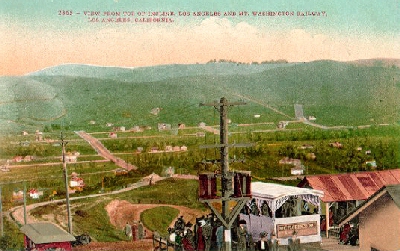
At the top of the Mount Washington funicular. A boxy white incline car is in the foreground. |
Bob Taylor's Online Real Estate Guide has a section on historic communities of Los Angeles, which includes an excellent article on the Los Angeles and Mount Washington Railway.
Go to top of page.
Victoria Station Restaurant at Universal City
Thank you to John Heller for telling me about the existence of a funicular which connected the Victoria Station Restaurant at Universal Studios with a parking lot up the hill. Victoria Station was a restaurant chain that included some railcars into their structures. The Universal City outlet was particularly elaborate, incorporating glass and iron elements from a dismantled British train station.
"Originally there was a funicular to bring diners up a steep hill from a large surface parking lot directly into the restaurant. As I recall it was a 'Westinghouse horizontal elevator' and had a single car with a counterweight that rode rollers in the trackway passing beneath the car at midpoint. The car was user-operated by elevator-style pushbuttons and an automatic car door. I believe the incline ran for about 15 years before being replaced by an enormous parking garage whose top deck was level with the restaurant. Patrons simply rode conventional elevators to the roof level then walked a short distance to the restaurant."
The restaurant was open from 1977 to 1997. The funicular was replaced in the 1980s.
Go to top of page.
Industry Hills Incline
|
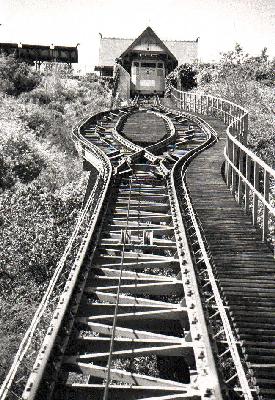
A car at the top of the Industry Hills Incline. Note the passing track in the middle. Photo courtesy of Ray Long. |
A funicular carries golfers and their carts from the 9th green of the Dwight D Eisenhower Course and the 18th green of the Babe Didrikson Zaharias Course up to a snack bar located in a replica of the Scottish Saint Andrews railway station at the Industry Hills Golf Club.
The line is 400 feet long and runs on a trestle at a grade of 33%. Two counterbalanced cars run on a single track with an automatic passing turnout. Each car can carry three golf carts. The Austrian Voest-Alpine system, including the power station, is completely automatic.
The resort opened in January, 1981. At present (2009), the incline is not in operation.

|
Looking down the Industry Hills Incline. The two cars pass in the middle. Photo courtesy of Ray Long. |
Go to top of page.
Getty Museum Shuttle
This line is not a funicular, but it is a modern cable-driven Automated People Mover (APM).
Space is tight around the hilltop location of the J Paul Getty Center (1200 Getty Center Drive, Los Angeles, CA 90049). Faced with the task of moving visitors from public transit or a parking garage at the foot of the hill, the architect chose to use a cable-driven APM, the Otis Elevator Company's Hovair (r) Shuttle system.
Each 7.5 ton Hovair car rides on an air cushion produced by a large blower underneath the car. Each train is made up of three cars. The trains are pulled by a 1 1/16" steel cable. They cover the 4000 foot track in 3.62 minutes.
The Getty Center, including an art museum, a research library, and educational facilities, opened on December 16, 1997.
Go to top of page.
Private Funiculars
In addition to the common carrier funiculars listed above, the hilly topography of Southern California encouraged the building of many private funiculars and inclines, some of which are still operating.
I received a question from Lauren Weinstein of Professor Neon's TV & Movie Mania about a strange looking round house with a funicular which appeared in "The Duplicate Man", an episode of the great science fiction series The Outer Limits. I put the question to the TrolleysCA email group and got the answer. The Malin House in Silver Lake, CA still has its own funicular. Thanks to the late Paul Ward, Ray Long, David McCanne, and LAPRY@aol.com for the information. And thanks to Lauren for raising the question.
The late Paul Ward also reported that "There are several private funiculars in the Silver Lake neighborhood, and until three or four years ago, there was a wonderful funicular at Forest Lawn Cemetery. It was built by the boss in the twenties, because whenever he drove through the gates in the morning, the guard alerted the staff to stop their partying and debauchery and get to work. The manager's house was at the end of a cul-de-sac in Glendale below the cemetery, and when he had the funicular built, he could ascend the grade and coast down the road to his office in his Locomobile, without the staff knowing of his approach. He was then able to catch them in their laziness.
"The funicular is still there, but the car is gone, and the cable house has been sealed up in concrete."
From Ray Long: "...there was one (funicular) used for construction of the geodesic dome house in Hollywoodland and one above Hollyridge Drive same canyon. Laurel Canyon had a couple at one time or another. All of them I believe are now among the missing. The dome house was demolished after Buckminster Fuller died.
"I have been led to believe that there are (present tense) three private funiculars on Santa Catalina Island. They are supposedly little more than inclined elevators for access to private homes.
"Regarding the two in Hollywoodland. On the west side of the canyon, there was an incline used to haul construction materials up to the now extinct geodesic dome house on the west side of the canyon. One of the houses on the east ridge had an incline of sorts from Hollyridge Drive to the top of the hill. I haven't been up there in 30 years so I don't know the status today.
"There were a couple more in Laurel Canyon. These private inclines were stretching the definition of the words 'incline' and 'permanent' but they were private and were used as incline elevators or dumb waiters."
Some homes on steep hillsides use devices called "Hillevators", which are small systems with single cars. There are at least six such homes along Coastline Drive in Malibu.
|
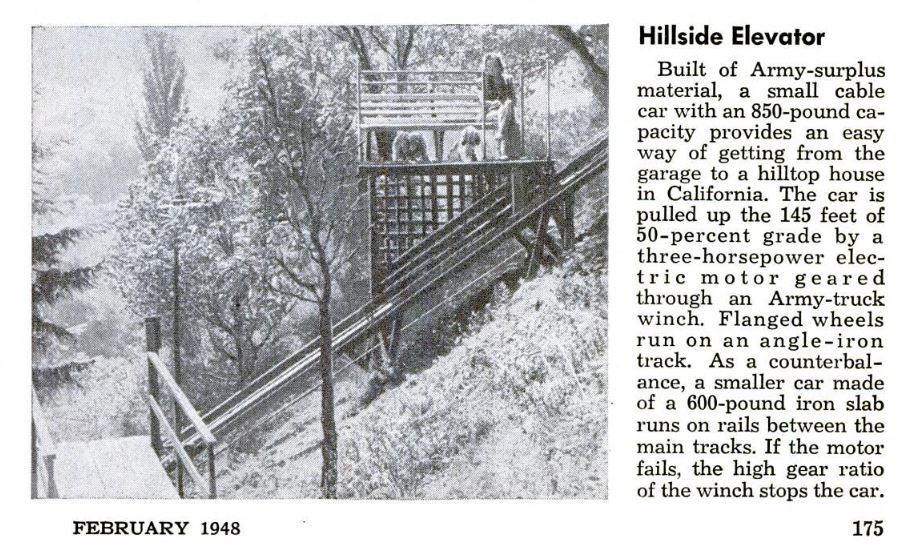
"Hillside Elevator" from the February, 1948 Popular Mechanics describes a private funicular made from war surplus materials including the winch from an Army truck. |
Go to top of page.