This article, from The San Francisco Call, Monday, December 18, 1905, describes an accident between a McAllister Street cable car and a Fillmore Street electric car, both of the United Railroads of San Francisco.
In a communited fracture, the bone is broken into multiple pieces.

|
From the San Francisco Call / Monday, December 18, 1905. Page 1.
| Three people were seriously injured last evening in a streetcar collison at Fillmore and McAllister streets. A score more were painfully hurt. One boy's feet had to be amputated and two men may lose their feet as a result of the accident. It is feared that the lad, Rudolph Wolfe, may not survive. Overcrowding of cars and slippery rails, together with alleged lax methods were responsible for the smash-up. The motorman of one car says the accident was caused by his slowing down to save the lives of two women who got on the track in front of him. |
Boy May Lose His Life, Two Men Are Permanently Maimed and Score of Others Wounded.
Hundred More Passengers Escape Injury When Street Vehicles Crash on Crossing.
Three people were dangerously injured and a score more painfully hurt last evening, shortly after 5 o'clock in a collision between a McAllister-street cable car and a Fillmore-street trolley car. Fully 100 people miraculously escaped injury. One of those seriously hurt, a little boy, may not survive his injuries. To the manner in which the United Railroads gives service to the public, allowing the overcrowding of its vehicles, is due much of the blame for the accident. According to eye-witnesses, Motorinan Horton of the Fillmore-street line did wrong in starting his car across the tracks before the cable car had been brought to a stop.
If the story of the motorman is correct, two women, who became "rattled" in front of his car and caused him to slow down, in order to save their lives, are responsible for the accident. It was a question of killing them or taking a chance of being; too late to clear the McAllister-street car, he says.
The tracks were slippery from the day's rain. Car No. 272 of the McAllister-street line, in charge of Gripman D. Milan and Conductor J. Messner, was descending the grade between Steiner and Fillmore streets. The heavy vehicle was crowded so that passengers clung to all the stanchions. A small boy could not have sandwiched in anywhere. When the cablef car was about a third of a block from Fillmore, Motorman J. L. Horton of Fillmore-street car No. 764, south bound, started across the tracks. He believed he had time enough to clear the cable tracks. Half across the rails of the intersecting car tracks, Horton slowed down his car to prevent running down two women, who became confused upon the rails. He saw the rapidly approaching cable car and reallzed that a collision was imminent. He had to think quickly. Should he run down the women and avoid a possible collision, or should he ring the females out of his path and take chances of the gripman on the oncoming car seeing his predicament, thus giving him a chance to throw on full speed and clear the tracks.
Horton chose the latter course. He clanged his bell frantically. As he put it, "My hair stood on end; my God, I was powerless to do better." When the women had cleared his tracks he shot his car ahead with a full current. Gripman Milan saw the impendirg collision and threw on all brakes. His vehlcle was too heavily laden, though, to respond to the impediment intended to arrest its rapid flight.
There was a crash. The cable car struck the full in the center, careening it and throwing it diagonally across the tracks. The screams of frightened women, mothers crying for lost little ones, crashing glass and the report of the terrfic impact caused a reign of terror for a few moments. Policeman Winters, standing at the corner, saw the collision and ran to succor the maimed. For a moment men and women stood stock still -- the lull after the crash. For a moment, horror-stricken onlookers and miraculously saved passenger, stunned by the shock,allowed pictures of awful disaster to flit through thelr brains. Then came the reactlon. Willing hands grasped the injured and hurried, them into near-by stores. Policemen Bunner and Harrell and Sergeant Griffin were soon upon the scene and rendered every aid. Ambulances and patrol wagons responded promptly, and in a comparatively short space of time those most seriously hurt were at the Central Emergency Hospital.
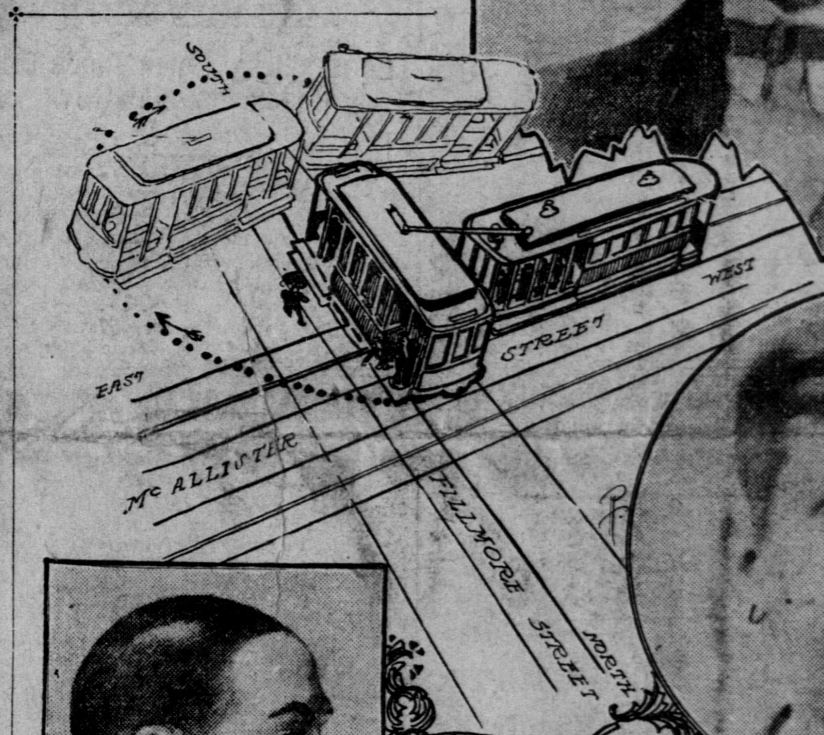
When the trolley car received the force of the collision it seemed as though it would turn over. The wet pavement alone prevented this accident and probably greater injury to the passengers. The electric car, turning rapidly at right angles to its own track, sped for a distance of 150 feet along the slippery street, and then ran into the curb at the sidewalk. Three who fell from their places on the steps were run-down by it. The heavy wheels ground the legs of Rudolph Wolfe, a 13-year-old boy, of 1508 Turk street to a pulp. Edward Doyen, an upholsterer, of 325 Langton street, who was thrown off was caught beneath the swinging car and both of his ankles were badly crushed, his ribs fractured and he was generally contused and lacerated, as well as being cut by flying glass. Gustave Fritz, an iron worker, of 2525 Lombard street was hurled as from a catapult and struck the stones with awful force. While he lay there the derailed car caught his legs and tore them fearfully.
Fully a score of people were more or less injured. Women crying in search of lost children limped about among the wreckage whlle many made their way painfully to their homes before their names could be ascertained. Wolfe and Fritz were carried into the drug store of Dr. Evans, at McAllister and Fillmore streets, where hemorrhage was stopped and wounds were dressed. Doyen was taken to a nearby saloon where an excited German proprietor refused to even donate a towel with which to bind up the injured man's legs. A mob of infuriated spectators charged the saloon and in a moment towels in profusion were at hand for dressing. Wolfe, Fritz and Doyen were removed to the Central Emergency Hospital.
Chief Surgeon Millar and Dr. Glover did heroic work. As rapidly as possible the injured were attended to. Young Wolfe's rlght leg had to be amputated. His left one, though badly torn, may be saved. It is feared that the lad is internally injured and may not survive the shock. Fritz sustained compound comminuted fractures of both ankles, also extensive lacerations. Doyen (can't read it - JT) a compound comminuted fracture of the tibia and fibula of the left leg, a comminuted fracture of the ankle, lacerations of the chest, fractured wrist and some broken ribs. All three suffered from shock.
Drs. Mlllar and Glover say that Doyen's foot probabiy will have to be amputated, and also entertain a fear that like procedure will have to be taken in the case of Frltz in case the feet of these victims are not amputated the surgeons say that they will be stiff and useless when healed. Doyen was removed to the St. Francis Hospltal.
When the mother of young Wolfe went to her son, lying on a cot at the Central Emergency Hospital, waiting to enter the operating-room, she saw the dripping blood and the paled countenance of her llttle son and nearly swooned. The lad bore his injury bravely. He was just returning from the Alhambra Theater, where he had secured tickets to the show. The coveted pasteboards were in the lad's hand and he clung tightly to his treasure through it all. "I guess I won't be able to go to the theater now, mother," he said, and his little form gave a violent twitch as a pang of pain pierced his torn leg. Though most seriously hurt of all, the brave boy never uttered a cry, but took his lot like a little man. Mrs. Wolfe is a nurse at the Adler Sanitarium.
Others who were not so badly injured and who went to their homes were Marcel Merke, boy, 926 Fillmore street, face and head cut; ; Miss Abbie Leroux, 370 Precita avenue, both hands jammed; William H. Abenroth, first sergeant, Troop J, Fourth Cavalry, sprain of knee, lacerations; William A. Mundell, newspaper man, 1281 Market street, sprain of shoulder, cut by flying glass; Dr. T. J. Crowley, 865 Fillmore street, bruises and shock; Jeff Lloyd, 1023 Fillmore street, cuts by glass; George Amandt, 673 McAllister street, cuts and bruises; James Courtland, 144 Silver avenue, sprains of wrlst and shoulder.
Many of those slightly hurt went away before their names could be learned. Most of those injured were riding on the Fillmore-street car.
Motorman Horton gripman Milan were arrested and booked at the City Hall station for battery. They were released on $20 bail each.
Motorman Horton's story follows:
"I had just started across the McAllister-street tracks, when two women got in my path. I slowed down, clanging my bell to warn them. They seemed confused. I saw the approaching cable car and realized my predicament. Was I to run down the women, or take chances of a collision? My hair stood on end, I had to act quickly. My God, I did only what any man would have done. When the women got out of my way, I threw full speed on, but it was too late. I did my best, but this is awful."
Horton was affected by the accident and distractedly explained how he was not to blame. He and Gripman Milan visited the hospital soon after the accident and condoled with the injured, showing sorrow at the result of the accident for whlch they are held responsible.
Gripman Milan's account of the accident is as follows:
I was coming down the grade from Steiner street. My car was crowded. When a distance away from the crossing, I saw the electric car start across the tracks and hesitate. I released my grip and I applied brakes to come to a stop but the tracks were too slippery. We slid rlght into them."
ln dlrect contradiction to Motorman Horton's story is that of eyewitnesses who say that the electric car did not come to a stop before crossing McAllister street This is denied by the conductor and motornan, who say they stopped to allow passengers to alight and get aboard.
|
|
| Rudolph Wolfe, 13-year-old boy, 1508 Turk street; amputated foot, lacerated foot; may die. |
| Edward Doyen, 525 Langton street, upholsterer; serious laceration and fracture of bones of both feet, fractured ribs; possible amputatlon. |
| Gustave Fritz, 2525 Lombard street, ironmolder; severe laceratlons and fractures of bones of feet; possible amputation. |
| Marcel Merke, boy, 926 Fillmore street; cuts on face and head. |
| Miss Abbie Leroux, 370 Precita avenue; hands crushed. |
| William H. Abendroth, cavalryman; sprain of knee. |
| William A. Mundell, newspaper man, 12S1 Market street; sprain of shoulder, lacerations of hand and head. |
| Dr. T.. J. Crowley, 665 Fillmore street; bruises. |
| Jeff Lloyd, 1023 Fillmore street; cut by flying glass. |
| George Amendt, 673 McAllister street; cuts and bruises. |
| James Courtland, 144 Silver avenue; sprains of wrist and shoulder. |
From the San Francisco Call / Tuesday, December 19, 1905. Page 6.
VICTIMS OF CAR COLLISION NOT YET OUT OF DANGER.
Doctors Fear for Lives of Young Wolfe and Doyen, but Fritz and Dr. Crowley Are Better.
Rudolph Wolfe, the 13-year-old lad who was seriously injured Sunday night in the street-car collision at McAllister and Fillmore streets, is not yet out of danger. He was removed to the Children's Hospital, where his life is despaired of. The boy has not yet recovered from the shock and the best the doctors can say for him is that he is holding his own.
Edward Doyen, the upholsterer who sustained dangerous, lacerations and fractures of the feet, legs and ribs, is at the Waldeck. His condition is no better and the surgeons say they may yet have to amputate the injured limbs to save the patient's life. Doyen is in a serious condition.
Gustave Fritz, the ironworker, was taken to the St. Francis Hospital, and of the three badly injured in the wreck is doing the best. Fritz was not so seriously hurt as Doyen and the boy and it is believed he will recover. His case has not developed so favorably, however, that it can be said he will not eventually lose a foot. .
Motorman Horton still adheres to his story about the confused women in his car's path and his statement is borne out by some witnesses.
Dr. T. J. Crowley's condition is improved, but he has not fully recovered from the shock of the accident.
|
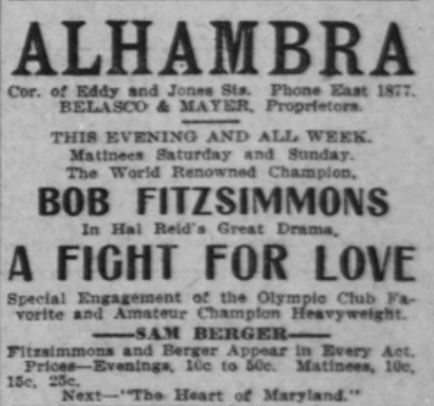
| I wondered why poor Rudolph Wolfe was so excited to get a ticket to the Alhambra Theater. I'll bet he was hoping to attend A Fight for Love starring Bob Fitzsimmons, who had been heavyweight champ from 1897 to 1899. Sam Berger, who had competed for San Francisco's Olympic Club, won the heavyweight boxing gold medal at the 1904 Summer Olympics in Saint Louis. This ad is from the 26-December-1905 San Francisco Call. |
Go to top of page.
|
| An image from the December 18, 1905 San Francisco Call shows the scene of the accident at McAllister and Fillmore Streets. We see the Fillmore Street electric car derailed and spun around after being hit by the McAllister Street cable car. ????, 2018 Picture of the Month |
Go to top of page.